 There was a good deal of work done in the novel—building, journeying, selling, making, cooking and so forth. Is it fair to say that work was a central character, a natural character? In what ways were some of the people deepened (or even made) by their work?
I love this question, in part because I did so much research about work and some did not make it into the novel! I learned about shoeing a horse and had an entire chapter in which Henry and Jacob shoe Caesar (Henry’s horse) but I cut it—a digression. People in the nineteenth century, especially an adventurer like Henry, enslaved people such as Uncle Eli and Mittie Ann, and even Emma, who was tutored in how to keep house—did a great deal of work, whether it was making a new dress or picking cotton or carving out a canoe or preparing for market, as the Iyalode (the female governor) does when Emma meets her in West Africa. Not all of these forms of work were equally difficult or equally rewarded. But there was a lot of what might be called “hand” work—not typing on keys as we do at computers, but making, growing, mending, clearing land, building houses, thatching roofs (in Africa). There is so little for Emma and Henry to purchase. Most of what they have they must manage to make. Yoruba people (the clan in the area where my characters travel) were “makers” of cloth, art, metal works, jewelry, hair weaving!
Your insight is absolutely apropos. Henry already is who he is (by the time he and Emma marry) because of what he has made, built, written, battled. Enslaved Uncle Eli maintains his spirituality and some selfness because he can still create out of his own imagination. Emma becomes who she is in her three African years because she learns African forms of work, including mixing mud for her house by kneading it with her feet. In this way, Africa enters her and begins to reshape her imagination and her heart.
As a first-time novelist, I thought: these people have to DO something while I’m creating a scene. And so they worked!
The Bowmans were driven people. The same can probably be said of many people in the novel. For the couple, what pushed them? What pulled them?
There are shorter and longer answers. Henry is pushed by guilt and longing. He feels guilty about his mother’s death (not because he caused it but because children internalize their parents’ pain). He is guilty of killing Native Americans and Mexicans. He was a womanizer as a young man. He “wants to be shed of all that,” as a character in Huckleberry Finn might say. He experiences a salvific moment on the road back to Georgia when a man brings him fish and water. That scene was written so that the reader might imagine it as an angelic visitation. Henry sees it that way. He is “convicted,” in the language of Southern Baptists. Going to Africa to “witness” about Jesus is his way of working through guilt. It takes him a good while, as you know.
Emma is pulled and pushed by desire and by outrage. Uncle Eli, the old African, plants a seed in her imagination from the time she is very young. He “initiates” her into Yoruba numerology and Ifa divination in his use of the number 4. He tells her stories that shape her mind and when she sees the globe on her father’s desk, she is drawn to Africa. She doesn’t understand the connection, of course, but I hope readers begin to discern it. Her African epiphany originates in Uncle Eli, who sends her on a mission that happens to be Christian (it is a mission of love) though his purposes are born out of his remembrance of African traditional religion. She is pushed, of course, out of horror at what her father allows to happen to Uncle Eli. She cannot stay in “bent” Georgia. Its violence toward enslaved people is a fire she runs from.
Emma laments trading places with Uncle Eli. How does her relationship with the elder slave tutor her in her life in Eli’s homeland?
As I’ve said, his influence is a driving force in her going to West Africa. Once she arrives, and little by little, she opens herself to the mysteries and beauties of Yorubaland. At first, of course, she is a bit horrified: by women whose clothing doesn’t cover their breasts, or men eating with their fingers. But her mind is fertile. She is curious. I molded her as a girl to prefer the outdoors, to take risks (horseback riding, for example) and added to this her relation to the old man. She wants to know things, in part because Uncle Eli was always doing things she wanted to understand. He was her mystery and her guru. So while she is not consciously aware of it, all through her African journeys, she is able to make the next leap (whether it’s eating fufu or wearing a more airy, African-like dress, or even entertaining the idea of an African diviner being of some use to her) because of her closeness to the old man. She is multi-cultural before multi-cultural was in! But this is American history. Take Huckleberry Finn again as an example. As much as Huck thinks he is superior to Jim, he is actually being tutored by Jim, in love especially, but in other practical matters of survival as well. The way they eat and live on the raft and hide in the day and move at night, the stories Huck learns from Jim: all of that is Huck becoming “black”—or multi-cultural.
At any early point in the story the preacher tells his wife that she is a guest in Africa. Does she believe him? Does she begin to see things that way as she follows Eli’s counsel to “find a place”? Does she see things differently as the story is told?
No and yes. At first she cannot comprehend her own foreignness. She thinks Africans are strange; they are the strangers. She is “normal,” and her expectations are “normal.” In her view, these folks should know better than to meddle with her laundry. But she is, of course, meddling in their culture! She is trying to change their religious views. She is taking their handicrafts and decorating her house with them. She is tutoring their children in English. I do admire her (and her historical counter-part) for learning Yoruba and for recording the language. Later missionaries did not always take such pains to learn the local language. As we know, language is a primary way by which we learn to see the world. The more she learns Yoruba, the more she comprehends what her neighbors know, what the Iyalode knows, for example. So through this learning, she begins to comprehend differently. There’s a scene with the Iya in which Emma thinks she is giving the woman a lesson in geography. But as it turns out, the Iya is the one who understands Emma’s situation better than Emma does. The Iyalode comprehends Emma’s pregnancy! And Emma begins to see how she is seen. This is a major moment in Emma’s development: beginning to see herself from an African’s point of view. This seeing-herself-as-stranger culminates with Jacob. She dallies a little with him and entertains romantic notions. But she doesn’t really SEE him or herself-in-relation-to-him, from HIS point of view, until he rebuffs her. Then she sees. And then, of course, she sees her entire history, all the way back to Uncle Eli’s toes.
Your book is sweeping in its delivery of several characters whose pasts and lives are so different on the surface. And they come together in the novel, often, to form or re-form one another’s faith. Can you speak to that?
My vision is trans-Atlantic because I was born in Nigeria and grew up there, visiting the U.S. on occasion, until I came here to live permanently as a young adult. Everything for me is about the cross-fertilization between the American South and West Africa. This is the story I want to tell over and over, whether in a short memoir about hair (Nigerian girl’s hair, my hair) or crimes of history or personal redemption. This novel is an orchestra composed out of the melodies and stories and tragedies of my life, my mother’s life, my people’s lives (whether those people are my Yoruba countrymen, my slave-owning ancestors, my missionary “family”). The trans-Atlantic South is my homeland.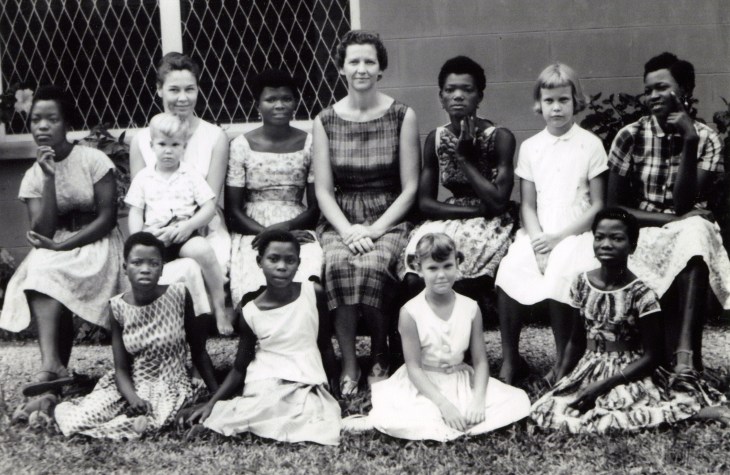
You have personal history so that your story and your life in Africa undoubtedly helped you frame some things. Did your work on the novel enrich or change your views of missionary work?
Actually writing this novel constitutes “Stage 3” in my perspective on missionary life. As a girl (Stage 1), I simply thought it was normal: all white people were missionaries and there were only a few of them and the world itself was black people. I thought my parents were good people (they were good people; my mother an educator, my father a business man; my mother wrote a history of the Nigerian Baptist Convention—not the American Baptist Convention). And yet as a graduate student and young professor studying post-colonialism and feminism, I became deeply skeptical about missions. This was Stage 2. I was embarrassed by my history. Writing this novel, I came to see missionaries as human beings who struggle just as anyone struggles: with conscience, longing, desire, hope, guilt, despair. Mission work in Africa is a mixed bag. Perhaps it has been primarily negative. I haven’t done enough research to be an authority on the entire continent. But look here: Nelson Mandela is Methodist. Am I going to tell him he has false consciousness because he doesn’t practice traditional African religion? Perhaps he does in his own way. All religions migrate just as cultures do. There is good and bad in all of it. The great crime of slavery was sometimes “covered” in the U.S. by appeal to the Bible! My characters go to Africa trying to do something else. They may be wrong-headed, but they are trying. I think my mother and father did the same. I won’t judge their lives. How can I?
Can you comment on the connections between your life as a writer and as a teacher? Do the two areas naturally feed one another? Do you experience the roles in any particular way?
I joke that teaching keeps me young. I look out at the classroom and see myself in my students and think I’m still 23. Ha! But teaching does keep me young. I try to stay abreast of what much younger folks are thinking about and talking about. At least I get half way across the divide, which is farther than I would get if I weren’t teaching. I keep being challenged and pushed when I teach, graduate students and undergraduates. Teaching offers me an opportunity to pass-it-forward. I can’t possibly repay all the teachers and mentors I have had in my life, including the Yoruba folks who took care of me when I was a girl. Sometimes I would like to teach less (I carry a 2/2 load). But N.C. State University offers great support for my writing. Though I was hired to teach literature, I am given travel money and research support to go to Nigeria and spend a summer month at a writing residency and compose a novel over a six-year span. University teaching is one of the greatest privileges a person can have in my view.
I wonder if you can talk a little about the writing box or about remembering. There is a powerful thread in the story when the characters, particularly Emma Bowman, return to the question of what will be taken with them and what will be left behind.
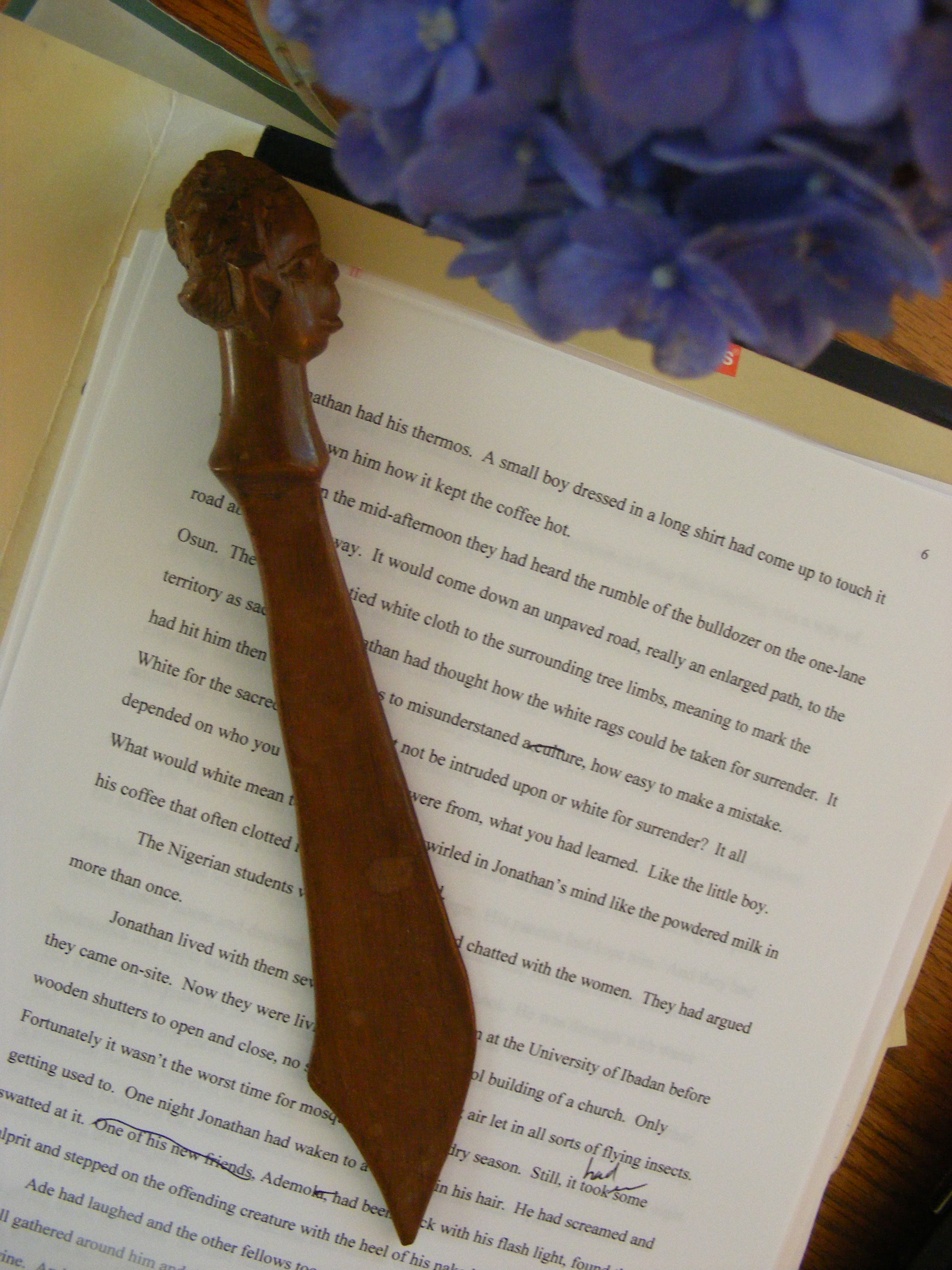
It’s interesting to me that you link these two: remembering and the writing box. I love the way a reader can show a writer what she did! Of course, Uncle Eli’s gift of the letter opener (his effigy) is linked with his admonition “remember; you find a place.” This admonition haunts Emma even as the letter opener comforts her. I intended that the reader understand that even as Emma is doing just what Uncle Eli asked, she doesn’t fully understand HOW she is following his instruction until the end of the novel when she understands his remembrance. He was remembering his homeland, teaching her about it; she travels to his homeland, unaware, and finally comes to see–“as if face to face”–that the old man was from this very place. So Uncle Eli’s memory is a force in the novel. I believe that memory is essential to practicing peace and justice. If we do not remember the past and honor it, how can we begin to establish a more just society in the present? We must remember slavery, Jim Crow, the genocide of Native Americans. I hope readers find a poetic irony in Emma’s bearing this memory; she is a daughter of white privilege. But when she steps outside of her known world and becomes the foreigner, she is able to see the light she thought she was bearing. And she was bearing it; she just didn’t fully comprehend it. The box is Emma’s heart, of course: the vault of memory and desire.
What are you reading these days?
I just read White Dog Fell from the Sky by Eleanor Morse, a wonderful novel about apartheid South Africa, and next on my list is Wash by Margaret Wrinkle, a novel about an enslaved man in Tennessee in the early 1800s who survives through a spiritual connection to his shamanic mother. Margaret and I are going to be on a panel together at the Atlanta Journal Constitution/Decatur Book Fair over Labor Day. You can see what I’m in to.
How can readers stay in touch with you and support what you’re putting in your own “writing box”?
My website is elaineneilorr.net
I love for readers to “friend” me either on my personal Facebook page or my author page; I like to see what they are doing. I’m happy to Skype in to book clubs. My email is on my website; it’s elaine@ncsu.edu







 Michael Washington