- I love you.
- Listen first.
- You are brilliant.
- You can be a gift to everyone you meet today.
- Obey me. And your mother.
- Play your guitar and sing and dance and spin around in the floor.
- Don’t hurt your friends.
- Clean up behind yourself.
- This is our house, and we let you live here, for now.
- Your smile melts me. Usually.
- Mommy loves you more than she could ever communicate through all those hugs and kisses.
- You come from a long, beautiful history, so ask me about it any day.
- Thank you for playing quietly when you woke up so early.
- Tell me what you’re thinking.
- Pray for me.
- There are immeasurably wonderful people in the world, but there are people worth leaving.
- Bend or stretch to smell every flower you walk by.
- You’ll get to drive one day, so keep pretending for as long as possible.
- Take your fingers out of your mouth.
- Never disrespect an older person even if it makes you change.
- Chew your food before you swallow it.
- I’m sorry.
- I need those hugs you give.
- I wish you could have grown up with your grandfathers.
- I’m still learning everything.
Author / Michael

Apples Falling From Trees
Javaka Steptoe’s Seeds
You drew pictures of life
with your words.
I listened and ate these words you said
to grow up strong.
Like the trees, I grew,
branches, leaves, flowers, and then the fruit.
I became the words I ate in you.
For better or worse
the apple doesn’t fall far from the tree.
Love Your Mother
I tell you in a dozen ways a week to love your mother. It’s a most salient measure for how you’ll love many people. As an observer, it enlivens me when I see you running to her, grabbing her, talking to her, seeking her out. Not always to be sure because sometimes you can be motivated by obvious errors. But mostly watching your love for her unfold is a treat.

Dawn and Bryce outside the King Home
Your mother will love you for as long as she possibly can, another way of saying all her days. And even when those days close to another less manageable time, her love will extend beyond time. She’ll keep your treasures whether she tells you or not. She’ll have little creations from your hands and from those of others that are about you, and she’ll pull them out at night and remember. Your mother will protest every injustice against you and be a fierce advocate always. She will overlook your faults until they even become her own. She will love, and we will all become her students, learning as she does.
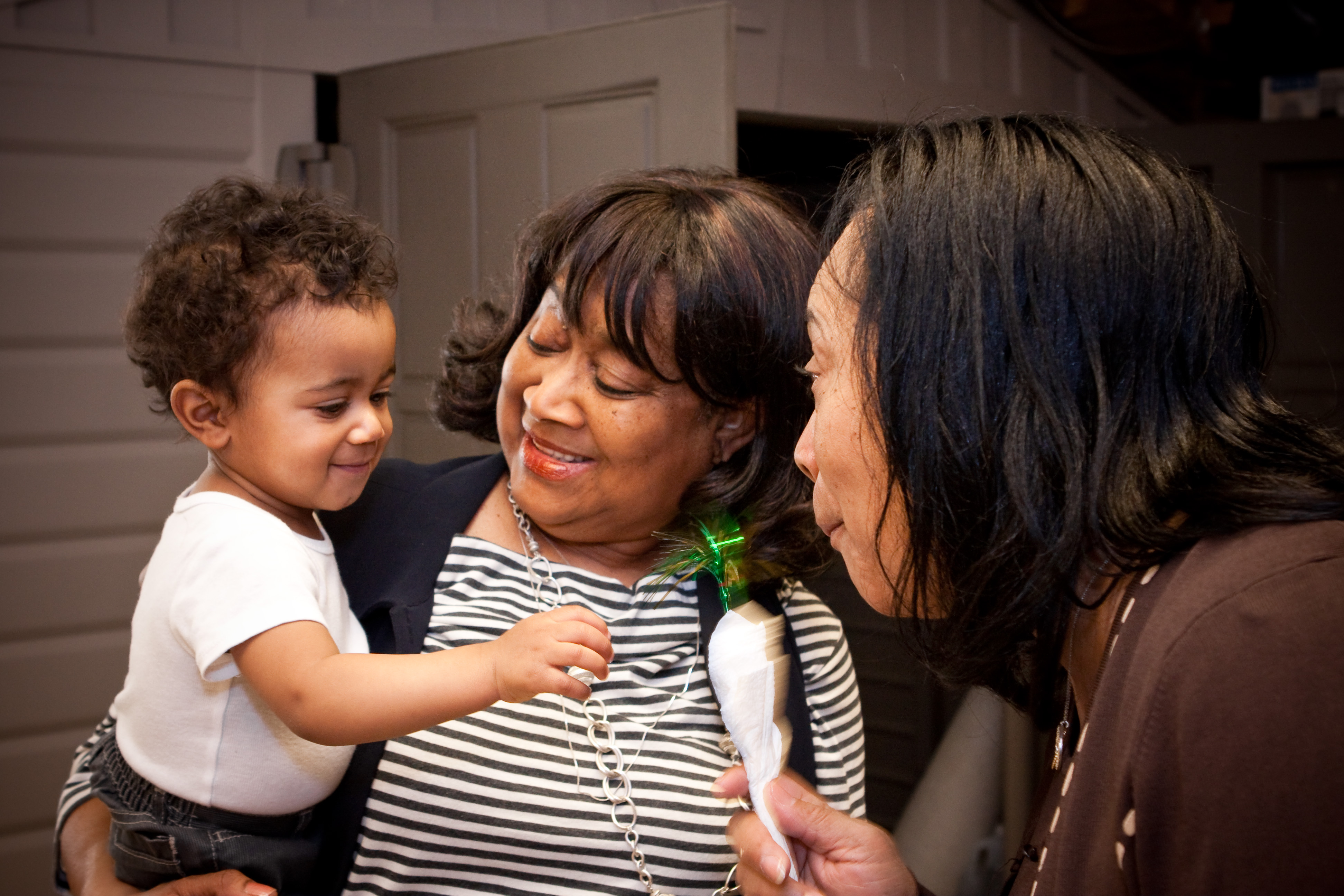
Bryce with Grannie and Grandma in 2011
Being Present
In an opinion piece about not being alone, Johnathan Foer writes about the diminished substitutes we’ve accepted and become with the progression of technology in communication:
Most of our communication technologies began as diminished substitutes for an impossible activity. We couldn’t always see one another face to face, so the telephone made it possible to keep in touch at a distance. One is not always home, so the answering machine made a kind of interaction possible without the person being near his phone. Online communication originated as a substitute for telephonic communication, which was considered, for whatever reasons, too burdensome or inconvenient. And then texting, which facilitated yet faster, and more mobile, messaging. These inventions were not created to be improvements upon face-to-face communication, but a declension of acceptable, if diminished, substitutes for it.
But then a funny thing happened: we began to prefer the diminished substitutes. It’s easier to make a phone call than to schlep to see someone in person. Leaving a message on someone’s machine is easier than having a phone conversation — you can say what you need to say without a response; hard news is easier to leave; it’s easier to check in without becoming entangled. So we began calling when we knew no one would pick up.
Shooting off an e-mail is easier, still, because one can hide behind the absence of vocal inflection, and of course there’s no chance of accidentally catching someone. And texting is even easier, as the expectation for articulateness is further reduced, and another shell is offered to hide in. Each step “forward” has made it easier, just a little, to avoid the emotional work of being present, to convey information rather than humanity.
You can find the full piece at the NYT here.
Let’s Try This Week
I hope this week holds a better end than last one for us, son. You gave me and your mother a fit and a problem. And I’m not interested in redoing what we did. There are many things about you that are, simply, unforgettable. You added to that list on Thursday and on Saturday. For now, I’ll preserve the details. You can ask me about the ingredients of this post some day, and I promise I’ll recall them. You made us scratch our heads, collect ourselves in a bathroom conference while you sat and waited and no doubt thought we were going crazy. But we were walking away from crazy. And we expect that you, too, will walk away from it. Let’s try this week. Let’s all be better. You, mommy, and me. The alternative to being better doesn’t look good for you, so take the suggestion as firm.
When I Stepped Away
Last week, Monday, you came to my neighborhood, took me to eat, and to do whatever I thought was nourishing to my soul, which happened to be seeing Man of Steel. That was your recommendation and I’m grateful you made it. The meal and the movie, the conversation, and the entire gesture you made, was, together, a fitting day off for me, a wonderful way to feel, through you, that the church I serve cares that I (and certainly not I alone) recuperate after the pile of offerings I give. When I stepped away from serving for a Day, I felt like I was served. Thank you, Tim, and thanks to the church that you represent in your acts of care to me. You join a gracious circle of others who love well, care well, and give well. I’m glad to be one of your pastors.
Poetry For the Weekend
Joyce Rupp’s Greedy for Too Many Things
ravenous for too many things,
even spiritual growth,
greedy to grow without effort,
to have it all, to sit back and bask,
luxuriating in what was never mine
in the first place.
greedy for more time in the day
when I already have
all the time I need.
greedy for companionship
while I ignore the One Companion
always near.
greedy for, oh, so much,
while I miss the chipmunk
chewing on the sunflower seed,
the sound of soft July wind
rustling cottonwood leaves,
the color of azure sky as the sun
rinses morning out of it.
Remembering
I sat with my mother, and looking and listening to her was like hearing a favorite splendid song. Her smile, in her eyes and her mouth, was an invitation to laugh as she told me stories from when I was my son’s age, when I said things I heard from Ms. Goodlett, our one-time babysitter. She mirrored the expressions in my face, the same ones I chuckle at with the boy these days, the ones I tell Bryce that I gave him. Mama told me stories like they happened just yesterday morning, like she had been remembering them so she could tell them to me, remembering them again for me.
A Meeting
Seated around a platter of grapes and cubed cheese was a sphere of laughter, circling memories of a shared acquaintance, a splendid friend and teacher; a set of stories about the places we have been, the families who have loved us, the work we’ve done and cherished; a cast of hopes, dressed in summer clothes and looking for tomorrow to come; the clear common purposefulness of living in light of grace and trying to put our best efforts inside that grace. These were some of the pieces of my meeting at a couple-congregant’s home, and it was joyous.
Sweet Sounds
Tonight I wish your mother was home to hear the sweet sound of your falling asleep, the sound of silence trading a days-long cough and a fit of sneezes. But she was not home. She was away, in class, accomplishing her latest midterm, doing the grueling part of something she loved. But I will surely tell her how you fought off the cough monsters in your chest, how you prevailed against the sneezing that held you just this afternoon, and she will go in for herself to kiss your face, to check you visibly, to listen to you breathing.
Reaching Light Switches
The other day my son walked into the bathroom, pressed the first light switch, which is next to the fan switch, and used the toilet. It took me back a second because when I saw him do it, I couldn’t quite believe it. Before then—or before whatever moment he had started turning on the light by simply lifting his hand—he had always stepped on his stool, the one which blocks a side of the sink cabinet, and pressed both buttons under the dry towel, to turn on the fan and the light. Until some moment in the last few days, the last couple weeks maybe, he was too short to reach the switch.
Aridity
I would go through periods of dryness, and they were very exacting and very costly, too. But in those arid times I still had to do my work, preparation. And I found that I preached not only out of the fullness…but I preached also out of the aridity, the emptiness.
In the transcript of our interview, two years ago, with Dr. Gardner C. Taylor
 Michael Washington