Author / Michael

Averted Vision
Such a contemplative thing to say:
Perhaps the reason we so often experience happiness only in hindsight, and that any deliberate campaign to achieve it is so misguided, is that it isn’t an obtainable goal in itself but only an after-effect. It’s the consequence of having lived in the way that we’re supposed to—by which I don’t mean ethically correctly but fully, consciously engaged in the business of living. In this respect it resembles averted vision, a phenomenon familiar to backyard astronomers whereby, in order to pick out a very faint star, you have to let your gaze drift casually to the space just next to it; if you look directly at it, it vanishes. And it’s also true, come to think of it, that the only stars we ever see are not the real stars, those blinding cataclysms in the present, but always only the light of the untouchable past.
From Tim Kreider’s We Learn Nothing, pg. 218
Creating a Rule of Life, pt 6
I like to tell people to “Take care,” when I end calls and emails. Because I don’t waste words–not intentionally–I think about how to end interactions. Sometimes I tell people to “Stay well” or I’ll close an email with “Every blessing,” taking the ending from Dr. Walter Elwell who emailed me about a paper once when I was in grad school. I still love that closing and every time I use it, I think of him and what he taught me about Jesus in my first class studying theology. Of course, most people don’t give that much thought to how I close my emails. Still, when I write “Take care,” I’m often thinking of the focus of this part of the Rule.
This isn’t caring for someone else. This is care for you by you. Most people are told–in a variety of ways–to care for others, but being told to care for self and actually doing so feels selfish. Consider the notion of being selfish. The snarky but well-meaning me wants to say that we are selves, that we are alive to be who we are and nothing else. When it comes to being selfish the question is, can we be anything else?
I know when people say it they intend to suggest that we not make ourselves the center of the universe, that we become giving people, and that we not restrict our experience of the world to the limits of our skin, our arm’s length, and our conceived notions. Still, all selfishness isn’t created equal.
I was speaking with pastoral psychotherapist Dr. Janice Hodge earlier this year and she reminded me of Jesus’ words where he summed up the commandments into a two-part law. It’s the one where Jesus said to love God and to love your neighbor as yourself. Dr. Hodge underlined the as yourself part and told me that most people dismiss that clincher. I’ve learned this over the years, forgotten it, and am learning it again.
The rule of life becomes a vehicle where we attend to others, to serving others, for sure. But it also makes us question what we’ll remember, be mindful of, and execute for the sake of ourselves. We don’t love others if we don’t love ourselves. What we do is attempt to love, try to love, get at love. We may be on the way to loving, but without the as yourself part, we’re still, simply, trying.
Because our denomination is strong in this area for its clergy persons, I have a pretty developed practice of self-care. I teach seminarians in this area as well, and anytime I answer questions around self-care, I’m immediately reflecting on my ups and downs, successes and failures at living it.
What do you need to do to attend to yourself? What activity do you need to start or end? Who do you need around you for the next six months, the next year, to strengthen you? Of course, we’ll get to the next parts of the Rule which have to do with what you’ll do for people, how you’ll love God or others. But stay with this until you come up to some unmistakable clarity about taking care of you.
Gratitude
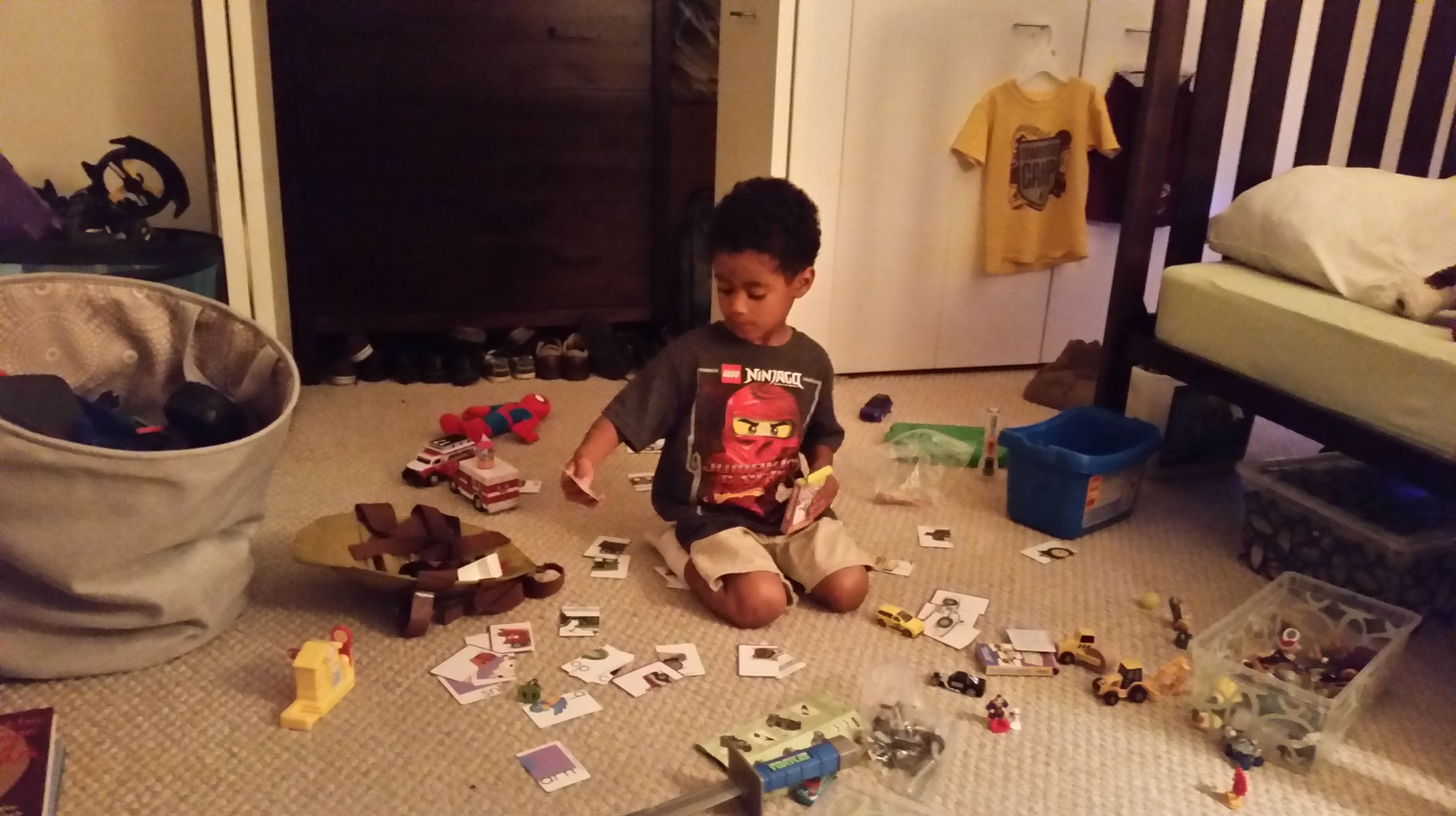
You don’t have an income or a bedroom that belongs to you. You don’t have clothes that haven’t been given to you. So, beautiful son of ours, remember to be thankful because your entire life is still so early and so young that it’s all a gift.
Walking into your room, which I still say is my home office, you are surrounded by gifts, things given, including the words painted on your walls which were done by Auntie Sheila and Uncle Alan. When you’re able to read those words, they too will remind you that you come from some where, that your life was given to you and given to us.
Everything around you, unearned by you and really unearned by us, is a bold or implicit sign to be grateful.
Singing with Brother Tom
When we first met, he seemed to be a stiff, jovial man. The stiffness was only in his movements and not his heart. He kept a full, broad smile on his face, wore glasses and a gray beard, and I could tell early on that he had jokes I wouldn’t understand. Jokes, perhaps, I’d laugh at later.
I was told to call him Brother Tom because that was his preference. We would get along because I could relate to his Christian faith, to the songs he sang, to the scriptures he went on and on about. All those markers would be little pieces of Brother Tom’s deep faith. He had an abiding song for his God.
On several occasions when I was with him, he had me pull his CD player to his side so he could play Gaither gospel, music I didn’t enjoy but lyrics I could follow. The tunes’ texts were so familiar that I could follow them, even if I had to close my ears to their sounds. Looking at Brother Tom’s face as he sang–closed eyes, his deep throat open–I’d think back to rehearsals with the Soul Children of Chicago when we would sing with all our selves. I’d think about my days at church singing in the choir. And I would join Brother Tom. Sometimes.
We talked about the Bible. We spoke of theology. He always asked about my ministry and my leadership. He wanted to talk about his writings, and I wanted to hear about his life. Sometimes it felt like our conversations were dull in the sense that they were aimless, almost lazy. But there was something building, an intimacy I wouldn’t know until my internship and time with him was ending. Still, with all those important words shared between us, it was his music that marked our time.
He would sing in the middle of a conversation, offering a public display of affection, even next to sleepy residents in St. Paul’s house. I didn’t want to wake up his fellow residents. But he didn’t mind it. He would simply sing. Loud and never quietly, he’d open his throat as if God was before him, waiting and encouraging him to sing louder.
Donny Hathaway, a singer I’m sure Brother Tom was unfamiliar with, sang that “for all we know tomorrow may never come.” But the faith residing in the deep bottoms of my old friend, old because he’d seen so many days with God and with people, old because he’d experienced plain loneliness and gripping isolation, old because he was aged by grace and suffering and illness, that faith had a different lyric. In some ways, Tom Lopresti sang because he believed he would see a tomorrow.
On the first day of the week, when he died, Brother Tom’s voice joined another melodious chorale. He wouldn’t sing along. He would join the sounds of the stars and the unseen vocalists from all eternity. In death, he would start a new chorus, hardly ending his lovely baritone rendition of thankfulness. He would keep singing, even if I’d never hear him again. Perhaps this time he’d open his eyes, but Brother Tom would sing. For sure he would.
Listen. Obey.
As your mother told you–and as I’ve said to you before–when we put you into the hands of someone else, that’s the person we trust. So that’s the person you listen to.
Be it your teachers or other relatives, if you don’t listen to the people we give you to, you’re also not listening to us. And for now, you have to listen to us. You don’t get to not listen. And not just because we’re bigger than you. We actually know more than you.
We know that when you do your own thing, that thing is still so underdeveloped that it makes no sense in the world. One day that will change. One day you have more choices than you do time. One day you’ll pick the menu and the shoes and the time we leave and return. But you don’t drive. You don’t know the city’s grid. You don’t understand the nuances of roasting a chicken, even if you’re a good sous chef.
So, hear me, hear your mother. And we’ll let you stay with us. If you don’t listen, you’re only a quick walk from the Swansons, a short drive from either of our mothers, the full house with your cousins and my brother, a spot next to Champ’s cage at your other uncle’s, or slightly longer commutes to your aunts. I’m sure even Grammie will take you if we call her and say you’re on a flight. But I’m also certain those lovely people will have similar expectations. And they–though they may fight me on the point–will not love you nearly as much as me and your mother.
30 Questions for (Engaged) Couples, pt 2
My spiritual mother has a pretty expansive questionnaire which she created when she led a Chicago church. My questions aren’t as good, but they reflect some of the common questions I bring up with couples in our church. I need to keep a running list since I don’t keep notes on such meetings.
Some of these feel immediately appropriate for personal reflection; all of them assume that a couple will discuss them at some point. Of course, the inability to talk through questions like these are always clinically interesting to me. With some revision, all of these questions can be asked at different points in the future of a marriage.
This is the second part of the list. I’ll frame these as if I’m not in the room with the pair. What would you add? Here goes:
- When we’re at our best together, what are we doing, what aren’t we doing?
- How would I capture my spouse-to-be in a word, phrase, paragraph, and page?
- How much time we spend talking in a week?
- When I close my eyes, what’s the future I imagine with you?
- How will we spend our time together?
- What does an expanded family look like for us?
- What are the changes, transitions, and decisions in front of us for the rest of our lives?
- What will I shine at in this relationship, and what will I inevitably fail at?
- What will my spouse-to-be shine at in this relationship, and what will s/he inevitably fail at?
- How has my loved one shown me grace in the past?
- What is the significance of the party (i.e., wedding) we’re planning?
- Who are some of my dead relatives I wish my loved one could have met?
- What do I mean by the vows I’ll take?
- Where can we put our joint energies and our best collected efforts as a couple?
- How will this marriage make me, change me, challenge me, and better me?
30 Questions For (Engaged) Couples, pt 1
My spiritual mother has a pretty expansive questionnaire which she created when she led a Chicago church. My questions aren’t as good, but they reflect some of the common questions I bring up with couples in our church. I need to keep a running list since I don’t keep notes on such meetings.
Some of these feel immediately appropriate for personal reflection; all of them assume that a couple will discuss them at some point. Of course, the inability to talk through questions like these are always clinically interesting to me. With some revision, all of these questions can be asked at different points in the future of a marriage.
This is part one of my list. I’ll frame these as if I’m not in the room with the pair. Here goes:
- Who are the characters included in our story?
- How did God bring us here, to this point?
- Where have we celebrated so far, and where have we struggled?
- Why do we want to get married?
- What do my friends say about my intended?
- How will my family interact with this person over the next forty years?
- Can we talk about our credit reports?
- What do I simply adore about this relationship?
- When I’m stressed, how does it impact my partner?
- How would I like my partner to describe me to someone else?
- What about my background haven’t I shared with you yet?
- Can you tell me what’s bothering you in ways that I can understand?
- How can I best explain my sexual history and how I’ve been created, shaped, formed, and active sexually?
- What don’t you want me to know about you when it comes to sexual intimacy?
- How do I think a pastor or a counselor can enrich our relationship?
Intimate Partners, Violence, and Other Related Things
There is a misconception that abuse is limited to physicality (or heterosexual relationships) but it’s not. I believe emotional, psychic and psychological abuse is also unacceptable and just as damaging.
There is so much worth rehearsing in our heads, pushing into our ways of being, and practicing in our relationships in those words and in the post below. I’ve been encountering more conversations about intimate partner violence, relational abuse, domestic violence, whichever brand you’re familiar with. And among the many things I question and consider, I come back to how I’ll raise my son to live in the world.
But I’m a pastor and a teacher, and I always (and almost immediately) question what I’m saying and showing and putting forward for the people who are a part of my spheres of ministry and influence. I hope the men especially that I know are doing the same things as they listen to the news, watch television, and engage in barbershop talk.
The sinister evil of abuse is in its pervading, serpent-like ability to creep and dance and stand in culture as if it belongs, as if the world is as it should be when people harm one another. Of course, it is a part of my faith structure, my theology, my talk about God-in-relation-to-God’s-stuff to say that the world is not exactly the way it should be and that such violence is only a grand, bold, and startling show of how bad the world is in these instances.
Relational violence is a narrow version of violence, and violence in its broadest sense is wrong and misdirected and worth our being troubled over and changed by. But this type of violence, this violence that happens between people who supposedly love each other, people who are related to each other, is so destructive.
I tell couples in my church who are preparing for marriage that marriage is so potentially and actually effective, for good or bad, because marriage is one of those mystical vehicles that God uses to initiate, enrich, or nurture grace in our lives. Of course, I can say about other vehicles and not marriage alone, but my point is to say that the impact of marriage is in its strong placement in our lives. We do marriage daily, and when we give ourselves to certain practices daily, those practices–loving practices, misshapen practices, and so forth–eventually because the ways we get whatever we perceive God has for us.
Further, or in other words, marriage specifically and loving relationships more broadly construct how we understand, accept, and exhibit love. Those relationships influence and shape us. So when those relationships are inherently and historically violent, we attach all types of meanings to that violence in the context of a relationship, right?
We think that relationships are supposed to be violent and that when violence isn’t present, the relationship is off. We believe worse things, too, like our prospects for better love or different love are low. We set ourselves into a theological or psychological framework to judge our love and our promise-keeping by our settling with abuse. We believe our faith demands that loyalty and commitment be expressed through the daily submission of our whole selves to the foolish presentation of hatred through words and gestures and the lack of good words and good gestures.
I’m grateful for all the good teachers and tutors who help me walk through the conversations (hushed though they may be) happening in the media these days. This post–and perhaps all the posts over at the Crunk Feminist Collective–needs to make its rounds. Read the full post here. And share it.
Preparations
I’ve seen you and thought of you sense we last sat down together, but talking about you with a friend brought all that history back in front of my face.
We were talking about what we’d do differently, whether we’d cut something here, change something there. It was good to come away from that conversation realizing that what we did together last time in the course of prayer we’d do again closely this time.
We’ll use most of the same methods. The students will be different, of course, but we’re returning to you as a topic, returning the lessons you brought us all. We’ll think together about theology and gender and embodiment and spiritual practices.
We’ll talk and talk and we’ll listen. We’ll read mystics and theologians and biblical scholars. We’ll train our eyes and ears to attend to our fellow learners.
And hopefully we’ll learn how to pray. May God teach us to pray.
Creating a Rule of Life, pt 4
Study. One word that doesn’t exactly inspire people. It’s read as a command to most of us.
Our teachers tell us to study. Our parents repeat the same. We are told by tests and by jobs and preachers and their scriptures. Study. Can this word, this act, be at all worth our incorporating into a rule that forms and transforms us?
I heard a colleague say the other day that Christian spirituality is not anti-intellectual. We were discussing a class we’re preparing to teach, talking about the reading load for it versus other courses similarly categorized. We were in agreement that what we had (and will have) students read was necessary for the work we were trying to accomplish in the course.
One way of thinking through how study fits into the Rule is by asking what the objective is. Dallas Willard’s writing is thick with this. He says in many ways that to be a Christian is to be a student of Jesus. We cannot be students of Jesus (or any religion really) if we are not learners. We have to study to be his followers.
I think to something a mentor said to me years ago about preaching. He said, “I don’t study to get ready. I study to be ready.” It was his way of saying that his work (and, by hopeful implication, my work) was to prepare in a way that he was always reasonably within the neighborhood the scriptures, always in some portion of conversation with God, always asking the hard questions of how whatever God said related to what we say.
What’s the objective? That’s one question. Another question in preparation for the Rule is, “What do I need to know right now?” Another version of that is, “What do I need to grow in over the season that this Rule will be in effect?”
Sometimes we focus ourselves on certain things. For a while, I was only reading 19th century United States of American history. I had to focus on it. In seminary I trained my gaze on pastoral care and theology. I’ve sensed pushed myself to read poetry, to always be reading fiction, poetry, theology, and history. To dabble in a collection of essays and to look for a good memoir. For me, this choice is an extension of the study part of my internal Rule. I need to always be growing in these areas. Language is at the core of all my work. Church, teaching, curriculum, and counseling all require the precise, careful, thoughtful and regular use of words well chosen. So that frames what I study.
A final question worth pondering is, “What’s in me that I need to study?” This gets down to me in my rule. I need to see certain things about myself that I’m not seeing. I need to notice not only the words of others in those published materials, but I need to read and review the words and phrases etched in me.
A Response to Opposing Narratives
I originally saw this at Religious Dispatch. People of faith should be praying, considering, working, and praying:
The current military operations in Israel and the Gaza strip should disturb all people of faith. The only moral path to a solution between Israelis and Palestinians (Israeli Jewish/Muslim/Christian and Palestinian Muslim/Christian) will be dialogue and negotiation. This is a long and arduous path, but the faith that grounds our traditions can sustain the slow evolution of history. The current conflict is an outgrowth of over a century of opposing narratives and ideological differences that no military operations can resolve.
Our traditions exist to uphold the moral foundations for civilizations and as such we urge an end to the current violence. While we acknowledge the need for self defense, when the can of violence opens, as it has now, worms of vengeance and blood-feud crawl out. Then people begin to abandon the principles of justice and mercy upon which civilizations are founded. Instead they turn to more tribal urges, seeking retribution for past wrongs.
We believe the current violence crosses that line. At some point people cease looking for solutions and instead succumb to base human urges for violence. They crave the blood of the enemy to compensate for the pain of loss. This is the way of our animal instincts, the ethos of ancient tribes and clans who exist only to protect all within, while opposing all others. The teachings of our ancestors rose above that thinking long ago to build great civilizations. We believe that when we look to our texts and traditions we can rise above the narrative of suffering and victimization to find roads to healing and wholeness.
The Torah this week teaches of the “Cities of Refuge” (Numbers 35: 6-28) places where a person can flee after an accidental death or manslaughter in order so that relatives of the deceased cannot exact revenge. The one who flees must face criminal justice, and the City of Refuge serves as both a haven and prison for the man slaughterer while restricting the blood thirst of the avenger. The people living in Israel and Gaza can look at the current situation and see only murder and intentional killing, or they can see how decades of hatred breed spontaneous violence. In these heated emotions, our traditions call for cooling off, seeking refuge, and then finding a path to justice. Only through such systems can order and peace be restored.
Several verses from the Quran also give us reminders to work for the protection of life and how to respond with good and forgiveness in times of major challenge and conflict.
Read the statement here.
 Michael Washington