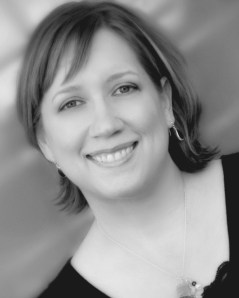
 Your novel started from an autobiographical nudge. Tell us about that. About seven years ago, my dad told me that my white grandmother fell in love with a black man when she was a young woman, but their families tore them apart. It opened a window on my grandmother’s personality, who had never seemed very happy to me. She died almost 20 years ago, so I wasn’t able to ask her the details, but it seemed to me she must have lost her one true love, and thus, her life was never quite the way she imagined it could have been. Because I didn’t know the particulars of what happened, Calling Me Home is almost all fiction, but there are bits and pieces of real life in the settings and characters.
You navigated troubling waters because you dealt with two people—one white, one black—falling in love when they weren’t supposed to fall in love. What helped your write these characters respectfully? What aided you to tell their stories with love, if I can put it that way? I suppose different things. One, there is a lot of literature out there that deals with forbidden love. We learn from those who came before us and have done such a marvelous job of portraying these characters. Two, I contemplated the experiences of those I’ve known who have fallen in love with the “wrong people.” Nobody intentionally sets out to do that—it simply happens. I’ve had conversations with people who had to give up love, or were conflicted by it. I’m a lifelong people watcher, so I think I tend to absorb many of the thoughts and emotions of folks in different situations, whether I experienced them myself or not. Third, true love is a universal experience, with feelings we all recognize and understand if we are healthy beings. You could say that I wrote of Robert and Isabelle’s love as love tends to happen—first, with a hyper focus on the two experiencing it, without regard to anyone or anything else around them, and later, with an increasingly wider focus on the world and how it would accept them. I allowed them to fall in love normally, so to speak, as young, idealist, impulsive teenagers do, and then I pulled the camera back enough to where the consequences came into view. Finally, though I don’t know the specific details of my grandmother’s real story, I feel a bit as though she were present, whispering to me of how it felt to love someone she wasn’t allowed to be with, and eventually to lose him.
I kept thinking about mothers and daughters as I read, partly because the story holds the experiences of a few mother-daughter pairs. Do you like the idea of families, including mothers and daughters, interacting with your novel in any way? I’ve been really pleased to hear from women who have read Calling Me Home and told me they are eager to pass the novel on to their mother, daughter, sister, and so on. Some have contacted me again, telling me how much that person enjoyed and sometimes related to the story. I do think it’s an especially appropriate story for making us think about our mother-daughter relationships—not just biological ones, but the surrogate ones we may have developed with other important people in our lives. I think it would be interesting to meet with a mother-daughter book club, or to participate in a group where mothers and teens read the book and discuss the issues. It was very interesting and gratifying to me to see my own mother’s and daughter’s reactions to reading the book and to hear their various thoughts.
You move from history to present day to tell a story about, among other things, friendship. What were some of the hindrances to Miss Isabelle and Dorrie’s friendship? In American culture, we’re most often steered toward making close friends with our peers. We tend to view those of other generations with a certain amount of mistrust, even—will they understand our feelings, will they approve or disapprove of our beliefs, actions, passions, when they are from such a different era? When we take that a step further, and encounter someone not only of a different generation, but different background or race, it adds yet another layer to what might already be considered an unlikely relationship. I think friendships like Dorrie and Isabelle’s would almost always to evolve from a situation like theirs—they originally had a business relationship, but the longevity and specifics allowed it to gradually deepen and become important to each of them.
But I also believe their friendship was almost inevitable—not necessarily because of their working relationship, but because of who each of them was and what each of them needed. Dorrie had a big heart and great compassion for her clients—not just a detached sense of seeing each one as “another head of hair.” Isabelle was very independent for an elderly woman, but also lonely. Dorrie was the person who reached out to her and didn’t forget her when she could no longer drive or get out and about. Dorrie was also patient with Isabelle—giving her lots of leeway with her crankiness, not taking it personally, and allowing her to share her deepest secrets on her own timing—until she began to sense it was critical for Isabelle to get that story out in the open. And Dorrie felt nurtured by Isabelle—something she didn’t always feel from her own mother. Not least of all, they made each other laugh, which is rarely a bad place to start a friendship.
Given the way your personal story related to Calling Me Home, in ways do you think readers can do what you’ve done? Your work is courageous in turning toward a relative’s background for inspiration, for truth, for pieces of their story. I struggled with my “right” to tell this story for several years before I began writing it, and throughout the process. I finally determined I was the only one who could tell this particular story exactly the way it came to me. For instance, someone else could write a story about an interracial relationship, from the perspective they chose or that chose them, and it would be completely different based on what they bring to the table—their own beliefs, passions, and life experiences.
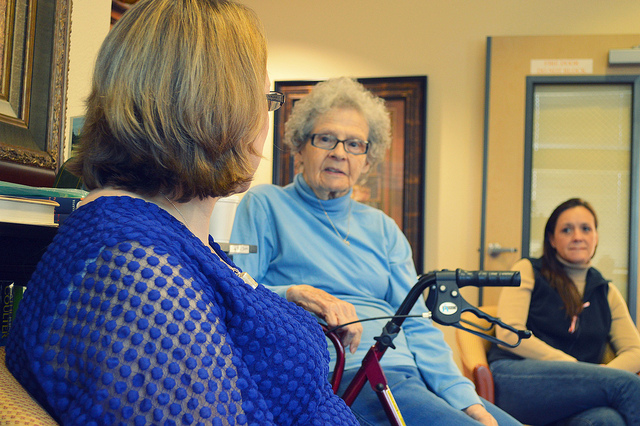
 One of my hopes while writing the story was that readers would think about and talk about the issues within, how they made them feel, and maybe even the memories the reading stirred up. I’ve included a photo here from a book club meeting I recently attended at an assisted living center. Though I’m in the forefront of the photo, the focus is on an attendee as she described a personal experience she had in 1945, coincidentally in the same area of Kentucky where Calling Me Home is set. It was a particularly meaningful moment along this journey for me as she is about the same age as Isabelle in my story, and she could speak firsthand about the era. The discussion in general with these folks was pretty fascinating, and this photo represents one of the really good days since publication happened.
To aspiring writers, I’d say this: If you have an idea for a story—even if it feels frightening—tell it. Write it the best you can.
What did you find difficult in your writing process (whatever you call your process for the novel)? What was life-giving? Strangely, once I gave myself permission to write this story, it flowed fairly quickly and easily. I always tell people, however, that when I’m drafting, I love revising, and when I’m revising, I love drafting. It’s all work. It’s work I love, but it’s work. Some days the work is easy. Other days, it’s a struggle to get five or ten words on the page. But honestly, for me, the most difficult part of writing is deciding to jump in. Deciding I’ve found the right story, the right conflicts, characters, voices, and so on. Once I get past that, I’m mostly off and running. The part where I’m off and running is life-giving. The part before that can take some time, and it feels like dying a slow and painful death. So I guess you could say that for me, writing is like living life in reverse. I’m not sure who you were writing to in this blog post you put up on April 5, but it was speaking right to me.
The journey your characters took was full of surprises, particularly for Dorrie. Thinking about your journey to bring this novel about, did you have any notable surprises you can share? I decided to set my story in a small town like the ones where my dad and grandmother grew up in northeast Kentucky. I knew the area somewhat, having been born in Kentucky and lived there off and on as a child, and visiting my grandparents in the Cincinnati and Newport metro area as a kid, then brief visits back as an adult. But it was mostly a child’s eye view, and a fairly modern one. I asked my dad to tell me about the town where he grew up, when he was growing up. I was shocked when he told me there was a sign at the edge of town warning black people to be gone by sundown. I had never heard of such a thing, and my story took on a whole new dimension as a result. It felt important to explore the history of these “sundown towns,” and I was blown away to learn all the different ways people of color were excluded from communities in every part of the United States, from north to south, east to west. It made setting Calling Me Home in the Cincinnati/Newport area seem even more appropriate. Though not the physical center of America, in a way, it’s a gateway between east and west, north and south, and what happened and still happens there is kind of the heartbeat of our country.
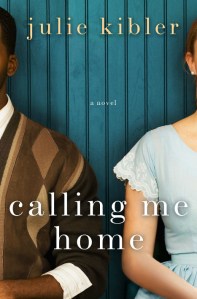 Talk about the work you’re doing now…for the novel. I imagine you are still working on the book, even if it looks like marketing and not revising. This is a great question, and it’s so interesting how you’ve worded it–“looks like marketing and not revising.” I was JUST thinking about this today as I attempted to do some work on my new story. I said to myself, “Wow, I almost feel like I’m still writing Calling Me Home. How on earth can I move on to something new?”
Between considering questions asked by book clubs, in interviews, through email, and in discussions of any kind, and simply still thinking about the story every single day, I do feel like I’m still working on it, sometimes harder than ever. It is challenging to find a new frame of mind, where I can devote mental energy to creating a new world, new characters, new relationships, while still focusing so much on the already published novel. I would really like to be immersed in something new, and am taking baby steps. In the meantime, I continue to promote Calling Me Home through social media, bookstore events and book clubs, and any other means that seems logical or beneficial, and that work won’t end any time soon.
I also felt it was important to try to give back in some way and have been looking for ways to involve myself, at the very least financially, with organizations that address some of the issues in my book—racism, single parenting issues, at-risk teens. I decided to partner with a local nonprofit called Santa Fe Youth Services in Fort Worth, Texas. I already knew of them and had a lot of confidence in the work they do. They help families with at-risk teenagers—kids who have been in trouble with the law, or struggle with drugs or alcohol, or have behavioral issues, for instance. The organization works hands-on with these families, helping them with parenting skills and conflict resolution and attempting to connect them with the additional resources they need to help their children succeed.
How can readers stay in touch with you and support your work? I am most active on my Facebook author page (www.facebook.com/juliekiblerauthor), where I post updates about book news, links to interviews and articles, and interact with readers. I really enjoy getting emails and messages from readers, telling me their reaction to Calling Me Home, and try to answer each one, though I get a little behind on occasion. I have a website (www.juliekibler.com) where readers can learn about bookstore events, conferences I’m attending, etc. I’m a lightweight Twitterer: @juliekibler
Readers can support me most by telling friends and family (or hey, even strangers!) about Calling Me Home if they enjoyed it. Word-of-mouth is the single most important tool in building audience for a book. Readers, if you recently read a book and loved it, I challenge you to tell five or ten people about it—friends, family, coworkers, whether in person, through your Facebook page or on Twitter, through suggesting your book club read it—anywhere you talk to people. Why keep it a secret? Books are for sharing, and the author will appreciate your assistance in spreading the word!





 Michael Washington