Again, Fathers Know Best (EJ)

I’m repeating a few posts for my own good. Even though, in every case, families have grown and aged, I hope you enjoy this interview.

FF: Describe your family.

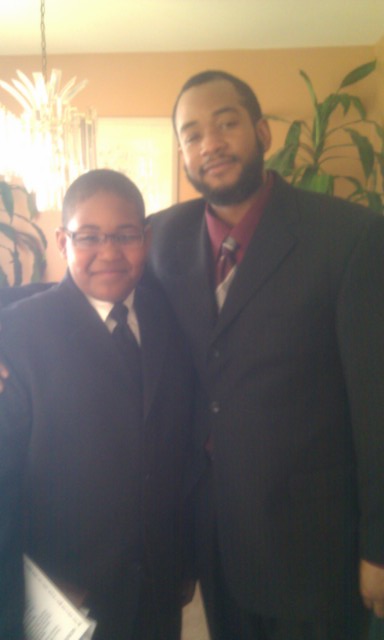
EJ: the diaspora of the Johnsons.  We are spread out.  My oldest son (Josiah, 13) primarily lives with his mother now in the Western Suburban area.  My youngest two, (Alexandria, 5) and (Franklin, 2) from my marriage also primarily live with their mother.  I would have to say that we are a righteous family.  A family where all the members are interested in doing good for themselves, for one another and others.  And I mean everybody.

Josiah the oldest of my three children is great. I can go on and on about this guy.  I remember when I used to worry about him. And I mean really worry.  I would say to myself “Lord, why would you send me a child like this?”  With him it was problems in school.  Problems in church at Sunday school.  Problems in extracurricular sports. Almost every area, this guy was kicking up dust.  What amazes me to say is that he is a phenomenal son and has always been.  In all those challenging areas that I’ve mentioned, through it all, he has always been a good person.  Adults marvel at how mature he has always been.  He is interested in trying everything, every sport, and every instrument.  He is littered with ambition and insight.  Overall, he is careful.  I’m relieved because I understand him now.  He’s me.

Alexandria, the middle child is the one that really introduced me to fatherhood.  I remember so well, she started coming down the birth canal at 12:00 A.M. on the dot on her due date.  She is still the same way.  She means what she says, and will do what she says.  Miss consistent, honest, innovator, beautiful, family leader.  She has always been special to me because when I was younger I could always envision myself with a daughter.  Even at the age of five she is the ideal daughter.  I am blessed because I understand her  like I understand my son.

The newest guy, Franklin is of the same flavor as the other two.  He is independent and vocal about his independence.  It’s amazing because he looks like my oldest son’s identical twin at his age.  I realize with Franklin the style of parenting I have used with Josiah and Alexandria will not get through.  He has a completely different set of motivations.
FF: How has fatherhood changed you?

EJ: I was 21 when I became a father.  At that time, I wasn’t used to depending on people or using people for help.  I had always been helpful to others, but had managed my life up to that point trying not to need help from others.   At that time, considering my proud personality, I had to learn to depend on others.  I had to be the one asking for advice.  I had to be the one who needed resources.  I was the one who didn’t know what to do, or say.  I began to live a new life.  Or I added a new “wing” to my existing life structure.
Fatherhood has inspired new relationships with people, places and things I ordinarily wouldn’t have any relation.  For example, I’ve been a member of the Chicago’s kids museum.  I’ve been to the zoo agazillion times.  There is no way in the world I would know who Dora the Explorer is.

FF: Have you made any mistakes as a dad? If you’re not a liar, name one and talk about what it meant to you.

EJ: I will mention probably the most benign or, at least, something where I won’t implicate myself by mentioning.  Without dwelling on buying diapers at the last minute from Walgreens (too expensive), or bringing home the wrong formula (in trouble with the wife).  I would say one of the mistakes worth talking about that I constantly keep making is being impatient.  Sometimes I forget that my children are children.  That they need some room to make mistakes.  A strong feature in my character is the ability to improve things.  On the downside of that feature is fault-finding.  I am sometimes driven to crave perfection.

FF: What’s the most helpful advice you heard when you were becoming a father or as you’ve been a father?

EJ: While living in South Holland, I was to fortunate to have made the acquaintance of several middle-aged adult fathers.  Fathers with whom I share common frames of references.  I was having difficulty getting through to my son on a lot of concerns.  Being able to watch these older gentlemen talk to their children, interact with their children, etc. provided a good template for me.  More importantly, the best piece of advice that one of the father’s shared with me was “share stories about yourself when you were a child.”  This really worked!  Instead of telling my son what to do all the time, I would just share my stories that were similar to his experience.  I could tell this would really make him contemplate how  alike we are.  I could also see that he was generally more at ease knowing that he wasn’t alone.

FF: How do you attend to your relationship with your children’s mother? Has it changed over time. How so?

EJ:  Literally having to work/walk together with a person you don’t see everyday is a character challenge.  What tools I usually use are respect, understanding, and patience.  The ladies like respect and definitely being understood.  At first, it wasn’t always like this.  I remember wanting what I wanted when I wanted it.  That had to change.

FF: You move back and forth to see your children, to maintain relationships with them. What has that meant to you as a dad and how you’ve gone about planning and living your life?

EJ: It mostly sucks.  Honestly!  To be with them or to pick them up it’s a long drive.  A tenacious drive.  When things go awry, I have a long way to travel to get to them.  After the divorce, I was picking up everyone from their various locations and it three hours to pick up everyone.  This is the downside of it though.  On the upside, the drive gives me a lot of time to plan and think of new projects, etc.  And when everyone is in the car we have a lot time to spend in each others space without it being overbearing.

I know every other Friday and Sunday for the last past 13 years have been reserved for transporting children.  Now after the divorce, it is every other Friday & Sunday, along with every Monday and Wednesday that are set aside for transporting kids.

It means not only setting aside time to be with my children but also making time for traveling to get to them to be able to spend time with them.

FF: What surprises are there along the way for parents? What do you wish you were told to expect?

EJ:  I’m surprised at how serious of job this is.  How much thought needs to be put into each day, each word, each meal, each everything.  Fathering requires a lot of attention and planning.  Initially, I thought all I had to do was feed em, cloth em and tell em what to do.  In this age, love means so much more children.  The amount of sacrifices that need to be made to communicate love to my children is beyond what I ever would have imagined.

FF: What is one recent memory you made with your children?
 EJ:  Franklin, the youngest, has recently learned how to ride his bike.  That was really amazing.  He also enjoys it because he can’t stop riding the bike.  Even in the house.  He wakes up in the morning and that is his priority, to get on the bike and ride around the basement.
Again, Fathers Know Best (Kevin)

I’m repeating a few posts for my own good. Even though, in every case, families have grown and aged, I hope you enjoy this interview.

FF: Describe your family.

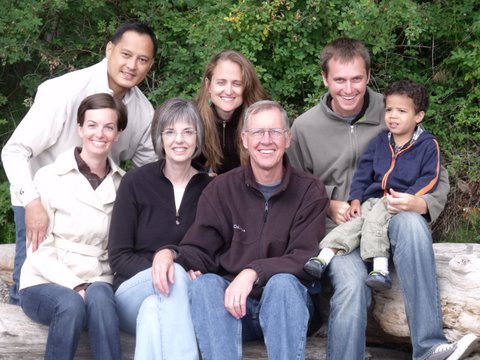
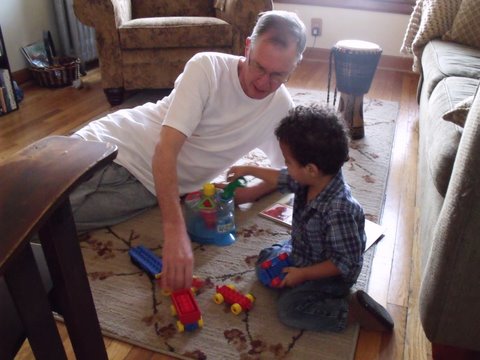
KS: Family of origin is two parents (both deceased), biological brother, 18months my senior, and an adopted sister, 6 years my junior. Current family is my lovely wife Linda of 37 years, son David, daughter-in-law Maggie and grandson Eliot in Chicago and daughter Anne Marie and son-in-law Tony in Singapore.

FF: How has fatherhood changed you?

KS: Fatherhood has given me the privilege of looking at life through a lens 25 years younger than my own. In some strange way the world of my children and, now, grandchild has become my world as well. I am now responsible for more than just my world. Fatherhood has energized and motivated me because I want to experience life with my children and not just observe. Fatherhood has also given me an immense amount of hope for the next generation.

FF: Have you made any mistakes as a dad? If you’re not a liar, name one and talk about what it meant to you..

KS: Just one?! I should not have been so trusting of others when it came to the care of my children. I did not protect them the way I should have.

FF: What’s the most helpful advice you heard when you were becoming a father or as you’ve been a father?

KS: Say “yes” as often as you can. Raise your child to flourish in the world not to remain dependent on you. Don’t fight with your kids over their choices of clothing and shoes; just give them a budget and turn them loose.

FF: How do you attend to your relationship with your wife because of parenting?  Has parenting changed your marriage?

KS: Creatively. We had to find new ways to connect with each other and it could not always be on our schedule. Intentional conversations about non-kid topics.

FF:  Talk about staying in the lives of your children for the long-range.  What is that like?  What do you do differently, for instance, with your grown children that you didn’t do when they were younger?  What does it take for you to stay invested in them and in your relationship with them?

KS: We have communication tools today that greatly facilitate long distance connectivity. We make good use of those but somehow the monitor is not a full substitute for face-to-face time. We make traveling and being together a priority in our time and resources. I don’t worry about my grown children like I did when they were under my roof. That allows space for all kinds of adult interaction that is a lot more fun.  As best as I can, I want to understand their world so I try to jump in whenever it is appropriate.

FF: What surprises are there along the way for parents? What do you wish you were told to expect?

KS: Most of the negative stereotypes of child development stages are wrong. They are more likely to manifest if you are anticipating them. Every season brought more joy then stress. Kids understand and can respond to a whole lot more than we give them credit for.

FF: What is one recent memory you made with your children?

KS: Spending a couple weeks with all of us together in Taiwan.

Again, Fathers Know Best (Josh)

I’m repeating a few posts for my own good. Even though, in every case, families have grown and aged, I hope you enjoy this interview.

FF: Describe your family.

JS: I like to think of my family as ‘typical,’ though I’m sure most people think the same of theirs, no matter how that looks. My wife, Annie, an educator in Chicago Public Schools, originally hails from Western Kentucky. We’ve been married 4 1/2 years now, and we live in the Ukrainian Village neighborhood of Chicago. I am a white boy from the Chicago suburbs (though I try my best to dispel such notions) who transplanted to the city about 5 years ago. I work from home as a freelance market research analyst. Back in July, we welcomed our daughter Lisa into the world. She is now 7 months old, and ready to tackle anything—a trait we like to encourage in her. We also have two cats: Leroy (aka “Fats”) and Bianca. They have been surprisingly good with the transition from being the ‘kitty-babies’ to simply being pets who don’t get the attention they were accustomed to. They also have a healthy sense of anxiety around Lisa—she likes to grab and pull their fur, and they like to run away from her before she gets the chance.

As funny as it is for me to say it, we’re one of those ‘crunchy’ families. We (Annie, really) had an unmedicated home birth; we use cloth diapers; and we do a bunch of other ‘crunchy’ things. Annie is all about it because it’s healthier, better for the environment, etc. I’m mostly on board because it’s so much cheaper! Instead of buying 3500+ diapers for a kid through potty training, we have about 25 cloth diapers (and we can re-use them if/when we have more kids!). Instead of having to haul around formula, bottles, find a way to heat water, etc, Annie can just feed her at the “milk bar.” Plus, since we nurse, it means I don’t have to get up as much in the night!
FF: How has fatherhood changed you?

JS: I used to get very little sleep because I didn’t need it and wasn’t tired. Now, I need more sleep than I’m getting, and my waking time is not all by choice.  In a deeper sense, I worry more and hope more. I worry about the world in which my little girl is growing up. I wonder if our culture will twist her sense of beauty and self-worth, or even cause her to think that her value is only found in her appearance. I worry about whether gender stereotypes will limit her notions of what she can do–if she feels forced to wear pink and love princesses and unable to wear lab coats or be an astronaut. I worry about the gangs in our neighborhood and find myself paying attention to the tags, hoping that the most recent dis won’t be cause for shootings when the weather warms. I find myself encouraged by the neighborhood school (where I’m already involved as an LSC member), which is fantastic. I worry about the potential for flooding in the condo we’re about to buy, and trust that there isn’t harmful mold hiding under the carpets.

But I have hope too. I have hope that she will be a friend to others. I have hope that she will love the Lord. I have hope that somehow, my muddling fathering will help guide her into a full and vibrant person. I have hope that she will be an advocate for positive change in her world. I have hope that the best thing I can do–the strongest vote I can make and the loudest voice I can raise–is to trust that by bringing a life into the world, I am making the world better.
FF: What mistakes have you made as a dad? Name at least one and talk about what it meant to you.

JS: I think the greatest mistake I’ve made thus far is not investing enough time in my relationship with my wife over the past 7 months. We’ve both been busy with the routine of taking care of Lisa, preparing for the next day, working, and trying to find a moment of sleep to overcome exhaustion. We’ve not spent enough time on dates. We’ve not spent enough time just talking to each other. Because of this, our relationship has suffered–not in serious ways, but in subtle ones that lurk beneath the surface. I don’t ever want to get to a point, even years from now, where our lack of connection with each other causes us to have distance. And the better we are as husband and wife, the better we are/will be as parents.  We’re certainly nowhere close to this yet, but I don’t want my daughter to grow up in a home where good, healthy relationships aren’t being modeled for her. (Did I mention that I worry more these days?)
FF: What’s the most helpful advice you heard when you were becoming a father or advice you’ve gained since you’ve been a father?

JS: As soon as you find out you’re going to be a dad, start sleeping as much as you can. You’ll be glad for it later.

The best advice I’ve figured out since I’ve been a father is to get in your baby’s face. Let them feel your face and pull your hair and slobber on your nose. Blow raspberries on their belly and listen to them laugh. Sing to them. There is nothing more joyful and wonderful and awe-inspiring as seeing your child–this creature that was so utterly helpless and dependent–begin to respond to you and interact with you. Even before they have language, a kid will express so much emotion and share her love to you as a parent. Get close, and soak in as much of it as you can.
FF: How do you attend to your relationship with your wife outside of your being parents, and has parenting changed your marriage?

JS: Hah! I didn’t read ahead, and I feel like I already answered this one above. Parenting has definitely changed our marriage, simply by refocusing our attention on the little one rather than on ourselves. It’s so much *effort* to get away on our own, and so much of our lives are dictated by the baby’s schedule. Even when we do manage dates, there’s a sense of urgency to get back home to the baby, rather than linger and simply sit and enjoy each others’ company.


FF:  Talk about the role you want to play in teaching your daughter.  I imagine Annie will be a good educator to her, since she is an educator, but how have you taught her.  How do you hope to?

JS: I read to her. Probably not often enough, though she’s usually more interested in eating the pages than looking at the pictures. Her favorite books at the moment are “Moo, Baa, La La La,” “Oso Pardo, Oso Pardo, Que Ves Ahi?” and “Daddy and Me”. I love reading to her. Whenever I go on walks with her, I try to point out and talk about the things I see–dogs and trees and stores and cars and whatever else is around. She is wonderfully alert and just loves to take it all in.I must say, the notion of “teaching” Lisa seems a bit funny at this point. Most of her ‘learning’ is just a matter of her figuring out the world around her and how she can interact with it. My role in teaching her that sort of thing is more just a matter of exposing her to new situations, people, and things, and letting her figure it out. She has a wonderful ability to study objects in a measured way before picking them up or moving them or whatever she wants to do. She’s very thoughtful and deliberate; I don’t have to do much except get out of her way.

As she gets older, I hope to teach her in so many ways. I hope to teach her to be kind, loving, compassionate, encouraging, and friendly. I hope to help her gain a sense of God in her life. I hope to help her find the rhythms of family and spirituality by establishing traditions and sticking to them. When she gets to school age, I hope to help her with her homework and look for ways to challenge her and push her even more. I hope to expose her to a wide range of ideas and people and experiences and places. I hope to teach her to love the outcast, to be compassionate to the people around her to suffer. I could go on…
FF: What surprises are there along the way for parents? What do you wish you were told to expect?

JS: Well, there’s always the explosive poop while the diaper is off and baby is on the changing table. That’s always surprising.

I wish I had been told to expect that relationships would be so much harder to sustain after the baby comes. In the past 7 months of parenthood, I have not spent nearly enough time with my friends. Nor has Annie. As wonderful as it is to be a parent, there’s a sense of loss when it comes to the freedom I used to have to spend time with friends. If you can, really cultivate deep friendships with friends and get them used to coming to your home. It will be so much easier to maintain friendships if it’s already ‘normal’ for them to reach out to you and to come to you than it is to a) remember that you have friends you haven’t seen in a while, b) figure out when you can schedule to meet them, and c) actually muster the energy to pack up baby’s stuff, leave the house, and visit for a short while. If you think it’s hard to see your friends now, it’s 5 times harder once you’ve got a baby. Be intentional about your friends.FF: What is one recent memory you made with your child?JS: Every moment is a memory I’d love to hold on to. But one that feels especially cool at the moment is from last week. I had put Lisa in a sitting position in her crib for a moment while I went to prepare a diaper for her. A moment after I put her down, she grabbed the rail of the crib and pulled herself into a standing position–the first time she stood up completely on her own! I was simply shocked, but had the presence of mind to grab my mobile phone and shoot a video (http://www.youtube.com/watch?v=CoJUZyMbIls) when she did it a second time a few moments later. Such a great moment of pride for me (look how much she’s progressing!) and a cool ‘first’ for her!

Again, Fathers Know Best (Tim)

I’m repeating a few posts for my own good. Even though, in every case, families have grown and aged, I hope you enjoy this interview.

FF: Describe your family.

TW:  I have a beautiful wife (Kristi) of almost 8 years. I have two wonderful children, Kayla and BJ. Kayla will be 4 and BJ is 2.

FF: How has fatherhood changed you?

TW: Fatherhood has given me a greater understanding of how God loves and disciplines His people. I love and care for my kids, even though they don’t always appreciate it. I still feed them and clean up their bodily waste, even when they protest cleaning up their toys. Fatherhood has given me a greater appreciation for and understanding of how my parents raised me.

FF: What mistakes have you made as a dad? Name at least one and talk about what it meant to you.

TW: Since my children are at home with mommy all day, they are always screaming for mommy. When I come home from work, I enjoy brief celebrity status, then all attention switches back to mommy. So, at times, it was easy to distance myself emotionally, given that they didn’t seem to need me for anything. They are young and that’s usually how it works, but I would sometimes allow the pain of that to become an excuse to just let Kristi bear the burden of meeting their needs, instead of taking initiative. This was a big mistake that I used to make. I have progressed beyond that, and even forced them to come talk to me about something. I’m pretty confident that many fathers deal with this same issue.

FF: What’s the most helpful advice you heard when you were becoming a father or advice you’ve gained since you’ve been a father?

TW: My dad always taught me how important it is for Kristi and I to be in agreement and to keep our love for each other strong. When children come into the picture, it’s easy to put all the focus on them and neglect each other.

FF: How do you attend to your relationship with your wife outside of your being parents, and has parenting changed your marriage?

TW: Kristi and I always try to maintain some sort of a date night, even if we are just at home. Now that we are living in the city, we have greater access to babysitters. This has allowed us to go out more frequently than ever. Of course, parenting has changed our marriage. It’s forced us to be more creative and intentional with our time together. It’s something that we always need to balance.

FF: What are some of the things you’ve struggled with as a father?  What are some of the things that have given you the most joy?

TW: As for struggles, I mentioned one earlier. That’s been the main one. It’s very discouraging when they choose to get attitudes and disobey. What gives me the most joy is to watch their personalities develop as they mimic what Kristi and I do and say. I love watching them as they play and converse with each other.

FF: Describe adding a second child to the household.  Does having two children feel differently than one?

TW: Adding a second child presented new excitement and new challenges. Having two feels very different because these are two little human beings with very different personalities, issues, joys, needs, etc. It’s definitely more work. They both require individual attention in different ways. Different things make them upset or frustrated. So as we teach them, they are also teaching us.

FF: What surprises are there along the way for parents? What do you wish you were told to expect?

TW: Children have extremely different personalities. It’s also interesting to see them do and say things that remind you of yourself, or other family members. I wish there was an entire book in the Bible or at least a few chapters that were completely dedicated to raising children and what to expect. When we experience the challenges of parenting, I jokingly say to Kristi, “The Bible doesn’t say anything about this.” I love the word of God, I just wish that God would have put a lot more content regarding the “spiritual gift of parenting.”

FF: What is one recent memory you made with your child?

TW: We are currently potty-training BJ. One moment, we are congratulating him on going pee pee in the toilet. The next moment, we are reminding him that we go pee pee in the toilet, just after he has an “uh oh” moment. Sometimes we’ll ask him if he needs to go pee pee, and he will say “no”. The next minute, what does he do? He pees in his underwear. It’s been a fun and challenging experience. We’ve only been at this for the past 2 weeks. I think he’s getting it, slowly but surely.

Friends vs. Strangers

Photo Thanks to Kevin Curtis

Photo Thanks to Kevin Curtis

In a day I spend time working with three people: participants in mission at church; patients in a hospital setting, usually in medically intensive situations; and students preparing for continued ministry. All of those people are experiencing some thing in life that is calling out to them, emerging within them.

In the church, we are hearing and speaking to one another around an old and almost common event, reflecting upon the life of Jesus and what that life means now. In the hospital we are generally responding to the crisis of the medical moment and the myriad of ways hospitalization matters to people. In the learning environment (and I’m in three of them in one way or another), we are inspecting the materials available to us for preparation, refinement, and formation.

All those settings are identity shaping settings. In each place, we question—and I do this as a leader or caregiver or teacher—what’s happening and how those happenings turn us into the people we are. Jaco Hamman said, “Many of us live most of the time as strangers to ourselves” (From Becoming a Pastor: Forming Self and Soul for Ministry, p. 10).

When I read Hamman’s words, they struck me because they were a reminder that most of the time, we can be distant from our selves, strangers to ourselves. We can be strangers to the things that shape us and to who we are as shaped, identified people.

How do we get to know who we are? Where are the places in life that reveal, construct, critique, reform, affirm, and embolden identity? I’m paying attention to how my working worlds are more than places I go; there are places I’m made. The same is true for home and circles of friendship. Those are the contexts where identity happens. When we sit in those places with open eyes, we get closer to ourselves. We become friends to ourselves.

Again, Fathers Know Best (Gerald)

I’m repeating a few posts for my own good. Even though, in every case, families have grown and aged, I hope you enjoy this interview.

FF: Describe your family. 

Zoe, Vivian, and Gerald Liu

GL:  The family is made up of my wife Vivian and I (both 33 y.o. married almost 7 years), daughter Zoe (10 1/2 months), and our soft-coated wheaten terrier Colbie (4 years or is that 28 in dog years?).

FF: How has fatherhood changed you?

GL:  I think fatherhood has enhanced my interpretation of joy.  Through the challenging early goings of being new parents (with my wife Vivian BY FAR doing the most heavy lifting!) I think we grew to appreciate the small victories like when she first cooed, giggled, or slept through the night.  Even just returning home from after a long work day and seeing my daughter’s face or just dancing with her in the living room bring me the most satisfaction and joy.  I think it also helped me to have a higher appreciation for my own mom and dad and has given me a new viewpoint of the immense love of God.  I sometimes find myself pondering how my love for Zoe is completely eclipsed by God’s mighty love for me and that truth blows me away every time.

FF: What mistakes have you made as a dad? Name at least one and talk about what it meant to you.

GL:  Over protectiveness is one of my many mistakes.  I guess another result of fatherhood for me is an increased sense of fear for my daughter’s well being.  There have been situations where in my anxiety and panic I have spoken a bit harsh or unfairly to Vivian.  For instance if I thought a piece of food was too big for Zoe to swallow, I would in a panicked-tone question Vivian why she would give that to her (clearly it probably wasn’t too big.  I’m just a freak!).  I’m trying to get better, thanks for being patient Viv!  I think another mistake would be to take better care of my wife Vivian.  I think I some arguments we’ve had stemmed from communication or just the lack of simply asking Viv on how I can help.

FF: What’s the most helpful advice you heard when you were becoming a father or advice you’ve gained since you’ve been a father? 

GL:  I think people gave us a healthy fear of anticipating the challenges in the first few months.  I think that helped us prepare for the nightly feedings and sleepless nights.  A realization for me was understanding the statement “they grow up so fast!”.  Zoe’s only 10 1/2 months and everyday it seems like she has learned to do something new or something about her has changed (i.e. teeth).  So advice I give now to parents is “Don’t blink or you will miss something!!”.

FF: How do you attend to your relationship with your wife outside of your being parents, and has parenting changed your marriage?

GL:  People told us how important “date-nights” are for parents and we try to set aside time to connect and concentrate on our relationship.  When there is time we try to do things together like workout in the house, take walks, or watch a favorite show.  I definitely think our relationship has changed as a result of being parents.  I think we both cherish the time we have alone and are more communicative.

FF: What are some of the things you’ve struggled with as a relatively new father?  What are some of the things that have given you the most joy?

GL:  I think adjusting to new routines as a result of fatherly responsibilities is a general struggle.  Also another big struggle is balancing my friendships.  I think it takes much more planning and intentionality to get together with friends and its hard at times to relate to friends that live generally care-free lives.  The most joy I experience is in small things as I mentioned before.  When Zoe learns how to wave, or clap, or just laughs and giggles it makes me proud and happy.

FF: Would you be willing to talk about how your faith has been shaped or changed in the process of you and Vivian becoming parents?

GL:  There were some really dark times for us as we struggled for a number of years with our inability to conceive.  As couples around us became pregnant and other families grew, we often times felt envious, isolated, and alone in our struggles.  It was a load to bear and our focus and anxiety on conceiving became an unhealthy obsession that damaged our faith.  It was only after we begun to share our difficulties with others that we realized our situation was not uncommon and as we reached out to others for support we felt the “body of Christ” and its loving embrace for us in our time of need.

During one Sunday (Check out the podcast on thenewcom.com from 11/21/2010 towards the end 45 min or so in) where Viv and I were probably feeling the least hopeful, Pastor Peter preached on Jonah and talked about “rival gods” and how anything that we tell ourselves we “must” have is our real God and idol.  As he was preaching, I could not help to think that even our “good” and “reasonable” desires to have children was keeping our selves away from God.  Our “idol” was in having a baby and I realized that my hope was in our future family and not Christ.  After the sermon, Peter asked for people to come up and pray.  Without talking to each other or hesitation, both Viv and I stood up, walked to the front, and were in tears.  That moment confirmed to Viv and I where our hearts and minds were and that we were going to try to be, from that point on, ok with whatever God had planned for us.  Child or no child.  We both wanted God without condition and with an undivided heart despite our circumstances.

Little did we know, God was about to give us miraculous news.  Three days later, right before thanksgiving we confirmed that we were expecting.  God has a funny sense of timing and I truly believe that our journey was meant to be a testimony of how even the “good” things we naturally desire have the ability to wrestle our hearts away from the God who loves and desires our undivided hearts.

Now when I think of God while holding my daughter I am reminded of our family’s journey and know that as much as I love Zoe that my ultimate source of my joy, love, and salvation is in my God.  I hope to teach my Zoe that truth one day.

FF: What surprises are there along the way for parents? What do you wish you were told to expect? 

GL:  I would say that the surprises are in the amount changes to your own life, personality, and character are so many that after being a parent you may never comprehend how life was before your baby.  I wish I was told to expect how much baby stuff costs!  Yowzas!

FF: What is one recent memory you made with your child?

GL:  Swimming with Zoe for the first time.  While on vacation in Florida I’ll never forget how Zoe loved being in the pool and her enormous smile as she splashed the water with her hands.


Supervision Helps

She needed to turn aside and name what was unexamined and unfinished in her own life story as she continued in ministry to this woman. Were she simply to react to her as she had to her mother, she would have seen clearly neither her own story nor that of the patient, who was different from her mother in important ways. These parallels can be named and examined or referred for therapeutic work. Particular themes of grief or abandonment or abuse may provoke anxiety in the minister who has these themes as parts of his or her own history. Supervision helps the minister to learn to walk between the perils of overidentification and detached aloofness. Ministry in depth will always raise themes for the sensitive and reflective minister that are in need of attention in his or her own story. Recognizing these themes and remaining responsible in pastoral relationship are the goals of supervision that looks at life stories of parishioner and pastor.

(From Steere’s The Supervision of Pastoral Care, pg. 122)

Something I’m Thinking About

Photo Thanks to Tim Swaan

Photo Thanks to Tim Swaan

As I see one semester end (at seminary) and one unit end (in CPE) and one year end (at the church), I’m reading over a book that will likely find its way into one of my theory papers. It’s a book Dr. Scottie May introduced me to in grad school.

Parker Palmer is such a helpful teacher and guide. Here’s a taste about education but that can be said of preaching, speaking, parenting, and any other way of learning/educating:

If you want to understand our controlling conception of knowledge, do not ask for our best epistemological theories. Instead, observe the way we teach and look for the theory of knowledge implicit in those practices. That is the epistemology our students learn–no matter what our best contemporary theories may have to say.

…If this is the case, then as a teacher I can no longer take the easy way out, insisting that I am only responsible for conveying the facts of sociology or theology or whatever the subject may be. Instead, I must take responsibility for my mediator role, for the way my mode of teaching exerts a slow but steady formulative pressure on my students’ sense of self and world. I teach more than a body of knowledge or a set of skills. I teach a mode of relationship between the knower and the known, a way of being in the world. That way, reinforced in course after course, will remain with my students long after the facts have faded from their minds.

(From To Know As We Are Known, pg. 29, 30)

Teach Your Daughter (and Son)

Photo Thanks to The Typical Female Magazine

Photo Thanks to The Typical Female Magazine

Teach your daughter how to cook kale.

Teach your daughter how to bake chocolate cake made with six sticks of butter.

Pass on your own mom’s recipe for Christmas morning coffee cake. Pass on your love of being outside.

Maybe you and your daughter both have thick thighs or wide ribcages. It’s easy to hate these non-size zero body parts. Don’t. Tell your daughter that with her legs she can run a marathon if she wants to, and her ribcage is nothing but a carrying case for strong lungs. She can scream and she can sing and she can lift up the world, if she wants.

Remind your daughter that the best thing she can do with her body is to use it to mobilize her beautiful soul.

Read Sarah Koppelkam’s full article here.


Panama Jackson’s Letter to a Friend

Photo Thanks to Blake Verdoorn

Photo Thanks to Blake Verdoorn

Dear Homie,

If my math is correct, you’re set to become a father next month. Congratulations. There are few times in the life of a person more exciting (and nerve-racking) than the birth of your first child! As your friend and brother, I couldn’t be happier for you and the wife on this life-changing event. (it’s good to know how to use insurance terms, since in your case, the baby will be born during most open seasons—good timing!). I look forward to watching your daughter grow into the young woman she’ll become with the wisdom and guidance of her great parents.

And since I’ve been around that mountain a few times, I figured the least I could do was tell you a bit of what life is going to be like in the near term.

Basically, you’re going to miss a lot of it because of sleep deprivation. I mean, you’ll be there, but you won’t be there sometimes. Once, when #YoungPanamontana was an infant, I literally had a dream that I rolled over on her on the couch and woke up terrified that I’d killed my child, only to realize that she was upstairs asleep with her mother. Do you understand what I’m saying? I was so tired that I dreamed I was asleep, except I committed murder in my sleep WITH MY SLEEP. Which gets to where I’m going with this.

There are probably countless people who have told you to get all of your sleep now. And though you can’t, it’s one of those things that scientists should be working on: a sleep bank. Right now you can go to sleep at, say, midnight, and wake up at 8 a.m. after a night of uninterrupted sleep—assuming the wife allows you to sleep all night, since I’m sure she’s super uncomfortable right now.

But let’s say she does. Yeah, that’s going out the window the DAY young Homie-ette is born. See, babies, they have to eat every two hours for the first few days (weeks) of their lives. You don’t have to do the math to realize that means that at least 12 times a day—maybe less if she’s doing 2.5 hours—your child will be awake seeking sustenance and attention. Many of those hours come at times when you’d normally be asleep.

I don’t know what you all are going to do regarding breast-feeding (if your wife decides to breast-feed, it saves a FORTUNE on formula; if not, price matching and Amazon.com are your friends). But if she is going to, she’ll be up all night after short naps, only to arise to continue giving life to this person you two created.

Trust me on this one, fam: Wake up, too. Just be awake. Stare at the ceiling fan. Cut your toenails. Hold her boob. Do something so that she knows she isn’t up by herself. There’s a good chance she’ll be scowling at you even if you are helping, but it gets better. And if you’re asleep, there’s a great chance that she’s going to wake you up. I promise.

Read the rest of the letter here at the Root.

Living the Intersection

I appreciate that my training in clinical pastoral education is giving me reason to enter into a beautiful reading list. I’m covering by necessity pastoral arts, theology, history, and supervision. I’m spending my time becoming a better minister, a slower thinker, a deeper educator of servants, and hopefully a person more responsive to these gifts in a clinical encounter, whatever form it takes.

As I’ve mentioned on my blog, I’m reading, and in an effort to “keep more of what I’m reading,” this review is, in part, in order for me to see again some of the words of the writers I’m encountering. This book, Living the Intersection: Womanism and Afrocentrism in Theology is a book on theology, particularly womanist theology in contradistinction to afrocentricism.

The contributors draw upon their reading of Molefi Asante’s use of Afrocentrism. His conceptualization is widely read and has been a persistent critique to Christianity and Islam with regard to black people. The description of the concept is in the book, so I won’t completely summarize their rendering of Asante. Still, one of Asante’s basic assertions according to the editor of Living the Intersection is the mistaken notion that Christianity is a historically acceptable religious option for African Americans. His basic critique is the mismatchedness of the Christian faith and the better natural fit of, presumably, African Traditional Religions. His notion of Afrocentrism is in conversation in this book with thinkers from the womanist theological posture.

Womanist is a term from Alice Walker who in the novel The Temple of My Familiar “has taken some of her womanist ideas and tried to run them through narratively.” As Gilkes says in the collection, Walker gives writers a rich term to capture her own artistic attempts to debate humanity and reject racism in order to push “for a larger, relational, humanist vision.” Walker used a word (i.e., womanist) started something. Note that she was moving toward a vision. I think that’s an evocative theological motive: vision.

Photo Thanks to Esther Kang

Photo Thanks to Esther Kang

To be fair, most will tie Alice Walker’s literary genius to the conceptual offerings of others before her. Living the Intersection does the same. Deborah E. McDowell does this in her chapter on “Slavery as a Sacred Text.” McDowell reminds us of the tenuous relationship between black people and already-determined-and-already-decided-principles-of-somebody-else’s-interpretation, saying, that “Scripture is not sacred as an untamperable given; it is rather a set of texts to be questioned, negotiated with, and variously interpreted” (p. 82). Womanist interpretation is tied to the experience of a slave being told what to think and how long to think it relative to being “free in Christ.”

Youtha C. Hardman-Cromwell connects womanism to the wealth of poetic contributions written by black women. She decorates her chapter with pieces from Alice Walker, Gwendolyn Brooks, and Maya Angelou among others. She’s doing what the biblical psalmists did: pointing to the poetic, musical expression of a sister in order to underline some truth about life and God. Womanist theology comes out of poetry.

Given their nod to the historical connections leading to womanism, the contributors in Living the Intersection give much respect to Walker for snatching up the spirit of such fruitful work in Walker’s careful word choice. Edited by Cheryl J. Sanders, these writers are connecting language with spirituality and theological reflection in order to pursue a vision of beauty and wholeness. “We are here because we believe we have a story to tell to the nation, and our experience has something special to say to the world.” (p. 22) I wish that was on a t-shirt worn by all the people I love: I have something special to say to the world.

Living the Intersection is an anchoring text for those interested in listening to tones and songs of black women teaching foundational theology for the purpose of telling a story of faith which changes lives and builds people. This book, among those I’m reading as I study in CPE supervisory education, is about how we understand God, how we understand the lived experience of black women, and how we take cues from those two understandings for life.

Theology is God talk, language we use to express who we think God to be. It is necessarily risky. After all, theology is language about God. It relates to us, to those God has made, but it starts in relation to the One for whom words could forever be written and read. Eventually that linguistic effort ends in wholeness. Kelly Brown Douglas in the book delineates that wholeness is about triumph over oppression “so that the individual is whole even as she or he struggles for the community’s wholeness.” And “wholeness for a community indicates that it is not divided against itself and that is free, liberated from oppression.” (p. 68)

Photo Thanks to Esther Kang

Photo Thanks to Esther Kang

As students, we draw from our various sources to unearth, examine, and interrogate the ingredients of faith, to critique forms of faith, to inspire better uses and practices of faith. In the language of Sanders, our work is about the “survival and wholeness of an entire people” and about the “affirmation, assertiveness, and actualization of women.” The book says enough times for the reader to get that the affirmation of women is never akin to the diminution of men. There is a holistic vision that womanist theologians are pushing us toward, one that names the general and boldly wrong unnamededness of women. Encouraging the regular procurement of black women’s identity from themselves (Hardman-Cromwell), we are “moving the black community toward wholeness” (Douglas).

In this book, womanism stands next to afrocentrism, and the sister theologians–from a decidedly black, feminist, ethical, theological, and literary sphere–offer us an introduction to the foundational elements of womanism as a way of doing theology.

Doing theology is important. I can’t recall what I first meant when I started using that phrase, just after my seminary days. When I use the phrase now, I intend to mean that theology is immediately and always practiced. It is reflection with a purpose. It is considered and expressed language that is Spirit-empowered, generative, constructive, and prophetic. Theology is ethical because it meets the practice of our lives; it tutors us, trains us to be. We don’t simply write theology. We do it. We live it.

This beautiful book is full of my sisters and aunts and mothers, and they are all writing me into becoming…