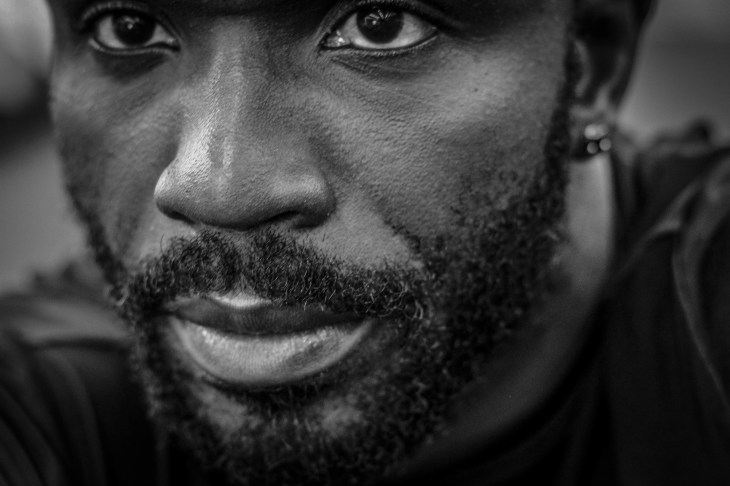
My Other Words to You

by Yamon FigursI didn’t say this on your Facebook wall, but these additional words sit and stand and leap behind what two sentences I did post. What you see is not just for you. What you see is for us. What you see is for you and us to change.

You’ve gone to the islands a couple times that I can think of, and it didn’t occur to me until I saw your photos that your going was about more than your teaching or your preaching or your inestimable ability to capture youth and leaders.

You have always been more than I could wrap my head around. You have always been more than anyone could. You have always been more.

I must admit and repent that I’ve not cultivated the vision to see you as you are. You know that history is full of times when we’ve had to knock each other back. That is the fundamental agreement we made some day over you cutting my hair or in the basement eating French silk pies. We agreed to be honest and truthful. We agreed we’d notice each other and tell each other what we saw.

The trick in keeping that agreement is in the constant cultivation of vision. And it wasn’t until I saw you seeing that landfill that the spirit—and we may blame a spirit—whispered to me that I wasn’t seeing. I wasn’t seeing you and why you were there in the Philippines.

I knew you were going. I celebrated and prayed when I saw you heading there. I did so the way I always do when I see you doing the doggone thing. You’re doing what you always have. You’re doing what you’re here to do. And with your persistence with your life call comes my sneaky ability to take vision for granted.

I assume you’ll do the thing. I assume you’ll achieve, not greatness, but dogged consistency in following Jesus. I assume you’ll be you. I assume too much.

In my assumptions I didn’t look closely. In my assumptions I stopped noticing what was, perhaps, just beyond both our gazes. Of course, you may know this. In which case, you can accept my words as a reminder. What you see is for you but it’s also for us. What you see is for you and us to do something about.

You haven’t been brought to that place—and I have in mind the Philippines and other places too—to stop at seeing. You have always been a moving man. You get to my nerves, you move so much. You get to me because you expect so much damned movement. But that is a quality that is necessary with what you saw.

Be moved by what you see. And then move us. Do it by grace. Do it in faith. Do it after and while being convinced that changing vision is never your job alone. It never really is your job. Change your vision and ours by changing what’s before us.

I love you whether you listen to me or not, and you know I hate to be ignored.

Prayers of the People

When one person is shot in an urban area, it’s horrific. I can only imagine–and I don’t want to imagine this–what it’s like to be part of the emergency response to dozens being shot.

The dead. Their bullet-speckled bodies. The trails of their dreams littered the packed corners of a club. The families forever impacted and immediately spun into the dizzying unbelievable grief of this type of death. The injured, still alive and, in a way, immeasurably lifeless. Emergency personnel and medical providers who “are professional” and who are also almost immediately depersonalized in the process. The offender permanently affixed in our minds for the last of his sins.

There is a whole lot wrong with the world as seen in this latest tragedy. I heard the snip of the story out of Orlando this morning and didn’t really see anything until this afternoon. And today is Sunday. Today is the Lord’s day in Christian parlance. It’s the primary day we gather to worship, to reflect, to listen, and to pray. Though all those things are parts of a Christian’s daily life, Sunday is the day we do those things together, side by side, hearing and being heard by our relatives in the faith. Sunday is the day that we, together, rehearse the promise that, though things like this happen now, they will not always be.

I’m sitting here, heading to a church function, thinking about my prayers in the church service, thinking about what I said and what I didn’t say. I’m thinking about how this was precisely the reason I stopped watching the news late into every Saturday night. It was a part of my religious practice actually, watching and listening so that I could give words to what I’d say on Sunday mornings when I led any parts of worship. I stopped because I didn’t want all these images informing my prayers. Even while the news was exactly what needed to frame the language of my prayers.

It’s bruising to pray well. It’s hard to pray honestly. It’s hard because you have to pray about the bald-faced evil that terrorizes people for no good reason. It’s one thing to pray for the long-stretched out problems that will really take God to change. It’s another thing to pray for things that God has left for us to do.

When I was in seminary, I learned a particular way to pray. We’d gather in the Chapel of the Unnamed Faithful and offer prayers of the people. In the church of my upbringing, we had altar call and altar prayer and extemporaneous prayer. But we didn’t have this explicitly framed prayers of the people. It’s essentially a list of prayers–often written out thoughtfully by the prayer leader before service–that is read and held by all the people in the gathered space. The prayers of the people were both a reminder to God what things we needed and a reminder to us what we needed to be.

I hope that people prayed today. I hope that people who never prayed did. I hope that church people and non-church people said something to God. And I hope that the intense tragedies like these make us into a more prayerful people. I’m sure nothing bad can come from praying. I’m sure change and grace can result in fact. I hope you’re praying. I hope you say something to God about what you see today and what we all saw, again, with this latest unmentionable terror.


Living Windows

WNCThis week the leadership of the National Cathedral decided to remove two confederate flags from the stained glass windows in the beautiful building. What remains will be a conversation starter for those who visit the Cathedral with plans for the Chapter (i.e., the leadership at the Cathedral) to determine in the next couple years “how the windows will live in the Cathedral.” The original piece I read is here.

I also read a wonderful article at Christianity Today that reminded me about the long history of Black church burnings in the United States and what it means when our churches burn. That piece is here.

I have very little room to think through these two pieces. I want to, and I will soon, but not right now. What’s in me requires space and patience to come forth. Sometimes good words and interesting experiences do that to me. They make me want to find the best words for the occasion.

But there’s teaching to be done, children challenging my limits, and other words rumbling in my head. For the moment, I’m putting these up here for my future reference. I’m not alone in this, but I have things to say. Even if I can’t put my words into sentences yet.


It Was Fear That I Saw

Photo Thanks to Matthew Wiebe

Photo Thanks to Matthew Wiebe

I’ve seen the look in too many people’s eyes. And I don’t say that as a pin of honor or badge on my lapel. It was a dreadful thing when I first started seeing fear so regularly. There’s nothing like the naked, bold, and startling fear in the eyes of a person who watched the slow-coming death of someone they love. Love makes us hold tightly. Love, often, is the enemy of surrender. And I thought about it when a woman asked me, in a way, about my own loves.

When I first started in ministry at Sweet Holy Spirit, my role was primarily administrative. Aside from some relatively small amount of pastoral care, I functioned the way an executive pastor functions, looking at costs, praying about meeting budget, managing operations, getting to know a staff, decreasing that staff, trying to compensate the staff based upon the unique and faithful expressions of ministry’s vocations. I brought an attorney on retainer, developed relationships with insurance agents, learned about wage demands from the IRS, and became a master at explaining differences between exempt and non-exempt employees.

Being an executive pastor who was in the seat when the pastor was away was more responsibility than I was ready for. It aged me. It still does in a way. And I remember seeing fear in those days. But it was a different fear. It was a fear of missing marks that were mostly set in the wide generous room of a large church. I had my own fears. But in terms of the real fears of others, I was hardly exposed to much. I was the person who kept at the overarching system so that the good folks in our church could come and hear the words spoken. But I hardly had enough time with those folks, those listeners. They would have taught me differently about different fear.

When I came to New Community, I came, in part, because it was twenty times smaller than my home church by my conservative estimate. I would be able to pastor in a classical way, and that vision is one that I’ve been able to live. I’ve been in homes, around tables, having conversations and not just at the office or even in my study at home. I’ve been able to search the lives of others at their leadership and invitation. I’ve seen more fears in the eyes of our people.

And still, my church is “relatively young” church. I find myself over the years putting up three or four fingers when I tell people how many times I’ve visited hospitals for the people of New Community. It’s relatively young, I tell them. People don’t ask the pastor to come to the hospital when a baby is born, and twenty and thirty-somethings don’t generally get hospitalized and require pastoral visitation. Where I preached twelve funerals a year (as part of a staff of ministers) at SHS, I’ve done almost as many weddings during some of my ten years at New Community.  Fear looks differently in those congregational contexts.

When I started working as a chaplain, I started seeing fear differently. In the medical center, I saw it all the time. I see it all the time. I can see it daily if I choose. Unfortunately, there is always somebody (perhaps a somebody in 900+ beds) negotiating with fear.

The good thing about being a chaplain who is also in the supervisory education process is that you’re always doing action, reflection, action. Always working in that CPE model of learning. In fact, you have to stop yourself from doing it. At home, in the congregation, in conversation with people who know nothing about this model of learning. Stop being shaped the education and be. Still, it relates to how you see yourself.

You become a process person, loosening your grip on content and becoming more interested in what’s happening, what’s taking place, what process we’re in, rather than the superficial and low-hanging surface of what’s merely explicit. Process is hardly ever explicit. And fear is the same. You have to see it even though it’s facing you.

That’s why relationships falter because it takes a therapist or a spiritual director or a guide who’s outside the dyad to say, “Hey, what’s happening here?” or “This is what I’m seeing.” or “If you keep in this direction, where are you headed?” These aren’t content statements but process ones.

You begin to see your own fears. You make friends with some of them. You give grace to them, gifting them with new understanding because the words behind and under those fears are understandable. They are real just like the fear.

Significant, Lasting Change

Photo Thanks to Leeroy

Photo Thanks to Leeroy

What is contemplation? Simply put, contemplation is entering a deeper silence and letting go of our habitual thoughts, sensations, and feelings. You may know contemplation by another name. Many religions use the word meditation. Christians often use the word prayer. But for many in the West, prayer has come to mean something functional, something you do to achieve a desired effect, which puts you back in charge. Prayers of petition aren’t all bad, but they don’t really lead to a new state of being or consciousness. The same old consciousness is self-centered: How can I get God to do what I want God to do? This kind of prayer allows you to remain an untransformed, egocentric person who is just trying to manipulate God.

That’s one reason why religion is in such desperate straits today: it isn’t really transforming people. It’s merely giving people some pious and religious ways to again be in charge and in control. It’s still the same small self or what Merton called the false self. Mature, authentic spirituality calls us into experiences and teachings that open us to an actual transformation of consciousness (Romans 12:2). I think some form of contemplative practice is necessary to be able to detach from your own agenda, your own anger, your own ego, and your own fear. We need some practice that touches our unconscious conditioning where all our wounds and defense mechanisms lie. That’s the only way we can be changed at any significant or lasting level.
From Fr. Richard Rohr’s newsletter

Opening to Depth

by Leeroy7

Photo Thanks to Leeroy

Evelyn Underhill, when talking about the Lord’s Prayer, said that we prefer to live upon the surface and ignore the deeps. I was reminded of the deeps when I was sitting near the new boy the other night. Dawn was asleep for the evening time frame, and I was not.

Bryce was sleep too. Me and Brooks were together. We were negotiating. He was sleepy and resistant to sleep’s power. I was trying, siding with sleep, lulling him like the last couple weeks.

I told him that he was tired. I told him that I wasn’t going to hold him all the time, every evening, until he went to sleep and while he stayed sleep, and on and on. These are words that just come out and though I was sincere, I felt like I was talking to myself.

Still, we made progress. He was not on my lap or in my arms. He was next to me, on his side, held against the couch, sidelined the way he likes to rest after he’s eaten. He was looking at me. I saw depth in his gaze.

Certainly it was the depth that I brought to the moment. It was the kind of deep moment that sleep deprivation and wonder at humanity-still-new gives a parent. It was slightly humorous, this depth. Normal people don’t experience this particular depth.

It’s like Underhill’s comment. When we’re normal, we stay on the surface. The experience, the unsettling experience, of being deprived makes you abnormal. Abnormality opens you to depth.

To be clear, I am not as sleep-deprived as I could be. And though my friends would say differently, I’m not as abnormal as I could be. But I’m opening slowly. I’m trying to attend to the deeps. I’m trying to be open to what’s there.

Quote of the Day

Photo Thanks to Jon Tyson

Photo Thanks to Jon Tyson

I’m posting quotes as we go through the fuzzy zone of being new parents again in these next days. This quote comes from Jaco Hamman (Becoming a Pastor, 71):

Ministry, like any other truly human activity, emerges from your inwardness, for better or worse. As you lead and pray, you project the condition of your inner space and those around you. Ministry opens the window to your soul.

Quote of the Day

Photo Thanks to Talia Cohen

Photo Thanks to Talia Cohen

I’m posting quotes as we go through the fuzzy zone of being new parents again in these next days. This quote comes from Carrie Doehring (The Practice of Pastoral Care: A Postmodern Approach, 111):

People become most aware of their values when they reach turning points in their lives and must make choices or when they are thrust into decision making because of a crisis. Prior to such moments, they may not have thought much about the values that orient them to the meaning and purpose of their lives. At its simplest, theology is a way to talk about people’s deepest values.

Quote of the Day

Photo Thanks to Caleb Morris

Photo Thanks to Caleb Morris

I’m posting quotes as we go through the fuzzy zone of being new parents again in these next days. This quote comes from Howard Thurman (Disciplines of the Spirit, 113):

When a man is despised and hated by other men and all around are the instruments of violence working in behalf of such attitudes, then he may find himself resorting to hatred as a means of salvaging a sense of self, however fragmented. Under such circumstances, hate becomes a man’s way of saying that he is present. Despite the will to his nonexistence on the part of his environment or persons in it, he affirms himself by affirming the nonexistence of those who so regard him. In the end the human spirit cannot tolerate this.

Quote of the Day

Photo Thanks to Milada Vigerova

Photo Thanks to Milada Vigerova

I’m posting quotes as we go through the fuzzy zone of being new parents again in these next days. This quote comes from Timothy Jones (Workday Prayers, 39):

Sometimes our words get in the way of what we want to express and do. We may pile them on even after they cease being truly wise or thought out. In these times, silence is usually more helpful to others than our words. “In quietness and in confidence shall be your strength,” the prophet said (Isaiah 30:15). On the job today, in what may be a wordy, noisy world, consider ways to nurture a silence that gives others room to speak, that gives God room to move.

Quote of the Day

Photo Thanks to Charlie Foster

Photo Thanks to Charlie Foster

I’m posting quotes as we go through the fuzzy zone of being new parents again in these next days. This quote comes from Peter Steinke (A Door Set Open, 12-13):

…nonplaces and superabundance.  Non-places are spaces designed for anonymity, passing through, and nonengagement…Disappearing are places intended for relationships, such as churches and civic groups. Few places remain where people can find community, meaning, and hope. The other feature of supermodernity is superabundance. An excess of events begs for our attention, but who has time to reflect on each one? To discern the meaning of an event is impossible when, the very next day, new events sweep over us. When excess combines with acceleration, no time is available for deliberating and musing. Everything becomes impermanent, fleeting, and remains unexamined.


Quote of the Day

Photo Thanks to Kirsty TG

Photo Thanks to Kirsty TG

I’m posting quotes as we go through the fuzzy zone of being new parents again in these next days. This quote comes from Parker Palmer (Let Your Life Speak, 48):

One sign that I am violating my own nature in the name of nobility is a condition called burnout. Though usually regarded as the result of trying to give too much, burnout in my experience results from trying to give what I do not possess—the ultimate in giving too little! Burnout is a state of emptiness, to be sure, but it does not result from giving all I have: it merely reveals the nothingness from which I was trying to give in the first place…When the gift I give to the other is integral to my own nature, when it comes from a place of organic reality within me, it will renew itself—and me—even as I give it away.