Love Your Mother

I tell you in a dozen ways a week to love your mother.  It’s a most salient measure for how you’ll love many people.  As an observer, it enlivens me when I see you running to her, grabbing her, talking to her, seeking her out.  Not always to be sure because sometimes you can be motivated by obvious errors.  But mostly watching your love for her unfold is a treat.

Dawn and Bryce outside the King Home

Dawn and Bryce outside the King Home

Your mother will love you for as long as she possibly can, another way of saying all her days.  And even when those days close to another less manageable time, her love will extend beyond time.  She’ll keep your treasures whether she tells you or not.  She’ll have little creations from your hands and from those of others that are about you, and she’ll pull them out at night and remember.  Your mother will protest every injustice against you and be a fierce advocate always.  She will overlook your faults until they even become her own.  She will love, and we will all become her students, learning as she does.

Bryce with Grannie and Grandma in 2011

Bryce with Grannie and Grandma in 2011

Remembering

I sat with my mother, and looking and listening to her was like hearing a favorite splendid song.  Her smile, in her eyes and her mouth, was an invitation to laugh as she told me stories from when I was my son’s age, when I said things I heard from Ms. Goodlett, our one-time babysitter.  She mirrored the expressions in my face, the same ones I chuckle at with the boy these days, the ones I tell Bryce that I gave him.  Mama told me stories like they happened just yesterday morning, like she had been remembering them so she could tell them to me, remembering them again for me.

Reaching Light Switches

The other day my son walked into the bathroom, pressed the first light switch, which is next to the fan switch, and used the toilet.  It took me back a second because when I saw him do it, I couldn’t quite believe it.  Before then—or before whatever moment he had started turning on the light by simply lifting his hand—he had always stepped on his stool, the one which blocks a side of the sink cabinet, and pressed both buttons under the dry towel, to turn on the fan and the light.  Until some moment in the last few days, the last couple weeks maybe, he was too short to reach the switch.

Until We Can’t Feel Them Anymore

I read these strategies over at the Crunk Feminist Collective, and while they’re especially written for Black women, I think all women and all men who love women and want to love women well should ingest them.  We need to know how to live, how to address the stressors in our lives, how to stop pushing away our “needs and desires down until we can’t feel them anymore.”

I think mothers, fathers, and friends of mothers and fathers need to be aware these strategies for staying alive.  I think of this list, and lists like them, as little love points for the people I care about.  I think these are some of the ways we ought to push each other live and thrive and flourish.

Read the full post here.  Because there’s a steeped personal introduction to the tips, a poem you really need to sip, a lot words I’ve left, and a few other things that are worth seeing over in the Collective.

  1. Take some time to/for yourself and be unapologetic about it.  At least one hour a day should be yours.
  2. Say no!  Be impolite.  Say no (without an explanation/reason).
  3. Reject negativity.  …we don’t have to take on other people’s baggage.
  4. Pay attention to your body.  When your body speaks, listen!  And do something about it.
  5. Have a bi-annual or annual check-up.  While sometimes our family histories can be mysteries, it is important to know what hereditary diseases or ailments you may be at risk for.
  6. Do a regular inventory and purge anything toxic in your life.  This includes people, relationships, thoughts, habits, and hobbies.
  7. Let people go.  If someone fails to treat you like the queen you are…on to the next one.
  8. Don’t be a people pleaser.  Living your life for yourself and not for other people makes a world of difference.
  9. Have a confidante.  We should all have someone in our life we don’t have to “put on” for.
  10. Celebrate yourself and your accomplishments even if/when you have to do it (by/for) yourself.  Don’t miss an opportunity to acknowledge all of what/who you are and where you come from.
  11. Take care of yourself mentally, physically and spiritually.  Figure out how best to take care of yourself.
  12. Kick it, regularly, with your homegirls.  This can be magic.
  13. Let people do things for you.  When someone offers to do something for you, let them!

If I didn’t suggest this already, read the full post here.

Milestones That Matter Most

It’s not surprising that well-intentioned parents cultivate cognitive intelligence and individual achievements as assiduously as we do. These are, after all, such important markers of success in modern-day America. But our focus on outcomes is leading us to look at milestones all wrong — as a series of boxes and achievements to check off a list on our way to a goal. We focus on our kids’ ability to read when they are at an age when we should be focusing on their kindness and character. We worry about overburdening them with chores because they have to do their homework, when we should be cultivating self-help skills that will make them self-reliant, and sending them a clear, unambiguous message: yes, academic achievement is important, but becoming kind and responsible is, too. These are all milestones we don’t want to miss.

See Christine Gross-Loh’s full piece here.

Pictures Of Our Lives

While Dawn trades the same from time to time, if you take a picture of me at night, between 10 and 11pm, it’ll look like me going into my son’s room, picking him up while he grabs for his blanket in protest, him stretching up or out and cradling into me like I’m a substitute bed, and me carrying him to the bathroom where he’ll “go”.

It’s amazing how many times I’ve done this simple series of quiet movements, under dimmed lights, so as to both not completely disturb the boy from sleep and to keep us from having a wet, sticky mess by morning’s hello.  It’s amazing that movements like these say so much about our little family, and all the families that do something like them.

Parent-Teacher Conference

We went to Bryce’s parent-teacher conference the other day.  After I got over the fact that daycare centers require such things, I felt my chest swelling as his teacher said how well he was doing, how he, as their oldest child, was helping and getting special jobs and relishing them in his own way.  She asked what our concerns were, took notes as we (Dawn really) said what she wanted to them to focus on.  It was brief.  I almost wondered why we had set up the meeting in the first place.  It was short and short things get short-changed in my mind.  It took reflection time for me to appreciate that short meetings can be meaningful, that they can shape the way we approach the long marathon of fatherhood.

After the teacher left, we looked over his binder which captured in pictures and notes and forms his track record over the last year.  I’m not one of those parents—at least not yet—who says, “Time has moved so fast,” because I’ve taken this experiment as slowly as it’s come.  But that book was another reminder of my boy’s growth, of my wife’s growth as a mother, and of my own.  Maybe someone should require Parent-Teacher conferences where us parents are the subjects of discussion.

At Daycare

Reading To You

We had been to the Harold Washington Library before, but you were too young remember.  So when we walked in from the State Street entrance, you looked around and your eyes trained up, especially when we walked into the round atrium that, as a space, feeds the soul.

We went to the children’s library, to get books and to read.  You pointed out the security, the police, like you always do, and the matronly officer who I wanted to call auntie spoke with a smile that you exchanged for one brighter than her own large grin.  You walked around pulling titles, saying “This one” and “That one, daddy.”  We sat on a multi-colored bench, the one like the old benches that you used to be in parks on the south side when I was a boy, before the city built shelters on corners, when churches like our family’s bought advertisements to tell people waiting on 95th or 87th or Halsted to come and worship.

After we read our first book, we went downstairs and thumbed through the four books we checked out because we would really read them later.  You were excellent in quieting down and listening to three authors read excerpts from their fiction, listening and only occasionally murmuring, as if each of them was pulling you next to them, lowering their voices, and, for a few minutes, reading to you.

At HWLC for Story Week

At HWLC for Story Week

Parenting & Violence That’s Not Really Violence

Among the many responses I’m having to my father’s death is a sneaky desire to be less violent.  I’m using the word broadly, but literally, and theologically and ambiguously.  Mostly because I don’t know where the springs of the desire are headed.

This is interesting to me because my father was never violent.  He was a most mild-mannered man.  I have one memory of him raising his voice in anger, one.  And I have a good memory for those kinds of things.  It was a couple months ago; that day he was slipping into frustration, complaining about a soreness that he had mentioned several times before.  He was irritated that I always asked him the same questions like how are you feeling, especially since he felt the same way from one question to the next time I asked it.  Otherwise, he was even, cool, and mild.  Maybe it’s the simple connection I’m making, that I wish to be like him.  It could be.

Perhaps all of life after a significant other’s death is learning how to notice.  I could, simply, be noticing.  For instance, I’ve noticed in my relationship with the boy—a relationship that is everything from surely loving to overwhelmingly unfair—I’ve had a moving emotion to make him do less.  I can’t get away from my imagination which makes persistent the question: what is he thinking about what I’m doing and that I’m making, i.e., forcing, him?  There is a kind of violence to the whole thing.  Somewhere I’m hoping that I’m doing the right thing, telling him when I need to, coming alongside him when he’s going at it on his own when I need to.

To be clear, the answer to that question isn’t ultimately important.  My son is nearly three.  And while he is a smart, even brilliant, boy, he doesn’t have that much happening in the way of complex cognitive processes, if all my psychology professors are to be accepted.  Much of my interactions are about convincing him to my view, will, or path.  I am his father, and he is, well, nearly three.  We’ll get to independent and critical thinking soon enough, if it’s not under the covers of these instructions I’m giving.

But I am aware that he has these desires, that they are different from my own, and that the clash of those emotions can make me more spicy, less mild, and that they will create what we call our “relationship.”  This is where I practice holding things less tightly, even when it comes to actual parenting, which is, in part, a lot of telling a child what to do.

Bonding With Your Child

I saw this post and thought to share the high points; it’s a quick reminder about the mutual benefits of fathers developing bonds with their children.  Here’s a summary with two sentences from the original post:

Get skin-to-skin.  The baby is happiest when connecting skin-to-skin with mama or papa. His temperature, heart, and breathing rates will be more consistent, and his blood sugar more stable.

Play games.  Make silly faces, play peek-a-boo, sing songs, for your baby. Set aside regular time for baby, whether it’s after work or in the morning, appoint a special time that’s just for you and the little one, so as the baby grows, this special bonding time becomes part of the daily routine.

Have glow time.  It’s all about taking personal time to lavish yourself and shine! While mama is taking some alone time to shine and do what she loves, you can have glow time with your baby.

Take charge.  Mama may like things done a certain way and may even school you on how to handle certain tasks when it comes to baby like- how to warm a bottle, change a diaper, comfort your baby, etc. But you will develop your own way of doing these things.

Slay your lists.  Men like to “fix” things and get things done, be productive, etc. When you are able to satisfy her needs and help reduce her stress load by checking off some of her to-do-list she will be thrilled- and when mama is happy everyone is happy.

Keep it movin’.  Whether you’re doing baby bench presses with your infant, baby yoga, or daddy dance party getting your baby to giggle while you’re moving him around is great. Movement also helps increase the baby’s muscle tone, and trains the baby’s proprioceptors- his sense of self in relation to space.

Find a papa posse.  Having a sense of community and knowing that you are not alone is key. Being a new father can be an isolating experience but certainly doesn’t have to be.

Read the full point by going here.

Choosing To Be A Dad

I think a lot about work/life balance these days.  How to balance career and family and how much my level of effort at work balances my level of effort at home.

We just finished a release at work and while the high fives were going around, I left. I walked out of the building at a few minutes after five. I had worked hard these past few months to get the release out the door, I was proud of my effort, but I only wanted to see my daughter.  Walking out of that building, I felt an immense sense of accomplishment and pride in what I had done there.  Walking into my apartment at 5:45 on a Friday and being greeted with “Daddy’s home” I forgot it all.

Why is it so hard to leave work at work?  I know that my family needs me more than my job does.  I know that a few extra minutes at home could mean the difference between being there for and missing a First. And yet there is a struggle.  Is it the immediacy of the problems at work?  Is it the sense of accomplishment or a swelling ego that causes me to work beyond what is required? Is it because my parents taught me how to work hard and I’m just applying life lessons?

I think it’s actually a lot simpler than that, for me at least.  The reality of the situation is that I’m good at my job and doing well makes me happy.  When I’m at home, I’m not as good.  I’m more necessary but less effective. I’m more likely to get pooped on than to save the day with a solution.  I’m more likely to miss a cue for hunger than see through the noise for that one necessary thing.  Being home is harder than being at work and I think that I, as a dad, need to admit that to myself and to my wife.

The hallmark of my next step of maturation will be to be present in situations that are difficult and to go there, even when more comfort lies elsewhere.  It’s not about work/life balance.  It’s about choosing to be a dad with a job instead of an employee with two roommates.

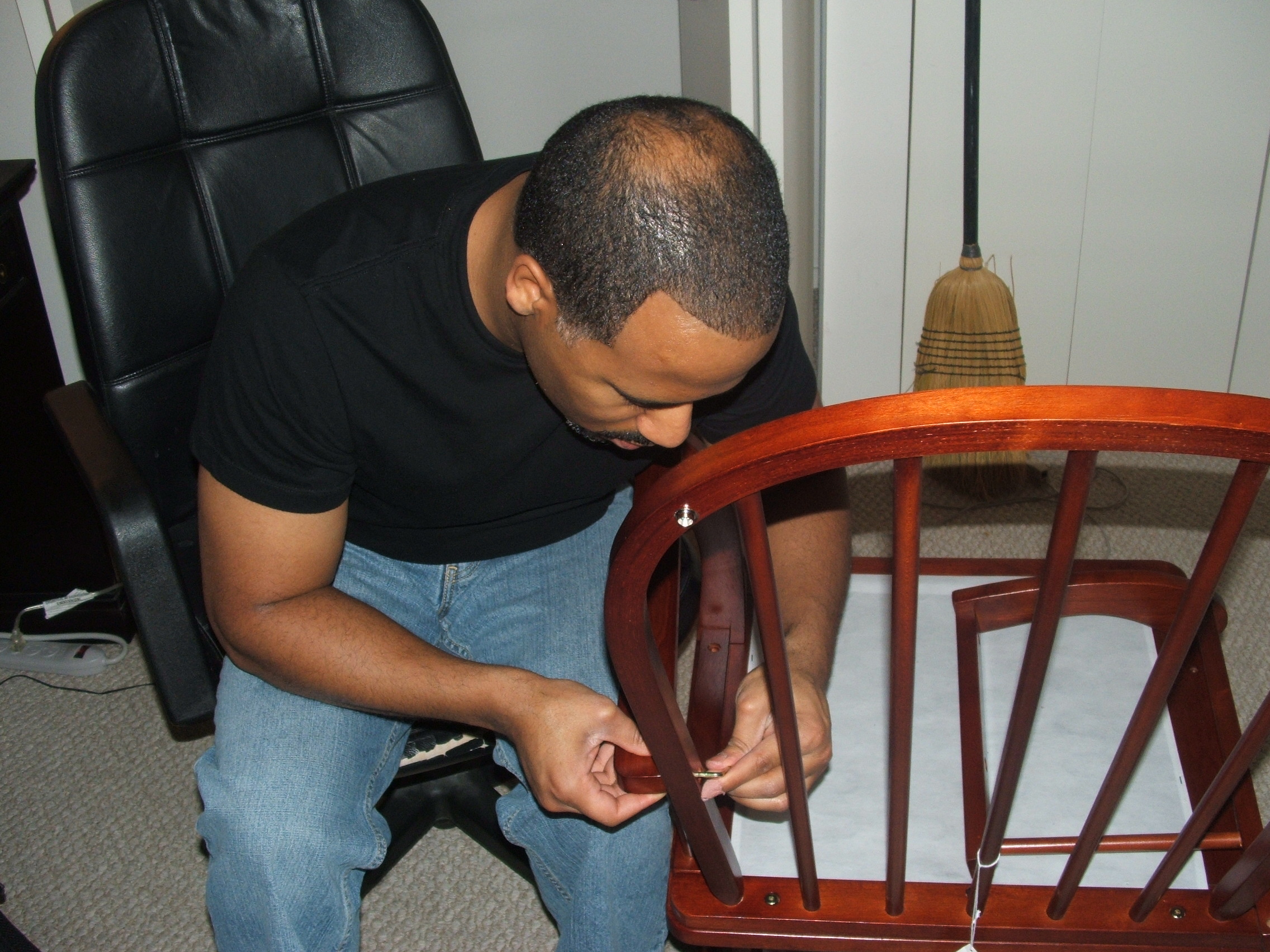
Assembly Required

Bryce is good at getting gifts.  And people are good at being generous to him.  Often the generosity of others means things for my time.

For instance, when Bryce was given a mini car—the kind he would see at the playlot and never release for others to play with—I had to put it together.  Of course, Dawn hadn’t explained that that was my responsibility until Christmas Eve night, before I was set to preach at church the following morning.  I wouldn’t have given my mechanic that thing, it was so complicated.

Here are a few things I don’t quite like when assembly is required.

  1. The box is so deceptive.  It’s shiny and colorful.  The picture of the thing is inspiring.  It touches the imagination of the boy so that he goes on and on about the car or the big wheel in the recent example.  But the picture never tells the story, does it?
  2. There are so many pieces.  Looking at the box, you’d think the thing could be put together without so much drama.  There I am, holding the instructions, opening small plastic bags, and trying to keep my son from walking through three piles of variously sized implements.  Slowly I begin to appreciate inventors and builders and craftspeople.  After I use other words under my breath.
  3. I always have to read the directions.  I’m a reader.  I’m happy about that.  But I secretly want to be one of those men who open up a box of boards, screws, and tiny pins and who make something by looking at the picture only.  I never claimed to be one of those guys.  I’ve only envied them.  And secretly hated them too.  While I like reading, it’s a different experience reading something that explains something else, when it takes you reading it fourteen times to grasp the point.
  4. I hate sweating.  Putting things together makes me sweat.  It requires a kind of concentration that I’m not used to.  I am fine with paying attention.  I’m good at listening and am even all right with taking cues, but putting pieces together is a large, monstrous task to me.  It makes my armpits stream, my forehead shine.  It makes my butt hurt for sitting in the same spot for longer than I really should.  I get up and have to change my clothes, like I’ve surfaced from a workout.
  5. The noise is unhelpful.  There’s pounding.  There’s language I wouldn’t generally use in public.  My son is walking around in circles singing about a new this or that.  I imagine my neighbors, trying to be nice because they know I’m hard at something for the boy.  But they tire of the hammering.  They’re exhausted because I’m racking at the kitchen island since it substitutes for the flat surface of the wood wedge I don’t have.
  6. It always takes more time than less.  This is probably the most pressing concern.  Reading those instructions, following the rolling screws and picking the right screwdriver; these things take time.  More time than skill.  And those are moments you don’t get back.  They are moments that add up into the invisible math of being a good parent, or trying to be.  You add pliers.  You insert a snap or a click.  And you don’t know what you’ll get.  All of a sudden putting together a chair two weeks before your son is born becomes an act of faith.
  7. There’s too much room for wrong.  Nothing tells you early that you’ve put something together wrong.  It’s not until the picture unfolds, right?  Then you know you’re stupid, that you’re illiterate, that you’re unlike your big brother, or that you should have called Karlos Dodson before you got started.
  8. I really feel like I should get it done.  I’m not one of those guys who cannot admit defeat.  I gladly do and will.  But when I know I’m on the way to finishing up, I can see it.  I see the end.  I see the thing shaping up.  Of course, there are a dozen setbacks, but the abiding feeling is some version of guilt.  That cracked voice that says you really should feel good about doing this because it’s for the kid.
  9. People aren’t good at encouragement.  Dawn is great at coming in when I’m three quarters finished and asking if I need help.  Bryce is great at walking around picking up little screws and asking if his big wheel is ready.  He’ll look at the box and say, “Where’s the car?”  I have to quiet them.  Usually with my eyes and the slight shake of my head.  They know I’m in my zone, the space that is uncomfortable; they know I’m resisting badness.  Thankfully, they leave.
  10. The thing I’m putting together isn’t for me.  This gets at one of the hearts of the matter for me.  It feels like the thing will belong to my son, that I’ll get no pleasure or benefit from all the hacking, screwing, and sweating.  Assembling a thing is an act of generosity.  It’s inherently gracious because it involves me making a gift available to my son for his pleasure and play.  But that can be transformational.  It can change me into a different man, a man who learns to receive pleasure in someone else’s.