Listen. Obey.

As your mother told you–and as I’ve said to you before–when we put you into the hands of someone else, that’s the person we trust.  So that’s the person you listen to.

Be it your teachers or other relatives, if you don’t listen to the people we give you to, you’re also not listening to us.  And for now, you have to listen to us.  You don’t get to not listen.  And not just because we’re bigger than you.  We actually know more than you.

We know that when you do your own thing, that thing is still so underdeveloped that it makes no sense in the world.  One day that will change.  One day you have more choices than you do time.  One day you’ll pick the menu and the shoes and the time we leave and return.  But you don’t drive.  You don’t know the city’s grid.  You don’t understand the nuances of roasting a chicken, even if you’re a good sous chef.

So, hear me, hear your mother.  And we’ll let you stay with us.  If you don’t listen, you’re only a quick walk from the Swansons, a short drive from either of our mothers, the full house with your cousins and my brother, a spot next to Champ’s cage at your other uncle’s, or slightly longer commutes to your aunts.  I’m sure even Grammie will take you if we call her and say you’re on a flight.  But I’m also certain those lovely people will have similar expectations.  And they–though they may fight me on the point–will not love you nearly as much as me and your mother.

Intimate Partners, Violence, and Other Related Things

There is a misconception that abuse is limited to physicality (or heterosexual relationships) but it’s not.  I believe emotional, psychic and psychological abuse is also unacceptable and just as damaging.

There is so much worth rehearsing in our heads, pushing into our ways of being, and practicing in our relationships in those words and in the post below.  I’ve been encountering more conversations about intimate partner violence, relational abuse, domestic violence, whichever brand you’re familiar with.  And among the many things I question and consider, I come back to how I’ll raise my son to live in the world.

But I’m a pastor and a teacher, and I always (and almost immediately) question what I’m saying and showing and putting forward for the people who are a part of my spheres of ministry and influence.  I hope the men especially that I know are doing the same things as they listen to the news, watch television, and engage in barbershop talk.

The sinister evil of abuse is in its pervading, serpent-like ability to creep and dance and stand in culture as if it belongs, as if the world is as it should be when people harm one another.  Of course, it is a part of my faith structure, my theology, my talk about God-in-relation-to-God’s-stuff to say that the world is not exactly the way it should be and that such violence is only a grand, bold, and startling show of how bad the world is in these instances.

Relational violence is a narrow version of violence, and violence in its broadest sense is wrong and misdirected and worth our being troubled over and changed by.  But this type of violence, this violence that happens between people who supposedly love each other, people who are related to each other, is so destructive.

I tell couples in my church who are preparing for marriage that marriage is so potentially and actually effective, for good or bad, because marriage is one of those mystical vehicles that God uses to initiate, enrich, or nurture grace in our lives.  Of course, I can say about other vehicles and not marriage alone, but my point is to say that the impact of marriage is in its strong placement in our lives.  We do marriage daily, and when we give ourselves to certain practices daily, those practices–loving practices, misshapen practices, and so forth–eventually because the ways we get whatever we perceive God has for us.

Further, or in other words, marriage specifically and loving relationships more broadly construct how we understand, accept, and exhibit love.  Those relationships influence and shape us.  So when those relationships are inherently and historically violent, we attach all types of meanings to that violence in the context of a relationship, right?

We think that relationships are supposed to be violent and that when violence isn’t present, the relationship is off.  We believe worse things, too, like our prospects for better love or different love are low.  We set ourselves into a theological or psychological framework to judge our love and our promise-keeping by our settling with abuse.  We believe our faith demands that loyalty and commitment be expressed through the daily submission of our whole selves to the foolish presentation of hatred through words and gestures and the lack of good words and good gestures.

I’m grateful for all the good teachers and tutors who help me walk through the conversations (hushed though they may be) happening in the media these days.  This post–and perhaps all the posts over at the Crunk Feminist Collective–needs to make its rounds.  Read the full post here.  And share it.

Places to Find Strength

To add more of an answer to your question, when you take off your red and blue power rings, you’ll still be strong.  Your strength doesn’t come from plastic pieces melded together in unseen factories.  Your strength has traveled a much longer distance to reach you.

Your strength comes from more people than you’ll meet because you were loved before you were conceived, loved by church people of all colors, loved by relatives around the world, loved by people who passed into eternity before they talked to you, loved by gift-givers who we thanked but whose generosity has rolled into the long sustained gift that is your life.

Your strength comes from your aunts and uncles who will give and have given their energies for you and for your cousins and who have been good parents, even to you, and who have been counselors and aides and supports and anchors for you already.  Use up the time they spend with you and relish their spoiling, open, broad care.

Your strength comes from your mother who has thrived and triumphed through and after hardships, injustice, great and difficult choices to become the splendid champion she is.  Ask her about them and close your lips to listen.

Your strength comes from your grandparents; one you don’t remember, except through our pictures and our stories; one you bring up from time to time, when you ask about sickness and death and heaven; and two you know and love and hug and see.  All of them have more to teach you than you can learn.  Find every way to be their student.

Your strength comes from great-grandparents who made music, who produced crops, who wandered over more acres than you’ll ever count, who gave hard, who had many children and watched them live and bear their own children and, some of them, die.  They wanted a beautiful future for you even though they couldn’t touch you and every act of submission and toil and business and production had seeds of grace for you in it.

Your strength comes from great-great-grandparents who sang spirituals in fields they didn’t own and worked day-long lives that collected into decades of labor that bore no capital or income or appreciation because their world was decorated in corruption of the deepest kind.  But there was so much more to them than their taken wages and taken days.  They, too, saw far into the dark ahead of their futures and they saw you and they worked and suffered and enjoyed and ate and slept and tried so that you would have all those abilities within you too.


Name the Reality

One casualty of that frantic schedule has been the Christian practice of prayer before meals, a practice often referred to, appropriately, as “giving thanks” or “saying grace.”  Christian parents honor the vows they make at their children’s baptisms to nurture their children in Christian faith in a variety of ways.  Some try to teach their children, with at best mixed results, how they should understand themselves and their world.  But whether they recognize it or not, all parents teach their children by how they themselves live.  Surely one of the most important things Christians do is teach their children to name the reality of God’s grace in their daily lives and to express gratitude for that grace and for their life before God by praying before meals.  It is one thing for a child to grow up in a Christian home and church in which the language of Christian faith may occasionally be heard.  It is something else altogether for a child to hear and learn how to speak not just about Christian faith, but the language of faith, the language of God’s grace in reference to the realities and events of their daily lives.

From George Stroup’s Before God (pgs. 160-161), a solid book that’s hardly about parenting and very much about parenting

Reasons To Obey Your Teachers

  1. Your teachers know more than you, despite your persistent belief to the contrary.
  2. We trust them.
  3. They are in your life to teach you, not to deal with your strong affinity to, only, play.
  4. You want to be as nice to them as possible since they report the happenings of your day to us.
  5. They make your toys sound cool even though they may not be.
  6. They are qualified to direct a part of your life just like your mother and me.
  7. You will need to know those numbers well to count off the money I expect you to return for the investment that is your daily existence.
  8. They teach you to share and listen and take your time.
  9. Teachers will take you on fun trips and give you great jobs to do.
  10. They are essentially stand-ins for me and your mother.
  11. Disobeying them gets you put out on the street, and you can’t come to my job during the day.
  12. These teachers actually care about you, and you should enjoy and relish that experience because not all of them will care.
  13. Spontaneous treats.
  14. They are the ones who’ll be most responsible for you becoming something.
  15. We tell you to obey them.
  16. You don’t want me to try to explain slanted lines and how to write an eight.
  17. Nobody else is there to help you when you have an accident.
  18. Your teachers earned your respect before you showed up.
  19. Your whole family expects you to do well in school because you have nothing else to do with your life right now.
  20. They keep careful notes about your progress, communicate to us regularly, avail themselves for conferences, and give you practice sheets to better than writing of yours.
  21. Neither of us wants me to keep my word about what happens if you disobey.  But, as you know, I will.

Three Things in Two Weeks

I’ve noticed these three things over the last two weeks with the boy’s transition from daycare to preschool:

  1. It wasn’t as bad as it could’ve been.  It wasn’t as bad as we thought it’d be.  Bryce certainly cried that first day.  When we returned to pick him up, the principal and office manager greeted us loudly, saying how glad Bryce would be to see us.  The office manager was asking the principal, “Who’s their child?  Not Bryce.”  I told Dawn that the boy already had a reputation.  Even then, when we went to the classroom, Bryce was playing with the science teacher’s toys, sufficiently entertained, and hardly ready to go.
  2. The rhythm structures life.  Just like when Bryce was in daycare, school has a way of giving us all structure.  There are expectations for him and for us.  Dawn makes his lunch each night.  I feed him breakfast daily.  He has to be at school by a certain time, and unlike before when he accompanied his mother to work for his work, I now take him to school in the morning.  This means, regardless of my body’s favorite rhythm, I am up and out consistently, even if I’m largely unconscious.
  3. Bryce really likes the uniform.  Dawn says his style follows my own.  I don’t know about that.  He’s particular, the boy.  He even told Dawn one day when they were playing, while he was still wearing his school pants and shirt, “You’re going to wrinkle me.”  We nearly fell out.  We don’t have to argue about removing his clothes before he plays after we come home.  Plus, he looks really good in a blazer.

Parents in a Student’s Life

A couple years ago, I asked Sonia Wang, a teacher and friend to write about the importance of parental involvement.  I’m sure you’ll enjoy her post again for its continued relevance.

Advocacy. This word is often seen as a job of someone else. But I think we forget that advocacy is merely being “in the know” so that we can speak up and respond appropriately as needed. One thing that our students, especially in urban environments, are lacking is having an ample group of advocates.

Where does this absence of advocates stem from? Often it starts with the students’ parents. It is argued that students spend the majority of their day in school, however, the more important truth is that students need consistency in their lives.

Consistency must be obtained in two ways—from home to school and from school to home. When a student is told in school that they need to read at least 30 minutes at home, but they are expected to cook dinner, watch their younger siblings, and then manage their work without a space to do work, there is a mixed message sent to the student. At the same time, when students are told at home that helping out with the family day care program holds priority in their lives and that message is overturned at school, students are flooded with mixed messages.

How do we as adults integrate into the lives of our students to best support them? As a classroom teacher, I strongly believe that there are two main sources for support—parents and mentors, which include teachers.

The role of parents in a student’s life is invaluable. A teacher can only impart so much when it comes to skills, content, and values, but if that is not reinforced by what happens at home, it becomes obsolete to the child. From my years of teaching, I cannot count how many times a student has referred to their parent’s indifference or absence in their academic achievement as a reason for their own indifference or absence of care for their academic progress or goals. The attitude and tone a parent holds for their child sets the baseline for the child’s personal expectations and hopes.

When a student knows that his/her parent knows what’s going on in their lives, especially in their school life, it not only sets a new tone to the importance of this thing known as “school” but it also redefines the student’s approach to school. Suddenly their work in school matters because what they do in class matters to people who matter to them. Reading a chapter and jotting personal thoughts on what was read isn’t just homework but it is an opportunity to show the parent what’s happening in class, what is being learned, and what thinking is happening.

Furthermore, let’s consider an example situation:

If a student is reading a novel that is perceived to be at a lower level than the student’s ability, his/her parent is now able to advocate for their student. This can lead to multiple outcomes:

1.)If the book is in fact easy, the teacher is now held accountable to meet the learning needs of the student in order for the student to GROW!! and

2.) If the book is actually at the student’s reading level because he/she is struggling, then there can be an honest conversation about where the student is at in their reading progress, what supports are in place in the classroom to monitor and assure growth, and what strategies can be implemented at home to support the student’s growth.

Regardless of what the outcome might be, the more important fact here is that the student has multiple advocates in his/her life; no longer is their education a passive one but one that is active and purposeful.

Parents must be involved in their student’s educational journey. Involvement does not mean teaching algebra in fourth grade or having the student comprehend Beowulf in middle school. I would actually discourage this type of involvement.

Instead, knowing your child’s syllabus, asking what he/she is learning, and checking in about their academic strengths and weaknesses are ways to be involved in his/her life. By doing so, our young people know they have advocates, people who will not allow them to be invisible in our current education system where too often our students are reduced to an ID number or a test score.

With advocates, our young people begin to see the importance of knowledge and voice. And in turn, they become our community’s most effective advocates.  
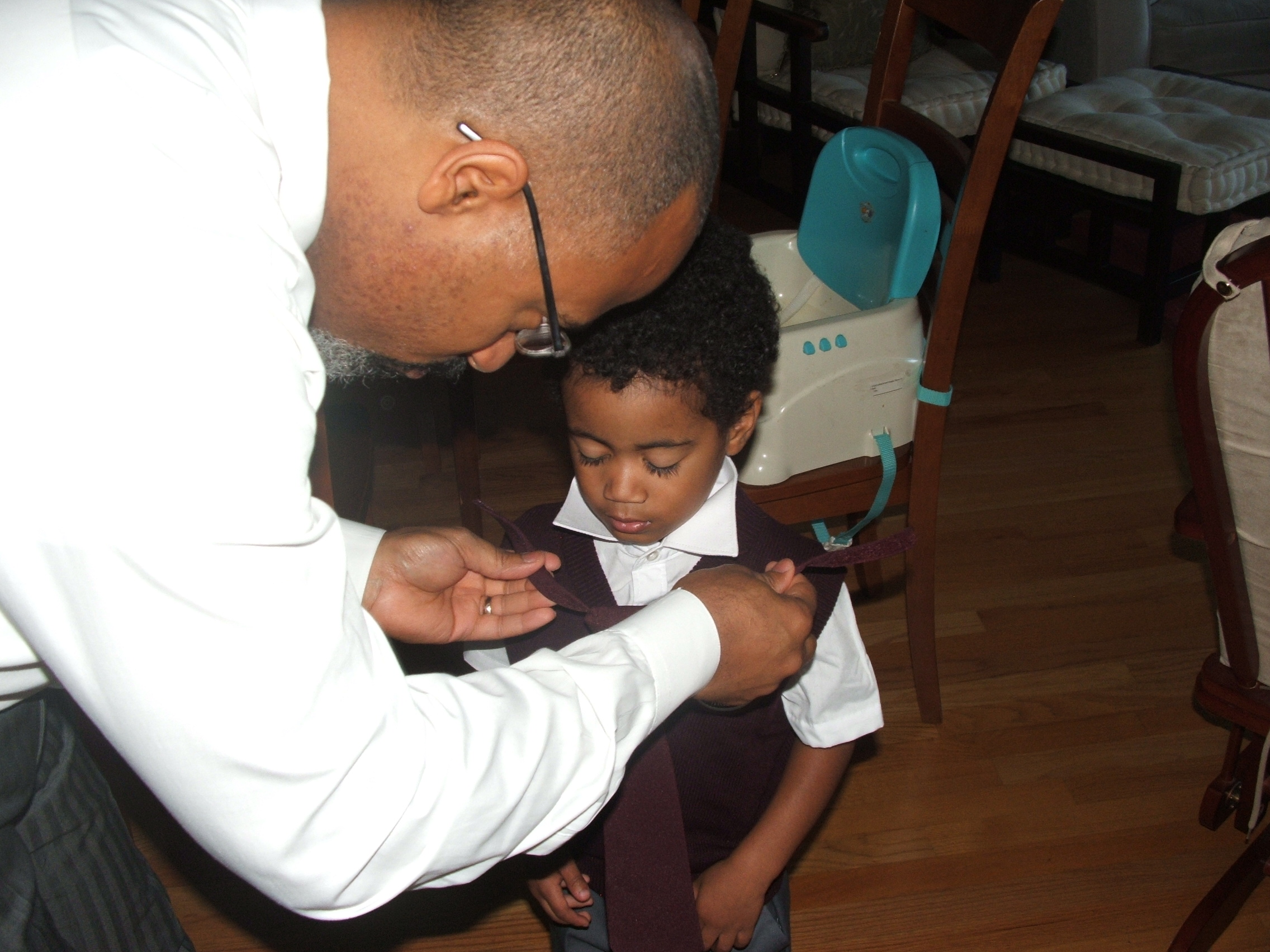
His First Tie

While it was not my idea to capture this with a camera, my wife’s pictures come in handy for this blog.  These are more than a week behind the actual taking of the photos, but it is helpful for those of you who still have that first tie to tie or cinch or clip or press in case there’s a nifty slice of velcro like there is with my boy’s necktie.

Lifting the collar, lining up the bulging knot, attaching the velcro lines

Lifting the collar, lining up the bulging knot, attaching the velcro lines

Pulling the tie down the middle, over the stomach, and lining it up behind the vest

Pulling the tie down the middle, over the stomach, and lining it up behind the vest

One classy kid

One classy kid

25 Things I’m Telling My Son As Often As Possible

  1. I love you.
  2. Listen first.
  3. You are brilliant.
  4. You can be a gift to everyone you meet today.
  5. Obey me.  And your mother.
  6. Play your guitar and sing and dance and spin around in the floor.
  7. Don’t hurt your friends.
  8. Clean up behind yourself.
  9. This is our house, and we let you live here, for now.
  10. Your smile melts me.  Usually.
  11. Mommy loves you more than she could ever communicate through all those hugs and kisses.
  12. You come from a long, beautiful history, so ask me about it any day.
  13. Thank you for playing quietly when you woke up so early.
  14. Tell me what you’re thinking.
  15. Pray for me.
  16. There are immeasurably wonderful people in the world, but there are people worth leaving.
  17. Bend or stretch to smell every flower you walk by.
  18. You’ll get to drive one day, so keep pretending for as long as possible.
  19. Take your fingers out of your mouth.
  20. Never disrespect an older person even if it makes you change.
  21. Chew your food before you swallow it.
  22. I’m sorry.
  23. I need those hugs you give.
  24. I wish you could have grown up with your grandfathers.
  25. I’m still learning everything.