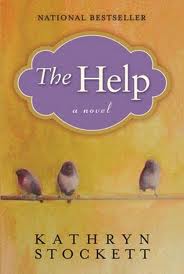
 Have you read Kathryn Stockett’s The Help? I haven’t. I told my close friend, Maggie, last year when she was reading it that I had my challenges coming to the work. I asked if she was enjoying it and was happy she said that she was. She resonated with much of the novel because of her background and because of her experience growing up a white woman in the South. I celebrated the book. I loved that she could find the portrayal in it credible when gauged by her own personal story. But I was off center.
I told Maggie and David and Dawn (we were all together at the time) that my conflict with the novel was with my desire to support and celebrate books in general and fiction in particular with my learned-over-the-years suspicion that my story–that story that I own collectively with all other black folks in this country–can so readily be accepted, supported, purchased, and promoted when it’s written by non-black folks. I continue to experience that conflict as the movie is now being promoted.
I’m careful not to take these conflicts too far on this blog. But my conflict is my conflict. In fact, I’m very thankful for the humility Ms. Stockett exhibits on her website when responding to the question, “Were you nervous that some people might take affront to you…writing in the voice of two African American maids?” She says,
…I was very worried about what I’d written and the line I’d crossed. And the truth is, I’m still nervous. I’ll never know what it really felt like to be in the shoes of those black women who worked in the white homes of the South during the 1960s and I hope that no one thinks I presume to know that. But I had to try. I wanted the story to be told. I hope I got some of it right.
Having not read the novel, conflicted man that I am still, I appreciate the author’s hope. I share it. And I also hope that the success of her novel continues to grow in relation to her posture around the issue of telling someone else’s story. Indeed, novelists always tell another character’s story. I hope she’s done that well.
That said, the other day I read the comments from Rosetta Ross, a religious studies scholar at Spelman, over at Religion Dispatches. I share some of her biographical experiences, reactions to The Help, and sentiments about the acceptance of African American culture when its ushered to the wider world through the pen and hands and submission processes of white publishing professionals in this case. Now, to be clear, I love white folks. Some of you all are white, and I hope you know I love you. And I hope you have a comment or two about this, especially if you’ve read the novel or seen the screening. And still, I’m intrigued by how often and constant black authors or, more pointedly, African American authors, try to tell stories that cannot be accepted and embraced as cultural stories, as stories for the wider reading public.
Dr. Ross identifies three messages from the embrace of The Help. Three reasons she won’t see the movie. She says,
The first false message says: The real agents of the world are white….This message is false because black women, from a variety of stations in life, have voices and live and demonstrate to the world fulfilled lives every day—without the assistance or interference of white people.
The second false message is this: The really important point of all cultural production and activity is for white agency and dignity to be actualized. The overarching plot of this book presents the narrative of a young white woman finding herself and her voice amidst cliches, circumscriptions, traditions of the South during the 1960s. Against this background, the black women are instrumental in Skeeter’s journey into adulthood. Skeeter’s journey is the more prominent message of the book, and, I suspect, of the film as well. I will not go to see the movie The Help because I do not wish to view yet another production that tells me, a black woman, it is all about whiteness.
…the third, and most detrimental false message: Black persons—perhaps people of color, generally—exist primarily to serve of enhance the lives of white people….A predominant element of the Western imaginary, the idea that black persons ultimately exist as servants for white life, has long been supported by rhetorical constructions of Christianity. The most obvious examples, of course, were rituals such as catechisms about the necessity for [black] servants to obey [white] masters…
What do you think about Professor Ross’s comments? Have you noticed some of the biases and patterns she speaks of, some of the messages she’s read and heard in the buzz around the novel and the film? What experience have you had around hearing your story told through someone else’s lips?
Finally, I hope you read the novel. One day I may. I’ve read many representations of black people written under the hand of non-blacks, and this novel may join that shelf. And, again, my conflicts aside, I can support the work of an author reaching the world with a good story–and upon the great experience my good friend had of the work. I can easily separate my experience of the novel (or my perspective of the novel as I approach it from a distance) from my hearty suggestion that it should be read by others.
By the way, if you’d like to see Professor Ross’s full essay at RD, click here.

 Michael Washington