“…recollections at soft distance…”

Some would say memory brings life after death.  Perhaps there’s truth in that, but only if we’re content to enjoy our recollections at soft distance, as passing flickers or occasional sparks.  If we’re grasping and desperate, if we want it all too much, if we reach out and try to touch it, what happens then?  It fades so fast from view that we’re left wondering if it was ever there at all.  Perhaps the trick is to find a gentle use for memory.  Learn to cup the small and glorious moments in our hands and treasure them, finding some solace this way.  Otherwise, all they do is remind us that we are too late.  That what is lost is lost forever.

From Emylia Hall’s The Book of Summers (pg. 323)

“…recollections at soft distance…”

Some would say memory brings life after death.  Perhaps there’s truth in that, but only if we’re content to enjoy our recollections at soft distance, as passing flickers or occasional sparks.  If we’re grasping and desperate, if we want it all too much, if we reach out and try to touch it, what happens then?  It fades so fast from view that we’re left wondering if it was ever there at all.  Perhaps the trick is to find a gentle use for memory.  Learn to cup the small and glorious moments in our hands and treasure them, finding some solace this way.  Otherwise, all they do is remind us that we are too late.  That what is lost is lost forever.

From Emylia Hall’s The Book of Summers (pg. 323)

Repeated Rituals of Domestic Life

Later, after I married and had a child, I learned to find equal meaning in the repeated rituals of domestic life.  Setting the table.  Lighting the candles.  Building the fire.  Cooking.  All those souffles, all that creme caramel, all those daubes and albondigas and gumbos.  Clean sheets, stacks of clean towels, hurricane lamps for storms, enough water and food to see us through whatever geological event came our way.  These fragments I have shored against my ruins, were the words that came to mind then.  These fragments mattered to me.  I believed in them.  That I could find meaning in the intensely personal nature of my life as a wife and mother did not seem inconsistent with finding meaning in the vast indifference of geology and the test shots; the two systems existed for me on parallel tracks that occasionally converged, notably during earthquakes.

From Joan Didion’s The Year of Magical Thinking, 190-191

Good Memories, pt 3

There are too many things to remember about our vacation.  I’ve jotted down lines in my moleskine journal to jog my mind.  Each phrase leads to a memory, to an event, to something we saw.  One line that’s not in my journal is the subject of this post.  I’ll finish up tomorrow with some pictures from our time, each one a memory in itself.

The evening I’ll write about was half way through the itinerary.  We left a show in one of the theaters on the ship.  Dawn was saying something about getting some popcorn when I went to have my nightly cup of tea.  From time to time we’d split up and agree when our next meeting would be.  We’d see a show together or make fun of people from Michigan as they guessed Motown tunes in a cafe.  Then we’d separate for a while so we could do whatever we wanted to do on our own.  We’ve found a nice complimentary system for vacations when we can do this–spending time together and apart.

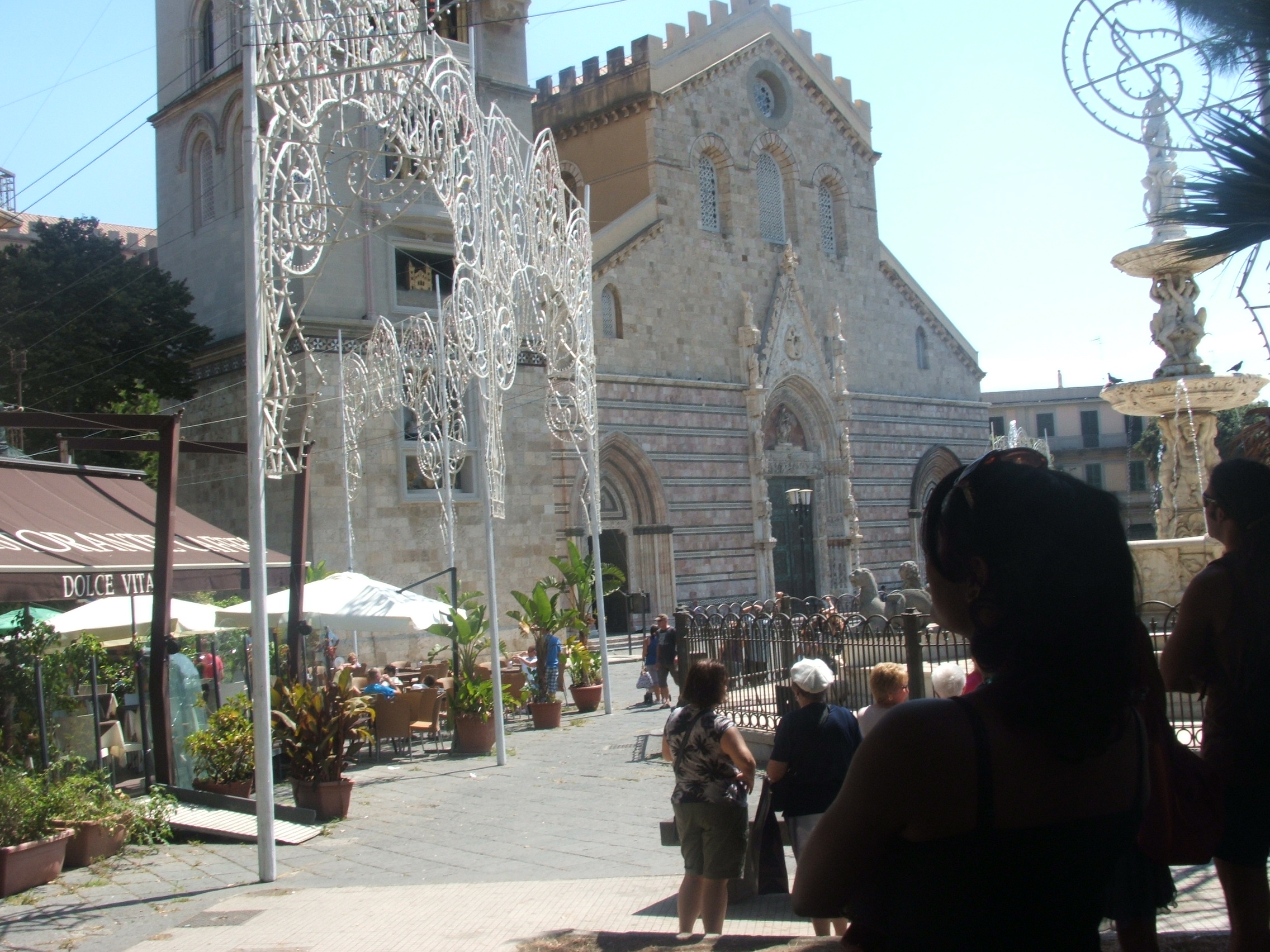
Well, as we left the show, we agreed to meet on one of the upper decks.  It was the last night in Italy.  That port was Messina, the one closest to Silicy and Taormina.  We spent that day walking around, me trying to look stern about not staying long in stores and Dawn trying, well, to do the opposite.  She looked at bags and hats and clothes.  We walked the streets, ate gelato (a practice at least one of us engaged in daily), and listened to music outside a large church near a city square with five hundred other people.  We stopped into a hidden restaurant.  I asked the woman at the door for a menu, made the decision to stay, and Dawn came in.  We asked the woman if she spoke English, and the look answered us before she could lie and mutter that she knew a little.  We thought to order by piecing together what we knew from Spanish but then chose to indulge only from the course of dishes spread on a kind of buffet table.  When Dawn asked something, the woman’s “Oh, Dear” became a joke between us, one that I’ll tell again and again.  I have no idea what we ate.

That night we passed through the last unseen Italian islands in the dark.  The decks were crammed with people.  The cruise director and the captain had promised to alter the route a bit so we could see the island of Stromboli.  It looked as if 4000 passengers lined one side of the ship to see the island, to get a glimpse at one of the world’s active volcanoes.  Me and Dawn decided to meet at a spot she’d found earlier that week, at the front of the ship.  Floors 5-7 were relatively quiet, and we were betting that most of our fellow travelers were cramping on the upper decks on the ship’s starboard? side.  We were right.  The forward portion of the vessel wasn’t empty, but we had more than enough room to ourselves in a quiet corner.  Quiet until some lovely father brought his three children, one of whom loved to say things.  She asked questions.  She made statements.  She talked about dinner.  She pointed out all the little boats around the island and wanted to know about all the 200 people on Stromboli and why they hadn’t moved since they lived under a volcano.

I looked at Dawn with that pre-parental expression, the one that’s not quite an eye roll.  I softened quickly.  One of us said something about Bryce.  He was soon to ask us a million questions about things too.  But that night, Bryce was in Chicago, having just seen his Grammie leave so that his Grandma could take her place.  It would have been about time for his afternoon visit to the park if the schedule was followed as customary.

John, the director, came on the speaker system.  Everyone quieted, even the little girl, as he told us what we knew–that we were at the island.  We stood on the front of the ship listening to the slapping of waves in ours ears.  I imagined those citizens of Stromboli, and I asked Dawn some of the same questions that little girl asked her father.  As we approached, Dawn mumbled something about going to get our camera.  I said it was too late.  We were upon the island, beyond the long wide rock it took so long to get to, and across from the volcano.

The sputtering red and orange took our collective breathes.  The kids were silent during that first bump and spray of color.  Red and yellow splattered and rolled downward.  After a while I wondered if what we saw was just for us.  It was timed too perfectly.  I told my wife that the islanders must have been pressing the big button on the side of the mountain because a ship was passing.  I also thought about those ruins of Pompeii we had seen and wondered why we were all so excited to be so close to a volcano.  Nonetheless, we saw five or six such eruptions in those too-brief moments.  They were dramatic and gorgeous and awesome.  They made me think about the greatness of God and about how many times God had seen what for us was a first.

We had been to a state park on the Hilo side of the Big Island with Karlos and Michelle four years ago.  (Incidentally, I could still move to the Island in a week if proper conditions existed.)  That day we traveled around the crater.  We ran along the edges of these huge rocks.  But we only saw steam.  We closed our noses to the smell of acid and sulfur.  We followed Karlos, running toward the red and orange, well past the STOP HERE signs.  But the lava was too far.  We were losing light.  Our wives were slowing down but still hardly complaining that they were wearing flip flops and not good shoes for volcano hopping.  That evening we went to the restaurant there in the park for dinner, somewhat disappointed.

I thought about that disappointing trek from 2007 when me and Dawn stood there whispering near Stromboli.  I love the Dodsons and would probably go anywhere with them.  But that night as we looked at those brilliant sprays and stretches of all those colors, I couldn’t think of one other person in the world I’d rather be with than my wife Dawn.  We took no pictures, though we bought one from the ship.  It’s the equivalent of a big rock with droplets and squiggles of fiery orange and yellow and red.  It’s a good picture, but I hope I can keep the images in my head for as long as I live.  I wouldn’t mind remembering those little children for all their noises either.

Good Memories, pt 2

We stood in the large hallway at the depot, both of us carrying a piece of luggage.  I wore a backpack.  Dawn had a strap hanging over her shoulder with a bag bulging at her thigh.  The bag squeaks every time she takes a step, and it reminds me of a hinge pleading for oil or grease or to be thrown to the ground.

The room looked like the check-in at an airport.  There was a line which snaked from the “enter” sign and ended with a dozen agents dressed in short sleeve white shirts.  Some of them wore ties or silk scarves, but most of them had their collars open as if they were welcoming the long lines of passengers and all the heat from outdoor Barcelona.  They wore pleasure on their faces, and I wondered whether they kept those smiles all day or if they painted them on their lips right before coming to their posts.

While we waited, we wondered to each other about the sanity of our fellow cruisers, particularly the ones who brought their children.  There was a family with a daughter.  There was a family with several daughters.  There were kids who were already making noises no one but their parents could appreciate or interpret.  Me and Dawn communicated in our party language, the way we talk to each other without words so that people can’t understand our gestures.  I’m not going to give them away, but I will tell you that there was a fair amount of glancing and nodding and shaking of the heads.  We saw a couple with a child in a stroller, and I’m sure it made Dawn think about the boy back home.  Me, well, I thought about all it took to get that kid in that line, all that money that those parents were willing to pay for a kid who couldn’t stand up in a long line with its own bags and who could only complain and who probably couldn’t say a full sentence yet.

At the counter they took my credit card, made me sign things, and told us we were welcome to board.  We turned toward the exit, still smiling; we made it.  My brother Mark being a great driver to get us to Terminal 5.  Leaving the boy with his Grannie and finding out, by the time we got to O’hare, that she had already altered his daily routine.  Stretching and walking up and down the length of a plane.  All those hours and in-flight movies.  Watching Dawn fall asleep in green chair in Amsterdam while we sagged through that first layover.  Words in Spanish that we both read with about 40% accuracy.  We made it.  Listless, limp, and faltering.  Passports and sail-n-sign cards in hand.

Outside the room with the white-shirted attendants, there was another short line of people.  The Carnival photographers were snapping pictures.  Dawn shook her head.  No pictures, she said.  I asked her, You don’t want to take a picture of this moment?  She didn’t.

This is a security photo, the nice man said.

They snapped our heads so they could prove we were who we were when we exited and re-entered the ship at the ports of call.

Then there was the embarkation photo, the one Dawn refused to take.  She took my arm, pulled her sunglasses down, and we walked by.  There was an orange background with yellow and red columns consuming a ten foot high spot.  I presumed it was evocative of Spain.  We walked by the photographer without posing, seeing the flash from the two umbrellas and muttering about those who were stopping.  They looked terrible but they didn’t care.  They were happy.  They were in Barcelona.  We were happy, too, but we had dignity.  At least the wife did.  She knew that taking pictures after flying and waiting and removing shoes and being spoken to in languages we didn’t understand and eating something in Amsterdam that hardly passed for Thai at a horribly early hour because I was starving was not wise.

But I wanted to take that first photo because I’m learning how to take pictures.  I’m learning to take them that is.

Early on in our relationship I had a thing about not taking pictures.  I didn’t care to.  I still don’t care to, but a couple years ago I made an inside promise to take more pictures.  It was something Pam Sheppard said to me, something I can’t remember.  It was probably something about the need to take them, the wisdom in keeping snapshots or something.  Pam is a brilliant and caring person.  She’s a clinician so she had to be.  As I said, whatever she said left me with the increasing impression that I should take pictures.

She probably said that one day I was going to die and when it came time for my funeral my family would have to choose that picture from seventh-grade when I wore my favorite white sweatshirt.  I was wearing Bugle Boy jeans, though you can’t see them because the shot’s a headshot.  That picture looks no different from my wedding picture because when we got married I looked like the same seventh-grader except that I was in a white jacket and not a white sweatshirt.

Even though Pam told me that I should take pictures, and even though I told her I would, and even though I do, in fact, take more pictures, I didn’t push the issue with Dawn about that first cruise shot.  After all, you have to choose which pictures to take when you’re married.  You have to choose which decisions you’ll make and resist unmaking.  You have to choose which moments you’ll capture and hold to tightly and which ones you’ll let fall into a body of water so large that you’ll never see the same wave again the way you first saw it.

Me and Dawn brought up the topic of pictures while we snapped our own shots of random strangers on the streets in Palma de Mallorca or when we took pictures of dead people in the Vatican.  I told her I was getting into collages this year, that I was going to unearth those pictures from all those envelopes in that drawer next to the glider at home.  I told her I was going to find a few ways to keep the places we’ve been and the things we’ve done before us.  I think I’m getting old or sentimental or soft or, maybe, smart.  Because it’s easy to forget where you’ve been with a person you go everywhere with, isn’t it?  No, me and the wife don’t go everywhere, but we go places together.  We share life, and we, like everybody, forget about the small, mostly ugly moments, like the ones when we’re sweaty and tired and grouchy and lagged by planes and everything else.  Remembering, taking pictures–mental or otherwise–might be the only way to prove it.