Good News in Writing World

Chimamanda Adichie is offering the world another book.  I’m placing it in my to-be-read pile.  Her work is refreshing, precise, full, and intelligent.  Both her novels and her collection of stories leave me with a broader world, and I think of her as a gift to the reading public.

If you’re looking for something to read, Americanah is a good option after next month.  I read of the book that a part of its appeal is “its immense, uncontained and beating heart”.  Don’t you love looking forward to a favorite author’s next work?

It looks like Ms. Adichie will work into her novel everything from cultural analysis and race to loving long-distance and the politics of black hair.  Familiarize yourself with Adichie’s earlier work by stopping by her website.

Interview with Julie Kibler, Author of Calling Me Home

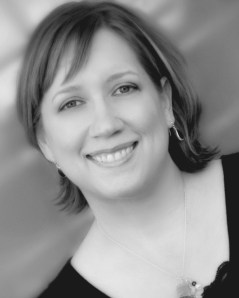
JulieKibler_Headshot2013Your novel started from an autobiographical nudge.  Tell us about that.  About seven years ago, my dad told me that my white grandmother fell in love with a black man when she was a young woman, but their families tore them apart. It opened a window on my grandmother’s personality, who had never seemed very happy to me. She died almost 20 years ago, so I wasn’t able to ask her the details, but it seemed to me she must have lost her one true love, and thus, her life was never quite the way she imagined it could have been. Because I didn’t know the particulars of what happened, Calling Me Home is almost all fiction, but there are bits and pieces of real life in the settings and characters.

You navigated troubling waters because you dealt with two people—one white, one black—falling in love when they weren’t supposed to fall in love.  What helped your write these characters respectfully?  What aided you to tell their stories with love, if I can put it that way?  I suppose different things. One, there is a lot of literature out there that deals with forbidden love. We learn from those who came before us and have done such a marvelous job of portraying these characters. Two, I contemplated the experiences of those I’ve known who have fallen in love with the “wrong people.” Nobody intentionally sets out to do that—it simply happens. I’ve had conversations with people who had to give up love, or were conflicted by it. I’m a lifelong people watcher, so I think I tend to absorb many of the thoughts and emotions of folks in different situations, whether I experienced them myself or not. Third, true love is a universal experience, with feelings we all recognize and understand if we are healthy beings. You could say that I wrote of Robert and Isabelle’s love as love tends to happen—first, with a hyper focus on the two experiencing it, without regard to anyone or anything else around them, and later, with an increasingly wider focus on the world and how it would accept them. I allowed them to fall in love normally, so to speak, as young, idealist, impulsive teenagers do, and then I pulled the camera back enough to where the consequences came into view. Finally, though I don’t know the specific details of my grandmother’s real story, I feel a bit as though she were present, whispering to me of how it felt to love someone she wasn’t allowed to be with, and eventually to lose him.

I kept thinking about mothers and daughters as I read, partly because the story holds the experiences of a few mother-daughter pairs.  Do you like the idea of families, including mothers and daughters, interacting with your novel in any way?  I’ve been really pleased to hear from women who have read Calling Me Home and told me they are eager to pass the novel on to their mother, daughter, sister, and so on. Some have contacted me again, telling me how much that person enjoyed and sometimes related to the story. I do think it’s an especially appropriate story for making us think about our mother-daughter relationships—not just biological ones, but the surrogate ones we may have developed with other important people in our lives. I think it would be interesting to meet with a mother-daughter book club, or to participate in a group where mothers and teens read the book and discuss the issues. It was very interesting and gratifying to me to see my own mother’s and daughter’s reactions to reading the book and to hear their various thoughts.

You move from history to present day to tell a story about, among other things, friendship.  What were some of the hindrances to Miss Isabelle and Dorrie’s friendship?  In American culture, we’re most often steered toward making close friends with our peers. We tend to view those of other generations with a certain amount of mistrust, even—will they understand our feelings, will they approve or disapprove of our beliefs, actions, passions, when they are from such a different era? When we take that a step further, and encounter someone not only of a different generation, but different background or race, it adds yet another layer to what might already be considered an unlikely relationship. I think friendships like Dorrie and Isabelle’s would almost always to evolve from a situation like theirs—they originally had a business relationship, but the longevity and specifics allowed it to gradually deepen and become important to each of them.

But I also believe their friendship was almost inevitable—not necessarily because of their working relationship, but because of who each of them was and what each of them needed. Dorrie had a big heart and great compassion for her clients—not just a detached sense of seeing each one as “another head of hair.” Isabelle was very independent for an elderly woman, but also lonely. Dorrie was the person who reached out to her and didn’t forget her when she could no longer drive or get out and about. Dorrie was also patient with Isabelle—giving her lots of leeway with her crankiness, not taking it personally, and allowing her to share her deepest secrets on her own timing—until she began to sense it was critical for Isabelle to get that story out in the open. And Dorrie felt nurtured by Isabelle—something she didn’t always feel from her own mother. Not least of all, they made each other laugh, which is rarely a bad place to start a friendship.

Given the way your personal story related to Calling Me Home, in ways do you think readers can do what you’ve done?  Your work is courageous in turning toward a relative’s background for inspiration, for truth, for pieces of their story.  I struggled with my “right” to tell this story for several years before I began writing it, and throughout the process. I finally determined I was the only one who could tell this particular story exactly the way it came to me. For instance, someone else could write a story about an interracial relationship, from the perspective they chose or that chose them, and it would be completely different based on what they bring to the table—their own beliefs, passions, and life experiences.

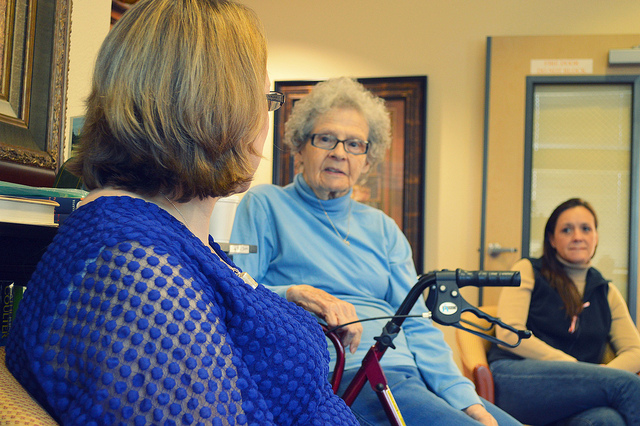
Book Club Reading CMHOne of my hopes while writing the story was that readers would think about and talk about the issues within, how they made them feel, and maybe even the memories the reading stirred up. I’ve included a photo here from a book club meeting I recently attended at an assisted living center. Though I’m in the forefront of the photo, the focus is on an attendee as she described a personal experience she had in 1945, coincidentally in the same area of Kentucky where Calling Me Home is set. It was a particularly meaningful moment along this journey for me as she is about the same age as Isabelle in my story, and she could speak firsthand about the era. The discussion in general with these folks was pretty fascinating, and this photo represents one of the really good days since publication happened.

To aspiring writers, I’d say this: If you have an idea for a story—even if it feels frightening—tell it. Write it the best you can.

What did you find difficult in your writing process (whatever you call your process for the novel)?  What was life-giving?  Strangely, once I gave myself permission to write this story, it flowed fairly quickly and easily. I always tell people, however, that when I’m drafting, I love revising, and when I’m revising, I love drafting. It’s all work. It’s work I love, but it’s work. Some days the work is easy. Other days, it’s a struggle to get five or ten words on the page. But honestly, for me, the most difficult part of writing is deciding to jump in. Deciding I’ve found the right story, the right conflicts, characters, voices, and so on. Once I get past that, I’m mostly off and running. The part where I’m off and running is life-giving. The part before that can take some time, and it feels like dying a slow and painful death. So I guess you could say that for me, writing is like living life in reverse. I’m not sure who you were writing to in this blog post you put up on April 5, but it was speaking right to me.

The journey your characters took was full of surprises, particularly for Dorrie.  Thinking about your journey to bring this novel about, did you have any notable surprises you can share?  I decided to set my story in a small town like the ones where my dad and grandmother grew up in northeast Kentucky. I knew the area somewhat, having been born in Kentucky and lived there off and on as a child, and visiting my grandparents in the Cincinnati and Newport metro area as a kid, then brief visits back as an adult. But it was mostly a child’s eye view, and a fairly modern one. I asked my dad to tell me about the town where he grew up, when he was growing up. I was shocked when he told me there was a sign at the edge of town warning black people to be gone by sundown. I had never heard of such a thing, and my story took on a whole new dimension as a result. It felt important to explore the history of these “sundown towns,” and I was blown away to learn all the different ways people of color were excluded from communities in every part of the United States, from north to south, east to west. It made setting Calling Me Home in the Cincinnati/Newport area seem even more appropriate. Though not the physical center of America, in a way, it’s a gateway between east and west, north and south, and what happened and still happens there is kind of the heartbeat of our country.
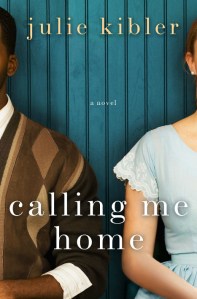
CMH_Cover_smallTalk about the work you’re doing now…for the novel.  I imagine you are still working on the book, even if it looks like marketing and not revising.  This is a great question, and it’s so interesting how you’ve worded it–“looks like marketing and not revising.” I was JUST thinking about this today as I attempted to do some work on my new story. I said to myself, “Wow, I almost feel like I’m still writing Calling Me Home. How on earth can I move on to something new?”

Between considering questions asked by book clubs, in interviews, through email, and in discussions of any kind, and simply still thinking about the story every single day, I do feel like I’m still working on it, sometimes harder than ever. It is challenging to find a new frame of mind, where I can devote mental energy to creating a new world, new characters, new relationships, while still focusing so much on the already published novel. I would really like to be immersed in something new, and am taking baby steps. In the meantime, I continue to promote Calling Me Home through social media, bookstore events and book clubs, and any other means that seems logical or beneficial, and that work won’t end any time soon.

I also felt it was important to try to give back in some way and have been looking for ways to involve myself, at the very least financially, with organizations that address some of the issues in my book—racism, single parenting issues, at-risk teens. I decided to partner with a local nonprofit called Santa Fe Youth Services in Fort Worth, Texas. I already knew of them and had a lot of confidence in the work they do. They help families with at-risk teenagers—kids who have been in trouble with the law, or struggle with drugs or alcohol, or have behavioral issues, for instance. The organization works hands-on with these families, helping them with parenting skills and conflict resolution and attempting to connect them with the additional resources they need to help their children succeed.

How can readers stay in touch with you and support your work?  I am most active on my Facebook author page (www.facebook.com/juliekiblerauthor), where I post updates about book news, links to interviews and articles, and interact with readers. I really enjoy getting emails and messages from readers, telling me their reaction to Calling Me Home, and try to answer each one, though I get a little behind on occasion. I have a website (www.juliekibler.com) where readers can learn about bookstore events, conferences I’m attending, etc. I’m a lightweight Twitterer: @juliekibler

Readers can support me most by telling friends and family (or hey, even strangers!) about Calling Me Home if they enjoyed it. Word-of-mouth is the single most important tool in building audience for a book. Readers, if you recently read a book and loved it, I challenge you to tell five or ten people about it—friends, family, coworkers, whether in person, through your Facebook page or on Twitter, through suggesting your book club read it—anywhere you talk to people. Why keep it a secret? Books are for sharing, and the author will appreciate your assistance in spreading the word!

Victor Lavalle on Writing and Revising

I’m finishing Victor Lavalle’s latest novel, The Devil in Silver, a story about inmates in a mental hospital who befriend each other while fighting a known but unknown devil and an increasingly unresponsive health system.  These videos aren’t about Victor’s novel but writing itself; he reads a good bit of a story in the video and discusses it the way he would in one of his classes.  I hope you learn from him.  It’s helpful if you’re writing now or revising.

Because Love Itself Is Beautiful

It is rather obvious why I chose this title.  I believe it is what life is much of the time.  When I think of great lovers in history, there was always some pain involved.  Maybe not for everyone, but most likely.

I, also, think Love is beautiful and feels good.  I think what some people do with it, who do not know what they are doing, is what makes it painful…sometimes.

So maybe it is not Love that hurts, maybe it’s the person we love.  It can even be a lack of Love.  Because Love itself is beautiful.

I named this book what I think about Life; Some Love, Some Pain, Sometime.

From J. California Cooper’s note in Some Love, Some Pain, Sometime.

“…recollections at soft distance…”

Some would say memory brings life after death.  Perhaps there’s truth in that, but only if we’re content to enjoy our recollections at soft distance, as passing flickers or occasional sparks.  If we’re grasping and desperate, if we want it all too much, if we reach out and try to touch it, what happens then?  It fades so fast from view that we’re left wondering if it was ever there at all.  Perhaps the trick is to find a gentle use for memory.  Learn to cup the small and glorious moments in our hands and treasure them, finding some solace this way.  Otherwise, all they do is remind us that we are too late.  That what is lost is lost forever.

From Emylia Hall’s The Book of Summers (pg. 323)

“…recollections at soft distance…”

Some would say memory brings life after death.  Perhaps there’s truth in that, but only if we’re content to enjoy our recollections at soft distance, as passing flickers or occasional sparks.  If we’re grasping and desperate, if we want it all too much, if we reach out and try to touch it, what happens then?  It fades so fast from view that we’re left wondering if it was ever there at all.  Perhaps the trick is to find a gentle use for memory.  Learn to cup the small and glorious moments in our hands and treasure them, finding some solace this way.  Otherwise, all they do is remind us that we are too late.  That what is lost is lost forever.

From Emylia Hall’s The Book of Summers (pg. 323)

“…because they are strong.”

Sometimes the most penetrating words rise from fiction:

She told me about a group of people in Guinea who carry the sky on their heads.  They are the people of Creation.  Strong, tall, and mighty people who can bear anything.  Their Maker, she said, gives them the sky to carry because they are strong.  These people do not know who they are, but if you see a lot of trouble in your life, it is because you were chosen to carry part of the sky on your head.

Do This Sometime This Week

I’ve had wonderful experiences expressing gratitude to the writers I read.  I’m surprised by their reactions to my thanksgiving.  Until I remember that writers and communicators are people too.  Their words come from deep, unseen places.  Their stories and anecdotes, their lessons and characters come out of things we often can’t see on the page.  And what they do matters.  Have you thought about that, how much writing matters?

It’s definitely and a nod to the importance of reading.  But words have to be printed for them to be picked up.  They have to be written to be read.  And I love what writers do.  Aside from my obvious connection as a writer and aspirant of related futures, it’s wonderful to read something life-giving.  Still, that’s not the most sparkling event of my experience.

Communicating, even just a line or two in an email, with a writer is that much more exhilarating.  It brings me back to the humanity of the writer.  It helps me recall that this person–whose words have created a world for me to sit in and walk in and breathe in–goes to the grocery store to pick up yogurt and broccoli and plums.  She goes to restroom and leaves it stinking.  He shaves and has hair to clean out of the sink.  That writer reads emails from people like me.  That writer needs to know that what she did or what he wrote wasn’t published without an impact.

So I want to challenge you to do something in the next week.  If you’ve read an article, a blog post, a book, an essay, or something written that doesn’t fall into those categories, will you write a note to the author and send it?

Thank them.  Tell them what you read and when you read it.  Tell them anything you want.

I was at a conference once, in a breakout session with a novelist I attribute as responsible for my starting to desire to write fiction.  One of the women in the room told her that she saw her at some random place in the neighborhood, which made me feel weird.  The author was gracious.

That said, don’t find them in person.  Just write them and email them.  You’ll likely have to search for them through Google, but the odds are in your favor.  They may or may not reply, but I’m certain they’ll appreciate it.  And who knows, they may just respond right after they get home from the grocery store or, perhaps, after the come from the restroom.

For those of you who have an author you can’t email–perhaps they’re dead or reclusive–post something as a comment.  Name them and their work.  I’d love to know about them.

Books I’m Reading

I just finished Will and Spirit by Gerald May, a commitment of careful reading.  I took a year and a half to read it slowly while reading other things.  Here’s a list of the ten books in my current pile.  I’m holding the ones with asterisks now:

  1. The Memory Palace by Mira Bartok
  2. Blacks by Gwendolyn Brooks*
  3. The Year of Magical Thinking by Joan Didion
  4. Exploring Prosperity Preaching by Debra Mumford*
  5. Lying Awake by Mark Salzman*
  6. Faith in the Fire by Gardner C. Taylor*
  7. Mothers and Sons by Colm Toibin
  8. An Altar In The World by Barbara Brown Taylor
  9. Allah: A Christian Response by Miroslav Volf
  10. A Happy Marriage by Rafael Yglesias

Any recommendations for me, particularly for novels, short story collections, memoirs, or psychology and theology?

And what are you reading?

Short Story Recommendations

I still think of myself as a person learning to appreciate fiction.  I’ve been reading fiction actively for about seven years, reading more fiction than non-fiction as I go along.  For the last couple years I’ve been getting more into short story collections.  They are both rewarding and brief.

Here are a few recommendations, in case you’re looking for something good to read, alphabetized by author name.

  • The Thing Around Your Neck by Chimamanda Ngozi Adichie.  This collection is full of grace and care, and it describes well the things that bind people.  I read it a while ago.  I was thankful to get it after reading both of Chimamanda’s novels, two lyrical works she’s won many praises for.  The stories were just as impressive, just as wonderful, and just as searing.  Reading them made me appreciate language more, made me think better about others and how I look at their lives when they are very different from me.
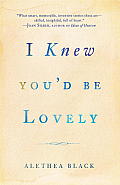
  • I Knew You’d Be Lovely by Alethea Black.  I finished reading this collection on a trip to the Boston area.  It was a treat to read, in part, because the author is from that region.  I soaked these stories up.  They were pointed to the heart and they illuminated the varied ways one event can take on significance in people’s lives.  I read it thinking through the great detail and world-building which came along with the fresh plot lines.  I appreciated seeing the cast of characters giving pieces of their lives to me.  Alethea just participated in a blog interview here.  Leslie won a copy of the collection.
  • Vida by Patricia Engel.  I read this collection two years ago, when I put myself on a short story diet for a few months.  I enjoyed entering into the families, neighborhoods, and conversations Engel created.  I felt like I could see and feel and smell and hear the conversations in her dialogue, like I could sit in front of the scenes she wrote, meeting the men and women on those pages like they were friends and enemies.  The collection was refreshing and stood up and sang right with some of the other stuff I thumbed through around that time.  I’m still waiting for the author to publish more stuff.  I should email her and tell her.
  • Before You Suffocate Your Own Fool Self by Danielle Evans.  This delightful collection came to me at the recommendations of writers and bloggers all over the place back when it was first published.  I was glad to get my hands on it and glad to read each story.  The author depicted the youth and young adults with grace, care, specificity and humor.  She dealt with issues of identity and race and love.  When I think about the stories, I smile.  I’ll probably be re-reading them soon.
  • Gumbo edited by E. Lynn Harris and Marita Golden.  This is a feast that I’m still sniffing, biting and savoring.  It is more than a collection; it’s a massive tribute to two writers (Zora Neal Hurston and Richard Wright) and an undertaking of support for the writing foundation in their name which Marita Golden started.  I’m about a fourth of the way through the 800 page collection.  I’ll be reading it for years, but it will be responsible for the love and appreciation I continue to nurture for black writers and all writers.  This collection is a guide for me, a lifesaver for me, a friend I can call when I can’t sleep or write or when I don’t feel like doing either.
  • Lost in the City by Edward P. Jones.  I enjoyed both collections I’ve read by this author, but I came to Lost first.  It was also shorter than the second collection, which is why I’m commending it.  Most readers who are new to short stories look for reasons not to take them on.  Length can be a reason.  But this collection and the other work I’ve read by Edward Jones is still teaching me how to be a patient, careful reader.  His work teaches me how to enjoy a created world on a page.  He is a writer the world needs to read with love and open ears.
  • Unaccustomed Earth by Jhumphi Lahiri.  I read this book because a coworker told me I should.  That coworker maintains a good place in my mind because of that recommendation.  I may be setting up evaluations of people where I determine how much I like them based upon what they tell me to read.  The people, places, and environments I read in Lahiri’s collection were enticing and probing and edifying.  More than anything, I think this collection sparked my imagination, made me want to write better, made me want to read with love and write with depth.  Other books have pulled that same desire from me, but I remember feeling that while reading this.
  • I Got Somebody in Staunton by William Henry Lewis.  This is collection is a tutor for me right now.  I’ve read through it, both slowly and quickly because the pages were a combination of entertaining and elegant.  Lewis did a great job to build characters who stick with you, incorporating humor and depth and color and breath.  I think these stories are truly worth lingering over, spending time with, even though reading them doesn’t require time commitments.  That’s the mark of a good story to me.
  • Elbow Room by James Alan McPherson.  If there’s one book of short stories I’d love to get as a gift, it would be this one.  I already read it, but I rented it from the library when I did.  I haven’t bought it yet because I haven’t seen it in the bookstore.  It’s dated, but it’s worth reading and re-reading.  It’s worth owning.  I’d trade ten books on my shelf for this one if I had to.  I’m coming close to saying it’s one of the best books I’ve read.  I just don’t want to appear presumptuous in saying so.  The author won a Pulitzer for his work, and the pages still speak to readers.  I think you should read this book at the library and then go to your closest bookstore and do what I haven’t–demand it right away.
  • Drinking Coffee Elsewhere by ZZ Packer.  I read this collection a few years ago, and I still recall how well Packer introduced me to her characters, to their worlds particularly as women, and to an empathy that I’m steadily cultivating in my life.  I think of her stories as an education in fiction and in living.  This collection should be read and read again.  Her writing is precise and picturesque and spicy.

What short story collections would you recommend?

Interview & Book Giveaway With Alethea Black, Author of I Knew You’d Be Lovely

MW: Tell us about you, perhaps before, behind, or beneath the pages of your work.

AB: I lead a fairly simple life. I live in a house on a lake with a wood-burning stove and a little dog (a dappled miniature dachshund) who’s sleeping beside me right now. I’m a night owl, which is too bad, because I’ve heard the sun rises over the lake. But the moon rises over it, too, so it all works out.

MW:How did you start writing, and how do you sustain your writing life?

AB: I started writing after my sister gave me a 1994 volume of The Best American Short Stories. Something about the stories in that anthology gave me a feeling of having come home. For many years I sustained my writing habit by proofreading for BusinessWeek, but I was laid off in 2009 when the magazine was bought by Bloomberg.

MW: What can you tell us about your writing process?  What helps you nurture your work?

AB: I tend to write a lot when an idea is exciting to me and a project feels urgent — then I can really take the night owl tendency to extremes — and not to write very much when things aren’t hot. This is probably the exact opposite of what you’re supposed to do, so I wouldn’t necessarily recommend it, but it’s how things seem to work for me. I find ideas everywhere; the book I’m working on now takes its opening line from something a writer named Mo told me a couple of years ago at the all-night post office across from Madison Square Garden.

MW: Can you give us a view into your world of writing short stories?  What makes the form of fiction interesting to you?

AB: I like intelligent stories with humor and heart, and that’s the kind I try to write. The thing I love about storytelling — I’ve been thinking about this lately — is that sense it can give you that everything is somehow okay, even when things are stupendously, outrageously not okay. There’s a mysterious sense of consolation that  accompanies a well-told story.

MW: Your stories link through decisive moments.  Each one looks to emerge from or respond to a slice of time that is significant for your characters.  Did you always have that link or did that develop as you wrote?

AB: I had a teacher who told us that a writer should always be asking: “Why is this night different from every other?” I’ve tried to abide by that, even when it’s not Passover. The thing that interests me are those moments in life — even if they are subtle — when everything changes.

MW: How were you able to keep the stories fresh and engaging while keeping that common quality to them?

AB: Thank you for the compliment! I tend to write about everyday people in everyday situations but I try to find that spark of the extraordinary. If I can’t keep a story fresh and engaging, it goes in the trash and I start over. Life is short.

MW: The stories take place in the Northeast mostly—with my city being a shining exception!  Do you see geography as important either for your stories in the collection or for your self as an author?

AB: Who doesn’t love Chicago? Actually, I’m not very interested in geography, and I don’t think of myself as a regional writer in any sense. When other writers start to talk about geography, that’s usually when I take a nap. The landscape that interests me is the human heart.

MW: What are you reading or about to read these days?

AB: I just read CORPUS CHRISTI by Bret Anthony Johnston; I’m partway through VOLT by Alan Heathcock; and I’m about to pre-order THE WORLD WITHOUT YOU by Joshua Henkin.

MW: Are you currently working on things you can talk about?  If so, what?  And how can my readers keep in touch with you?

AB: My agent has my next book, a short novel called THE KEY, about a woman who’s missing her dead father when a stranger in Grand Central Station hands her a key. The next next book is about two brothers, one successful and one feckless, who spend a weekend together. I love hearing from readers — it’s been my favorite part of the publishing experience. They can find me at http://aletheablack.com.

Now for the giveaway.  If you’re interested in getting a free copy of Alethea’s collection, leave a comment with the title of the last book you read and a sentence about what you thought of the book.  And maybe tell other people to do the same.  Leave the comment by Friday 8, 11:59p.m.  I’ll choose a winner sometime Saturday and email the winner for a mailing address.

top