A Spiritual Hero

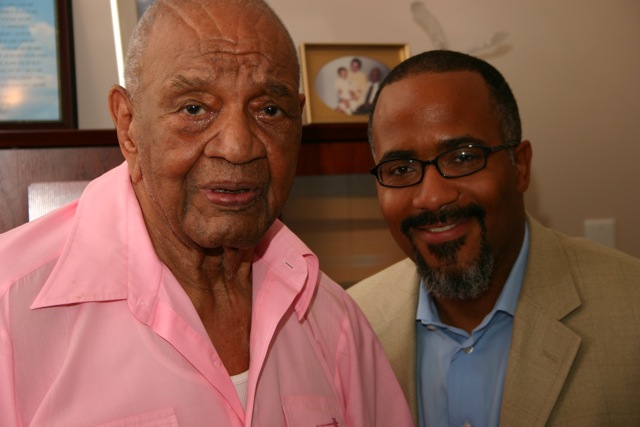
Michael and Gardner C. TaylorYesterday afternoon, the afternoon of Easter, Dr. Gardner C. Taylor died. I will reflect more on his passing, particularly as I said to Dawn on the poetic nature of him dying on Easter. It was fitting in many ways. But here is a quote from our interview with him in 2011, when his voice was as strong as a few months ago when he and Mrs. Taylor wished us a Happy New Year.

I’m literally numbering my days. I’m approaching what in my childhood we would have called my “commencement day.” My stage of life means to be aware that we all are just strangers and pilgrims. We can make this place home sometimes. Our danger is the false notion that it is home.

All in all, life’s a great experience. But by faith we believe there’s a better one. It’s hard to imagine what it can be like. At the point I have reached, one ponders more and more what it’s like. It does not yet appear. But this we know, the Bible says, that “we shall be like him, for we shall see him as he is.”

Those are tremendous things to wrestle with. Not too much for the human mind to ponder, but too much for it to have. I cannot picture this. The best I can do is try and understand the crude symbolism that we’re given. Our home will be far richer, far finer than anything we can think of. The maker of that home is God.


Public Process Note

I spend time with people who are dying, actively dying, and I spend time with the people who love them. It does and doesn’t get easier to listen to the rises of hope and the slips into sadness as some son imagines the soon-coming death of his mother or to the patient who looks ahead and thinks about not existing anymore.

I know how to stand and sit with a nurse whose patient just died or expired or passed away. I know how to acknowledge the connection between myself and a doctor I met only around the grim and delightful experience of a patient who died late that night a few months back, the recognition between us like a secret we keep to ourselves.

The medical intensive care unit, the on-call experience, the jacket that identifies me in the hospital all lend themselves to wearing the experience of somebody’s grief. Of course, I have my own because I learn something of these good people, I am known in little bits, and I know them in little bits. And then, I carry and hold the grief of others. And it does and doesn’t get easier.

This post isn’t about the skills necessary to carry the grief of others, and it’s not about the ways in which I support people up to the edge and just before the dark unknown that is death. Of course, for the Christian, the reality is that death is a step or slip or movement. Like the shift of one’s body in a gracious dance, death is supposed to be a movement into another life, another part of life. In the words of a young woman who said something I’ll never forget: Whether we live or die, we win. That is a Christian view of death.

The lived experience is murkier. Living with the stories and words and prayers of another as she approaches that existential doorstep into eternity is grounding.

When I woke up this morning, I heard myself say of one of my patients, “He’s not going to die over the weekend” and, shaking my head at the unbidden thought, “He’s not dying today”. Of course, when I arrived for our morning report where we discuss the issues of the previous day, where we talk about who needs to be followed or continually given care, that patient was on the lips of my colleague. She dropped her head and her tone and said she had sad news. It was brutal for that to be saved until the last relay.

I had been right up until that moment. He had not died. In my mind, he was still with us. In truth, his spirit or his intention was waiting on the perimeter of my unconscious, even before I woke, telling me in his own way–or in God’s own way–that he was, in fact, gone.

I was glad, made glad really, that my chaplain colleague was with him when he died. Knowing of his faith and seeing the notes that had been charted, she sat with him and played gospel music for him. She sang to him, held his hand. She was there when he breathed his last breath.

This morning became for me another moment to grieve, another patient I had cared for, another person I had gotten to know. He was another person whose story, in such a compressed time, I learned to appreciate.

I spent the day doing the same things I always do in the hospital. And if you weren’t a colleague of mine or a nurse from my unit, you wouldn’t know that this gentleman was now added to my mental picture of deceased patients. I would remember that he had been in that room. I would associate the number with the first meeting and then the second until I captured what my last prayers for him had been. Had I prayed a prayer of benediction? I generally tried to.

He joined a different cloud of witnesses and not just the one the scriptures speak of. His face became associated with his room so that when I walked by, I said another goodbye, and it was like that on the unit. He was still a teacher to me, a teacher in how to acknowledge what was happening in me, a teacher of remarking on a man’s grace-filled transformation, and how to continually respect the boundary that we give all that we have when we’re there and that when we’re not there, somebody else is.

He became an occasion for me to remember the other patients who I thought of in similar ways, even if there was one or two profound ways that distinguished him forever in my memory. He will be one of the people I look for when I slip through the split in the veil myself one day. I will anticipate him as a host quite like he was when he welcomed me at the hospital, and I believe he’ll be smiling widely and probably calling me by a title and a last name.

Last Breaths

I came to the hospital with televised notions of death. I came thinking of scenes from crime shows and legal shows, where death had already happened or where death came swiftly. I’ve probably read of deaths in fiction where the event stretched a bit. Fanciful notions that never prepared me for being in the room, in the area where that angel hovers. There is nothing like seeing death enter a space, move from one corner to another, and linger.

It seems to me that most deaths come slowly. People die in all kinds of ways. Death is dramatic and traumatic in many cases. Murders and long-term illness. Crimes of passion and crimes of technology. Decisions made by people who care too much and people who don’t care enough. Each can be an agent of death.

I’m learning that life is precious, fragile. The air we have in our lungs is phenomenal in what it does. Lungs make things in our bodies. But that breath leaves. It’s departure sober and quiet. Sometimes it takes a long time for a person to take her last breath. Other times breathing vanished before we really knew it, before the help arrived, before saving interventions began. We had already died, already surrendered to something else, some place else.

Contemplating last breaths makes the next one different. Seeing last breaths daily or almost daily both unhinges me for the silly ways I hear myself wasting air and anchors me in the coming reality of whatever is next. It is certainly a part of my practice that we live toward something and someone and some place beyond these. It makes me italicize last in my mind. Hopefully it’s a spark that ignites better living.


The Race

Posted for all those relatives–past and present–who do everything to share those last moments with their lovely ones.

The Race by Sharon Olds

When I got to the airport I rushed up to the desk,

bought a ticket, ten minutes later

they told me the flight was cancelled, the doctors

had said my father would not live through the night

and the flight was cancelled. A young man

with a dark brown moustache told me

another airline had a nonstop

leaving in seven minutes. See that

elevator over there, well go

down to the first floor, make a right, you’ll

see a yellow bus, get off at the

second Pan Am terminal, I

ran, I who have no sense of direction

raced exactly where he’d told me, a fish

slipping upstream deftly against

the flow of the river. I jumped off that bus with those

bags I had thrown everything into

in five minutes, and ran, the bags

wagged me from side to side as if

to prove I was under the claims of the material,

I ran up to a man with a flower on his breast,

I who always go to the end of the line, I said

Help me. He looked at my ticket, he said

Make a left and then a right, go up the moving stairs and then

run. I lumbered up the moving stairs,

at the top I saw the corridor,

and then I took a deep breath, I said

Goodbye to my body, goodbye to comfort,

I used my legs and heart as if I would

gladly use them up for this,

to touch him again in this life. I ran, and the

bags banged against me, wheeled and coursed

in skewed orbits, I have seen pictures of

women running, their belongings tied

in scarves grasped in their fists, I blessed my

long legs he gave me, my strong

heart I abandoned to its own purpose,

I ran to Gate 17 and they were

just lifting the thick white

lozenge of the door to fit it into

the socket of the plane. Like the one who is not

too rich, I turned sideways and

slipped through the needle’s eye, and then

I walked down the aisle toward my father. The jet

was full, and people’s hair was shining, they were

smiling, the interior of the plane was filled with a

mist of gold endorphin light,

I wept as people weep when they enter heaven,

in massive relief. We lifted up

gently from one tip of the continent

and did not stop until we set down lightly on the

other edge, I walked into his room

and watched his chest rise slowly

and sink again, all night

I watched him breathe.

Among Many Tasks

The fall will bring a slightly different schedule for me.  The whole thing holds together and will open me to new ways of deepening my vocation and the little works which make up my vocation.  I’ll be doing a lot, and I’m looking forward to it.

Perhaps it seems inappropriate to hold this poem on this blog, but it seems a striking reminder for me as a parent.  In the end, as I see it and believe it and imagine it, all our small works turn to one task of continued self-surrender, continued dying.

That dying sits at the bottom of my faith, though that bottom would quickly, almost too effortlessly, be named as living.  That eternal life only comes after one has regularly and daily passed through the gates of death.  Life comes from death, says the One we follow.  May this poet’s words be a reminder of these things to me:

Among Many Tasks

Among many tasks

very urgent

I’ve forgotten that

it’s also necessary

to be dying

frivolous

I have neglected this obligation

or have been fulfilling it

superficially

beginning tomorrow

everything will change

I will start dying assiduously

wisely optimistically

without wasting time

Tadeusz Rozewicz (From The Vintage Book of Contemporary World Poetry)

Singing with Brother Tom

When we first met, he seemed to be a stiff, jovial man.  The stiffness was only in his movements and not his heart.  He kept a full, broad smile on his face, wore glasses and a gray beard, and I could tell early on that he had jokes I wouldn’t understand.  Jokes, perhaps, I’d laugh at later.

I was told to call him Brother Tom because that was his preference.  We would get along because I could relate to his Christian faith, to the songs he sang, to the scriptures he went on and on about.  All those markers would be little pieces of Brother Tom’s deep faith.  He had an abiding song for his God.

On several occasions when I was with him, he had me pull his CD player to his side so he could play Gaither gospel, music I didn’t enjoy but lyrics I could follow.  The tunes’ texts were so familiar that I could follow them, even if I had to close my ears to their sounds.  Looking at Brother Tom’s face as he sang–closed eyes, his deep throat open–I’d think back to rehearsals with the Soul Children of Chicago when we would sing with all our selves.  I’d think about my days at church singing in the choir.  And I would join Brother Tom.  Sometimes.

We talked about the Bible.  We spoke of theology.  He always asked about my ministry and my leadership.  He wanted to talk about his writings, and I wanted to hear about his life.  Sometimes it felt like our conversations were dull in the sense that they were aimless, almost lazy.  But there was something building, an intimacy I wouldn’t know until my internship and time with him was ending.  Still, with all those important words shared between us, it was his music that marked our time.

He would sing in the middle of a conversation, offering a public display of affection, even next to sleepy residents in St. Paul’s house.  I didn’t want to wake up his fellow residents.  But he didn’t mind it.  He would simply sing.  Loud and never quietly, he’d open his throat as if God was before him, waiting and encouraging him to sing louder.

Donny Hathaway, a singer I’m sure Brother Tom was unfamiliar with, sang that “for all we know tomorrow may never come.”  But the faith residing in the deep bottoms of my old friend, old because he’d seen so many days with God and with people, old because he’d experienced plain loneliness and gripping isolation, old because he was aged by grace and suffering and illness, that faith had a different lyric.  In some ways, Tom Lopresti sang because he believed he would see a tomorrow.

On the first day of the week, when he died, Brother Tom’s voice joined another melodious chorale.  He wouldn’t sing along.  He would join the sounds of the stars and the unseen vocalists from all eternity.  In death, he would start a new chorus, hardly ending his lovely baritone rendition of thankfulness.  He would keep singing, even if I’d never hear him again.  Perhaps this time he’d open his eyes, but Brother Tom would sing.  For sure he would.

Neighbors in Another Place

I’ve learned, as a preacher, to let sermons go when they’re done.  I learned that from Dallas Willard in a book, and I’ve been practicing it for years.  But a message I preached is still, in a way, with me.  I was thinking a lot about a Colossians text (3:1-17) that says that Christians live in both heaven and earth at the same time.  “In glory” is the language in most translations.  That passage, among other things, evokes the truth that we have neighbors in both places, people we see and know in both places, expectations and conversations in both places.

I have been thinking about my father who died more than a year ago.  His birthday last week was the same day Maya Angelou died.  It was the same week my city was visited again by the clutch of violence as a teacher and real estate agent was killed sitting in her office on 79th street.  My brother talked with me about that corner; he works that area as a security officer.  These good people, all of them dying sooner than anyone who loves them wanted, have joined the community in another place.

The Colossians passage comes up again as I read this quote from a Catholic thinker, Ronald Rolheiser.  His book, Forgotten Among the Lilies, is a full gift of reflections, meditations, and challenges for the soul.  In this reflection, he is discussing the Christian belief of the communion of saints.  While he’s from a decidedly Catholic practice, this teaching extends beyond those doctrinal borders to the older understanding of the word, catholic, i.e., universal.

To believe in the communion of saints is to believe that those who have died are still linked to us in such a way that we can continue to communicate, to talk, with them.  It is to believe that our relationship with them can continue to grow and that the reconciliation which, for many human reasons, was not possible in this life can now take place.

Why?  Because not only is there communication between us and those who have died before us (this is the stuff of Christian doctrine, not that of seance) but because this communication is now privileged.  Death washes clean.  Not only does the church teach us that, we simply experience it.

How often in a family, in a friendship, in a community, in any human network, is there tension, misunderstanding, anger, frustration, irreconcilable difference, selfishness that divides, hurt which can no longer be undone, and then–someone dies.  The death brings with it a peace, a clarity and a charity which, prior to it, were not possible.

Why is this so?  It is not because the death has changed the chemistry of the family or the office or the circle, nor because, as may sometimes seem the case, the source of the tension or headache or heartache or bitterness has died.  It happens because, as Luke teaches us, when, on the cross Christ forgives the good thief, death washes things clean.

I think of the unfinished business of these good people–my father, Maya Angelou, Betty Howard.  I think of the ways they are now in that cloud of witnesses, that communion of saints, and how they hope for us and pull for us and, as my Catholic friends would say, intercede for us.  I hope their deaths bring us clarity and love and motivation to live beyond ourselves, for others, and for world-making justice.

Prayer For Winston

It’s probably around the time that Winston is standing near the casket of his aunt, saying things about her and saying things about you.  Will you be with him in the midst of a long day of many feelings?

While you know the joy that comes at the entrance of one of yours into bliss, you know the mixed feelings of grief and sorrow and pain as well.  Will you accompany him in the fragile experience of all these emotions and grant him a strong sense of your nearness.

You know the deep feelings of love, the memories, the jokes, the stories.  Enable him to remember with truth and humor and affection.

You know all the things that make us love animals, all the things that make us good and bad at loving.  Redeem every moment that he’s spent, and that his relatives have spent, combining those times into full experiences that help them support each other now.

You see those memories coming back when we see our loved ones, the remains of them, the last pictures of them.  Give Winston and his family and their friends a host of things to see during this day.

May they see you in the midst of their tears and their prayers and their songs and their presence.  May you be in the midst, drawing them all into your embrace.

Give them joy and praise  and kindness.  Let them eat well and restore each other through loving touches and long laughs.

And when the days pass, after others have stopped mentioning their relative, after they themselves have forgotten or begun to forget their loved one, make every spontaneous memory that arrives unbidden an occasion for gratitude and peace and anticipation for that last family gathering.

In the name of the One who conquered death.  Amen.

Things That Strengthen Us, pt 1 of 2

From Christman Wiman’s meditation, in My Bright Abyss, undoubtedly written first to the close loves of his life (pg. 161):

My loves, I will be with you, even if I am not with you.  Every day I feel a little more the impress of eternity, learn a little more “the discipline of suffering which leads to peace of the spirit,” as T. S. Eliot said, writing of the seventeenth-century poet and priest George Herbert (read him!), who died when he was thirty-nine and had only recently found true happiness with his new wife and new commitment to God.  My loves, I love you with all the volatility and expansiveness of spirit that you have taught me to feel, and I feel your futures opening out from you, and in those futures I know my own.  I will be with you.  I will comfort you in your despair and I will share in your joy.  They need not be only grief, only pain, these black holes in our lives.  If we can learn to live not merely with them but by means of them, if we can let them be part of the works of sacred art that we in fact are, then these apparent weaknesses can be the very things that strengthen us.

The Way Whole Worlds Change

Experiencing and anticipating all the anniversaries of my father’s death bring me both a sense of tenderness and pain.  The tenderness is joyous, the pain striking.

It was in April that me and Mark went to church with Pop, worshiped with him for the first and only time.  We drove down for the occasion and had planned to return within 24 hours.

We saw him serving as an usher.  He was proud to stand at the door of the church, excited in his way to greet people who came to church.  He was glad we were there, too.  I remember how he dressed that morning, after a night of laughing at me because I couldn’t sleep with my brother’s loud snores.  We didn’t eat breakfast because we were planning to see our friends at the Ole Saw Mill, a tradition for our dinners when we visited on short trips.

That was the morning my dad’s decline started as far as we could see.  He fainted in church that morning, during a not-so-engaging sermon.  My cousin called the paramedics, and they took a very long time to come.  There had been an accident at the Food Lion and “all” the trucks (two of them) were occupied by the injured going to the small hospital.  We didn’t eat at Saw Mill, not with dad.  Instead, we went to the hospital, called our aunts who came from Little Rock that afternoon, and waited to hear what dad’s condition was.

When our relatives arrived, dressed in their Sunday’s best, we went to get socks and fast food for dad.  Our aunts loved us, greeted us, checked in on their brother, and released us to go eat around 5pm that afternoon.  Some time after we got back to the hospital, it was clear that we could leave, that dad was going to transfer to the hospital in Little Rock the next day, and that, looking back, everything  was different.  That was in April.  May is dad’s birth month, the day being a week away.  Now that he’s gone, I’m looking at it on the calendar like a day I don’t want to come.

It’s strange being so close, and so far, from one year ago.  The whole world can change in such a short time.

Cornelius Eady’s Travelin’ Shoes

It’s something how poetry—and literature in general—can touch your reality with words that feel so much like your own.  I read this poem by Cornelius Eady last night and thought it an appropriate, almost exact, reflection of life right now.  It’s called “Travelin’ Shoes.”

And at last, I get the phone call.  The blues rolls into

my sleepy ears at five A.M., a dry, official voice from

my father’s hospital.  A question, a few quick facts,

and my daddy’s lying upstate on the coolin’ floor.

Death, it seems, was kinder to him in his last hour

than life was in his last four months.

Death, who pulls him to a low ebb, then slowly

floods over his wrecked body like a lover.

Cardio-vascular collapse, the polite voice is telling

me, but later my cousin tells me, he arrives on the

ward before they shut my father’s eyes and mouth to

see the joy still resting on his face from the moment

my daddy finally split his misery open.

Reflection on Resurrection & Mardell Culley, Sr.

I think that sermons are oral documents, best heard and not read, but as a memory for myself and an invitation to you, I’m posting the notes of my eulogy for my father.  I preached it yesterday, and while it doesn’t include necessary spontaneous elements which come from being in the preaching moment, I did stay close to my notes.

I often say in situations like this that there are, at least, two aspects to a eulogy: one that looks backward and one that looks ahead.  The backward part turns our vision to yesterday, and we remember what we’ve lived and felt and experienced from the deceased.  We reflect on things.  We laugh at jokes.  We tear up because of tender moments that nobody else shared but us and the dead person.

Alexander Maclaren, a late 19th century preacher, said, “Most men have to die before their true beauty is discerned.”  That true beauty is often seen and reflected in the stories we tell about those men.  Perhaps also in the stories we don’t tell.  There are things worth saying about my father, Mardell Culley, Sr.  Some of them have been said, some only considered.  I’ve thought of my time with pop.  You’ve probably thought of your time with him, as a friend, a brother, a neighbor.  Like me, you know him as an usher in the church, as a relative, as a man who drank a beer occasionally—as a man who drank too many beers occasionally.  But as helpful as it may be, I don’t want to dwell in that backward glance today.  I want to sit with that second part of the eulogy, the part that turns our gaze ahead.  And to focus our collective vision, I want to do what anchors me as a Christian: to see scripture.

The passage in John is about Jesus after he’s been told of his friend Lazarus’s death.  Jesus was with his disciples when he received the news.  He delayed their leaving to go and see about Lazarus’s remains and the sister friends, Mary and Martha who were grieving.  The passage has Jesus turning his soul inward before he travels on the road to Bethany.  The Bible says that Jesus did what all of us do when we love, wept for a friend.  Have you ever wept?  Maybe you didn’t shed tears but your heart ached in your own way—you wept.  Over your children, at a loved one’s descent into addiction, while confused, or something else…  If you love, you will weep.

JOHN 11:44 says, The man who had died came out, his hands and feet bound with linen strips, and his face wrapped with a cloth. Jesus said to them, “Unbind him, and let him go.”

There is more detail before this ministry of Jesus.  There are questions raised, answers given, prayers offered.  And then Jesus calls for the dead man.  I read that this passage about what Jesus does for Lazarus is a confirmation and a promise.  Jesus miraculously resuscitates Lazarus.  He comes out of the grave and is unwrapped so that he lives, so that he has more time on this side of eternity.  In doing this, the Lord shows us a picture of his own future.  We get a slice of what Jesus himself will experience—death and power over death.  Now, Lazarus eventually dies again.  Jesus, though, readies us as readers and listeners for what is to come: resurrected life.  Jesus will rise from the grave by God’s own power, and this passage readies us for such an event.  It prepares us for our own deaths in light of the resurrection.  It is a confirmation and a promise.  When Lazarus rises in this passage, we hear scripture telling us that what happened to him, in preliminary form, is a foretaste of what will come for all people in complete form.

As I prepared for today, I wanted to tell you something about my father, something from my experience of him, which is different from my brothers, from my aunts, from Mr. Robert Bell.  I’ve made lists in my head of things that I’ve recalled about daddy.

I’ve thought about things that he told me, things I’ve seen him do, lessons I believe I’m learning from him.  But rather than go into that, I thought of something more meaningful, at least, in my opinion, and the most meaningful thing I can tell you about my father is that he is loved by God.  That’s a deceptively simple thing to say, but I think it’s the most important thing I can tell you about Mardell Culley, Sr.: He is loved by God.  He is loved by God.  He is loved by God.  He is loved by God.  He is loved by God.

There are surely other things to say, and then again, there really isn’t more beyond this in my mind, perhaps other than the fact that my father knew he was so loved.  Yes, pop was a man with pain and memory and hurt and disease.  Yes, pop was wrestled in the mind by slow, ravaging dementia, unsettled by strokes and a failing brain.  Pop was angry from a loss of independence, from not being able to drive where he wanted, when he wanted.  Yes, pop was a stubborn man, a man spoiled by people, chiefly his sisters as far as I can tell; a man with a grin so infectious it could make you grin whether you wanted to or not.  There are other things to say, but atop that list for me today is that pop is loved by God.  Not some version of my father but him.  The man who got angrier as his frustrations grew.  That man is loved by God.  The man who couldn’t remember that you had been there moments after you left his room.  That man is loved by God.  The man who yelled and didn’t take his medicine even though he was usually mild-mannered.  That man is loved by God.  The man who wasn’t a perfect father to any of his sons, who wasn’t a perfect brother or a perfect friend.  That man is loved by God.

I tell you that like Lazarus in the gospel and like Mardell Culley who lived his last days in a nursing home completely against his best will—like these men who are loved by God—you and I are also loved.  Lazarus and my father, men who reflect a truth that is so large it’s incredible, are mirrors for us today: we, as we are, sit loved by God.  We, imperfect as we are, are perfectly acceptable to God.  We, with our bruises and our egos and our faults, are wanted and desired so by God that Jesus comes to us and offers a splendid future where resurrection is normal.

Resurrected life, in part, means life where God is immediately present.  I cannot imagine all that it means, but living on that other side of breath has to mean living in response to the limitless freedom that comes with no pain and only love.  What would that be for you?  Would it be a meeting with some family member who has died?  Would your resurrected life look like lowered blood pressure or stronger legs so that you could walk or run or leap as long as you want?  Would resurrected life mean courage and the absence of fear?  Would it mean that you could rest without having so many things to do?  These words in John’s gospel pull us to embody what it means for God to be immediate and present.  That’s our invitation today.

Among my last words to my father was a prayer.  I asked him at the acute care hospital in Searcy whether I could pray with him.  He bowed his head, tipping the white rain cap he was wearing.  He was fond of those hats—hats in general.  He had a large leather hat that was probably as old as me, but in this case, he wore a white hat with a thin blue stripe.  When he turned to bow, I took his thin, frail arm and bowed my head.  He prayed with me, for what I think was the first time, if I don’t get count thanksgiving for a meal.

When I last spoke with pop, it was days later, Monday, Christmas Eve.  Aunt Lynnie called while she at the nursing home and gave daddy the phone.  We talked briefly—him asking about Bryce and Dawn, me asking about him and if he’d gotten adjusted to being back at Robinson Nursing Home.  Aunt Mose was coming into the room while we were on the phone.  There was a lift in my father’s voice.  He wasn’t moaning or whispering.  He wasn’t muttering the way he often had when he was upset or ready for you to leave his company.  I thought he was getting better.  I didn’t know he was leaving.  I didn’t know at the time that his was the tone of a man getting ready to respond to the immediate presence of God.  I’d like to think that my father’s favorite holidays were the ones where he bought some of us gifts.  But Daddy would celebrate Christmas thinking of Jesus who he would soon see.  My father had his best Christmas ever this year.  Even with the lack of an appetite.  Even with the chest pains which caused our final alarms.  Daddy knew Tuesday and Wednesday that he was going the way his brothers had gone, the way Lazarus had gone.  He would see the Lord, the giver of Life.  Mardell Culley got the confirmation and the promise.

Pray with me: Oh, God who gives resurrected life, thank you for the chance to know my father, the opportunities to love him and be loved by him.  Thank you for every person who showed him kindness, who aided him in recovering and healing.  Thank you for his sisters, these beautiful women who have suffered all these times in closing the coffins of their brothers and for how you have sustained them under such grief.  Thank you for my brothers and our relatives who have all had our own unique relationships with my father and for how you have blessed us with memories to cherish.  Now, Lord, give us unwavering faith, as we leave this place, even if that faith is thin or frail or hardly visible.  Grant that we may see the true beauty of this beloved man, and grant that we may discern the true beauty of his savior.  Open our eyes to the wonder of every possibility that comes with life in you.  Keep company with us from this day on so that we might live as if death will, indeed, come for us.  Convince us of your promises to us and confirm your love for us as people who can only accept your unconditional love.  We ask these things in the name of the One who beat death and whose victory changed everything, Jesus.  Amen.
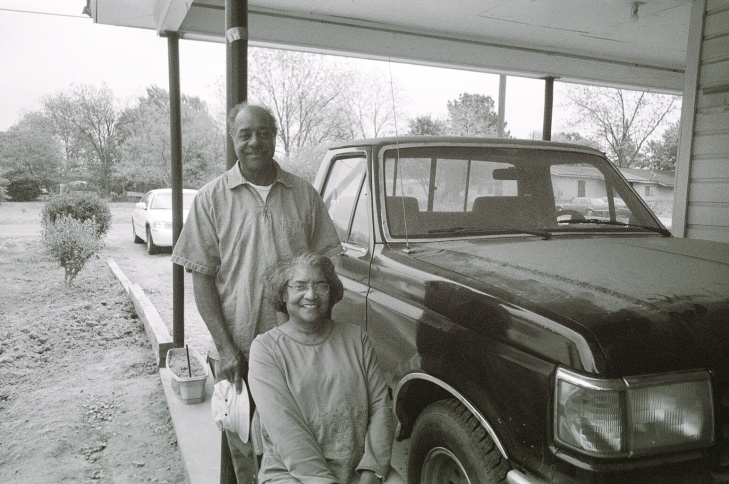
My Dad with his sister, auntie Lynnie a few years ago
My Dad with his sister, auntie Lynnie a few years ago