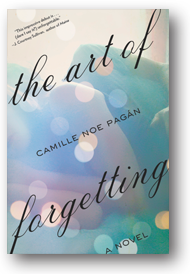
I understand that titles are often changed throughout the publishing process. Tell us how your title came about.
Hi Michael, thanks so much for including me on your stellar blog.
I was about halfway through the first draft of this novel when the title, The Art of Forgetting, came to me. It seemed spot on—and happily, my editor and publisher agreed! My agent tells me this is extremely rare, so I don’t anticipate it will happen for future novels.
What new things did you learn in writing this novel? For example, did you already have knowledge of Traumatic Brain Injury?
I’m a journalist by day, and I was writing an article about brain health when a doctor pointed out that brain injury is extremely common in women under the age of 40—more than breast and most other cancers, in fact. I started to research the topic and discovered that even a seemingly-small injury could lead to significant personality changes. It wasn’t long before I realized I had a great book plot on my hands. I did a lot of research while I was writing Forgetting—combing through medical journals, interviewing neurologists and even people who’d experienced brain injuries. What I learned is that while there are often commonalities in individuals with brain injury, no two brain injuries are identical in their symptoms. As a novelist, this gave me leeway to be creative with my plot and characters.
It seems your characters negotiated their friendships with care. All of them had their own unique qualities, their own memories, and perspectives shaped by remembered things. How did you balance the many needs, issues, and negotiations which were at work?
It was an extremely organic process: I tried to create characters who were true to life, from their larger motivations. I have to give a lot of credit to my agent and editor; this being my first novel, I made a lot of rookie mistakes—like having too many side characters—during earlier drafts. My editor, especially, helped me cull unnecessary information in order to streamline the story.
Who was your most challenging character to listen to, write, create? Do you know why?
Julia, hands down. She’s a very strong personality—someone with natural confidence who rarely doubts her own decisions. For that reason, she’s magnetic to Marissa, who can be meek and wishes she herself was naturally more confident.
Even after suffering a brain injury that alters her personality, many of Julia’s (often unlikable, if realistic) traits remain. Some readers told me that they hated Julia from start to finish, but the response I hear more often is that readers have had someone similar to Julia in their lives at one point.
Your story has a lot about body image, physical activity, and health in it. From running and dancing to building young girls, there’s a lot there. All of these are lengthy, relevant topics for children, youth, and adult readers. What kind of reception have you gotten relative to those topics? Any interesting feedback or stories from your readers?
You know, as someone who’s been writing about women’s health and psychology for more than a decade, I had a lot of material to work with and it felt natural to use it for my first novel. Women, especially younger women, spend a lot of time thinking about body image—not just their own, but body image as a concept, and what it means to be a woman comfortable in your own skin. I wanted this to be reflected in Marissa, who works at a women’s health magazine and struggles with some of the messages that her magazine conveys to readers.
The very best feedback I’ve received has been from readers who’ve suffered brain injury or who know someone who’s experienced brain injury. Not long after my novel was published, a woman who had copyedited the book contacted me. As it turned out, someone close to her had recently suffered a brain injury, and she said that my novel had been a source of comfort during that difficult time. It was the highest praise I could have received. To connect on that level, even with one reader—for me, that’s really the whole point of writing.
How would you like people to talk about this novel? What connections would you instigate from the book, if you could do so?
I didn’t write the book with a message in mind; the most I hope for with any novel is that readers will laugh a little and maybe cry a bit, too. The books that move me most are both funny and sad.
Discuss this stage of your novel’s life. It’s written, edited, and published. What are you doing with, for, and because of it now?
After 18 months of promoting Forgetting—before and during the hardback release, and then again when the paperback came out two months ago—I had to step back and just let it be. Right now, I’m focused on making my second novel as strong as it can be, which requires solid blocks of writing time and mental focus. Which means stepping away from Facebook, Twitter and blogs. It’s not easy!
What are you reading these days?
I’m just about finished with Nora Ephron’s HEARTBURN; the woman was a comedic genius. I recently read Matthew Norman’s terrific debut, DOMESTIC VIOLETS, which reminded me very much of Jonathan Tropper, who is one of my all-time favorite authors (I can’t wait for his latest, ONE LAST THING BEFORE I GO). I also enjoyed Gillian Flynn’s GONE GIRL—that’s sitting on the NYT bestseller list for a reason!—and Deborah Copaken Kogan’s THE RED BOOK. I’ve read a few that I didn’t love, too, but mum’s the word on those. It takes a lot of work to string 80,000+ words together in a coherent manner, so even if I didn’t connect with a book, you’ll never catch me trashing it or its author.
Are you working on anything you can talk about?
Absolutely! I just wrapped up the first draft of what I hope will be my second novel. It’s about four childhood friends who grew up in the Detroit area, one of whom becomes famous, and what happens when they reunite in their mid-thirties. I’m also reworking a historical fiction novel that I wrote last year. It needs a lot of work, but I have my fingers crossed that it will be published one day!
I know you don’t have time. I know that you may be at the beginning of the process or, worse, some where in the middle, and that middle looks like a big dark hole without relief or rescue or air. But do it anyway.
Your life is busy. Really busy. Your days are full, and next week is already jammed in your mind so that you’re starting to feel overwhelmed at my slight reminder that next week is next.
Creativity is far from you, even if there’s a little spark of wonder, discontent, and upset at the bottom of your stomach because you really are creative when you humbly say so yourself.
Give yourself room to make space for the words. You can’t make them come, but you can clean up the clutter that makes them uncomfortable.
You can close the door so they’ll feel welcome and confident that they won’t be shown prematurely to the world. They won’t feel like the naked things that they are; they’ll have time to explore the space behind the closed door. They may feel so hosted that they’ll stay a while.
You can turn on that lamp that makes you feel like doing something great, the one you bought at a yard sale before you moved into your new place. You can tell the words that they’ll be glad they came to dance in such a dazzling space.
You can sweep away the dead dry insects from the corner near your writing space because your words hate dead insects. You can turn off your phone and grab a pen and close your eyes and write your ABCs until the letters turn into words and the words turn into sentences and the sentences into the ideas underneath the noise of outside.
Imagine that you really are a storyteller, an idea machine, a keeper of some gift for the world. Then go sit down or stand up or walk around and write. Do it on your phone. Or on somebody’s permanently borrowed laptop. Do it on a legal pad, in a red moleskine, in an old ruffled spiral notebook, or on scraps of torn envelopes from mail you didn’t read.
Periodically I write and post a prayer for writers and for others. These prayers come out of my writing life, out of my hopes for the writers among us, and out of my desire for this blog to sit at the intersections between faith and writing. Pray them or a line from them, with and for the writers you read, know, and support. This prayer is about faith. Join me, if you will.
Dear God,
Unfold faith in us when our hands clench doubt. Pull the cord keeping us tied to what we see, and spin us in twirling circles of enfleshed hope. Open our eyes. Make our vision or visions clear, unencumbered by the litter of lifeless life. Where we sit and, then, lay in faithlessness, give us confidence to rise. Whisper to us the way babies do, in tones that are anything but quiet. Call to what talent you’ve placed inside us. Speak to our futures and talk to us until we believe enough to take one more step forward. Grant the same loud whisper tomorrow and each following day. When we are overwhelmed, convince us to stay faithful, to keep going, even when going is steep, hard, hardly possible. Give us little bits of you and make our days decorated by grace. We will be lonely in our work, and that loneliness will tempt us. Please be more powerful than the emotion that comes from our long obedience. Be more convincing than all the feelings within. Be more.
In the name of the One who wrote lost words in the sand,
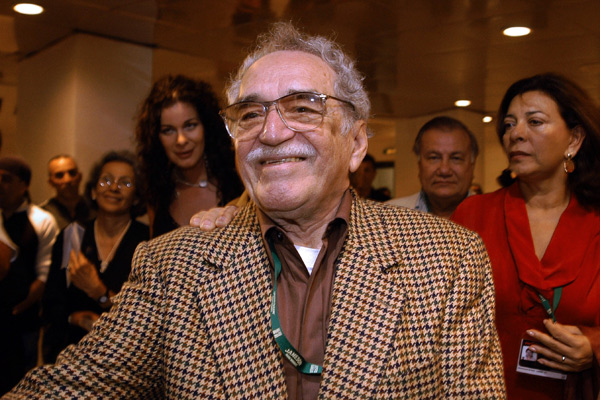
Nobel Prize-winning novelist Gabriel Garcia Marquez is suffering from dementia, which has made him unable to write, his brother says. “Dementia runs in our family, and he’s now suffering the ravages prematurely due to the cancer that put him almost on the verge of death,” Jaime Garcia Marquez, the author’s younger brother, told students in Cartagena, Colombia, the Guardian reported Saturday.
“Chemotherapy saved his life, but it also destroyed many neurons, many defences and cells, and accelerated the process,” Jaime continued. “But he still has the humour, joy and enthusiasm that he has always had.”
Gabriel Garcia Marquez, who is now in his mid-80s, is best known for his novel “One Hundred Years of Solitude,” first published in Spanish in 1967, which has sold more than 30 million copies worldwide. With it, he ushered in the genre known as magic realism, which combined fantastical elements and the real, and became closely associated with literature from Latin America.
“He has problems with his memory,” Jaime said. “Sometimes I cry because I feel like I’m losing him.”
Read this rest of this disheartening article where Gabriel’s brother says the author is unable to complete his last story by clicking here.
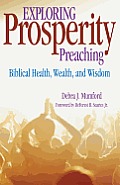
This book was graciously provided to me by Judson Press.
MW: I think one critical element within your book is faith. What is faith?
DM: Faith is the belief that God is able to do all things – even the seemingly impossible.
MW: Tell us what makes prosperity preaching so attractive. It’s a relatively recent development.
DM: At the core of prosperity preaching’s appeal that the hope that the American Dream which for many people has been elusive, can be realized by faith. If they have faith in God and are obedient to (what they are taught by prosperity preachers is) the word of God, they can be rich and enjoy perfect physical health.
This preaching is also attractive because it is cloaked inside of sound theology that sounds good. For example, four very appealing traits with which most Christians agree are:
Immovable, unshakeable faith. Nothing is impossible for God. So if Christians believe and do not doubt, nothing will be impossible for them.
Unlimited hope. Hope for a more abundant life compels believers to pray and believe for a tomorrow that is better than today. It is hard to live in this world without hope.
Personal accountability. Believers are taught to live righteous lives that are pleasing to God through prayer, reading the bible, being faithful in marriage, giving of tithes and offerings.
Importance of the Holy Spirit. Listeners are taught that the power of the anointing of the Holy Spirit is necessary for them to fulfill God’s will for them in the church and in the world.
The problem with each of these teachings is that they are taught as means of achieving financial wealth and perfect physical health. Though we all like to be beneficiaries of God’s blessings, we should strive to praise God and live Godly lives because we simply want to please the God who created us and sustains us daily.
MW: Why might other Christians have resisted this kind of hermeneutic in the past?
DM: Some people may have resisted this hermeneutic in the past because its message is problematic is many ways:
The preachers obtain their consistent message of prosperity by proof texting or interpreting verses of the bible out of context. Sighting isolated verses and ignoring the verses that come before and after them can make the bible mean almost anything.
When people do not become wealthy or have problems with their health, they (as individual followers) are blamed. Preachers tell their members that if they do not experience the wealth and health benefits prosperity preachers promise, they are obviously doing something wrong. Perhaps they do not have enough faith or are not working through all of the steps as the preachers instruct.
Adherents are encouraged to be individualistic in their thinking rather than communal. They are taught to pray and believe for their own prosperity rather than for prosperity for all people.
Social justice is overlooked. Members are taught that social ills of the world will disappear as more people are converted to Christianity. They are not taught that as Christians they have a moral and ethical responsibility to help all people and not just themselves.
MW: Talk about how your brother’s experience and your father’s ministry helped you in sustaining a critical book that was loving, analytical, and even. You could have been sharper in your exploration, but you weren’t. Yet you weren’t soft in your clear, pointed affirmations or disagreements either.
DM: It is because my father is a prosperity preacher and my brother was a member of a prosperity church that I worked to achieve balance in the book. My goal was to affirm teachings that were positive and to critique those that were not. I aimed for balance because I personally know that there are good and faithful Christians who are members of prosperity preaching churches and who preach and believe in the prosperity message. It is these people whom I had in mind when writing the book. I want them to understand from whence prosperity preaching originated and the positive and negative aspects of its teachings. I also wanted to offer them alternative ways of interpreting the bible and understanding theology.
MW: One of the important things you do, among many, is expand what poverty means. What is poverty? And can you talk about why the prosperity message, as it has been, has not necessarily been a message that for the world as much as for North America?
DM: I like the World Bank’s definition of poverty:
Poverty is pronounced deprivation in well-being, and comprises many dimensions. It includes low incomes and the inability to acquire the basic goods and services necessary for survival with dignity. Poverty also encompasses low levels of health and education, poor access to clean water and sanitation, inadequate physical security, lack of voice, and insufficient capacity and opportunity to better one’s life.
Their definition of poverty transcends money. It speaks to quality of life which I believe is what makes poverty so problematic. When people are poor, they are not only deprived of basic needs such as food, clothing and shelter, they are often also deprived of the opportunity to make their lives better. They cannot afford education and training that can help them get well- paying jobs. In our capitalistic society, money creates power. As a result, the opinions and needs of the poor are often overlooked and underrepresented. Hence, many of the poor find themselves caught in a cycle of poverty.
There are many poor in the United States of course. However, even people we consider poor in our nation, are not as poor as people in many other nations. Though it would seem that the prosperity message would not resonate well in very poor nations, it actually does. Prsoperity churches are located in nations such as Brazil, Kenya, and the Ukraine and many African countries. Many of the people who attend those churches want to be rich like people in the United States. However, the opportunities for them to become wealthy are often even more limited than they are in the US. Preaching prosperity in these poor nations is an especially egregious enterprise.
MW: I imagine you spend some time as a professor appealing to others to lean into the Bible and other sacred texts. In some ways you even put your own way of studying on the page. Why do you think it’s important to study the scriptures?
DM:The bible has been in the past and continues to be a sacred text for those of us who claim to follow Christ. The scriptures provide guidance for how we should treat our sisters, brothers, mothers, fathers, and our neighbors. It defines who our neighbors are. It offers encouragement when we want to give up, comfort when we are lonely and disheartened, strength when we are weak, and the opportunity to lament and grieve when we have suffered loss. The bible also informs the ways we see the world – that which we believe to be good and that which is bad. Unfortunately, the bible has also been used to discriminate against people for reasons such as gender, race, class, age, and sexuality. By learning to read the bible for ourselves, we will be better equipped to discern whether the messages being preached in our midst are true to the will of God. 2 Timothy 2:15 instructs us to study so that we can rightly divide the word of truth. We should all be willing to take the time to study the word of God for ourselves so we can better understand what God is calling us to do.
MW: It seems that the Word of Faith movement is, among other things, a severe attempt to apply the scriptures to a listener’s life. What are some ways you’ve suggested students/readers can approach, read, and apply the scriptures?
DM: Always pray for understanding before reading the scriptures. Then (1) read the text for basic understanding being sure to read as much of the chapter and book in which the text is found as possible; (3)use bible dictionaries, lexicons, and/or commentaries to define important and recurring words and phrases; and (4) research the geography, customs, current events, and politics of people in the text. This particular approach can enable people who read the Bible to mine its depths for deeper understanding. After following these steps, read the text again with the definitions and background information in mind. Then pray for God to help you determine how this text applies to your life.
MW: I kept thinking about theological education as I read your work. What do you see is the role of seminaries in educating leaders and non-leaders? How might congregations enhance what is happening in seminaries and divinity schools, again, for leaders and non-leaders?
DM: I believe that pastors and preachers are spiritual physicians. We would not allow medical personnel to attend to our needs without having been trained in their fields. Theological education is the training ground for pastors, preachers and religious educators. In seminaries and divinity schools women and men learn how to critically engage biblical texts, how to evangelize, how to think theologically about the world and its social conditions, how to preach and teach to different age groups and cultures, how to work effectively within the local culture of the congregations (church politics), how to engage with people who are theologically different they, and how to handle conflict. They also learn approaches to ministry to help them meet the many needs of their congregations.
People who are trained in seminaries can then teach people in their congregations how as well. Churches and denominational leaders can require their leaders earn degrees from seminaries and divinity schools. They can also encourage their members to attend seminars, lectures and conferences sponsored by theological institutions in their area. This way, all of the members will be exposed to theological education on some level.
MW: I appreciate how you gave several examples of ministers from the WOF and from the African American prophetic stream. Who are some of the preachers we who serve in churches need to hear, read, or study? Who can we not forget in your opinion, particularly from the prophetic stream?
DM:Donna Allen – Pastor, New Revelation Church, Oakland, California
Teresa Fry Brown – Professor of Homiletics and Director of Black Church Studies Candler School of Theology
MW: You talk about Christian entitlement and the danger of it. Explain that term and its accompanying dangers.
DM:Christian entitlement is the belief that only people who choose to follow particular teachings of Christ are entitled to certain benefits. It can cause people to ignore issues of social justice. If people believe they are the only people who deserve particular blessings from God, they may be less inclined to help people who believe differently than they. People who have the attitude of Christian entitle believe that, if people who believe they are being discriminated against would just be faithful, they would not have any problems. This attitude ignores the reality of systemic issues such as racism.
There may also be a sense of false pride or moral superiority. The moral superiority can cause people not to admit that though they are saved and sanctified, they are not perfect and should therefore extend to other people the grace they would like God to extend to them.
MW: What are you reading these days?
DM: I’ve been reading through the book of Job. I am always fascinated by the conversations he has with his friends throughout his ordeal. It raises questions about whether God tests us and how we respond to trials in our lives. It also raises questions about our faith in God – is it unconditional?
Books I have read recently include:
Your Spirits Walk BesideUs by Barbara Dianne Savage. Here she looks at a history of the intersections of African American religion and life through the works of icons like W.E.B. DuBois, Benjamin Mays and Carter G. Woodson, Mary McCleod Bethune, and Zora Neale Hurston.
A Quiet Revolution: The Veil’s Resurgence, from the Middle East to America by Leila Ahmed. Ahmed explores the issue of veiling for Muslim women by revealing the political, social, and religious issues at play in the lives of women who veil or do not veil.
The Anointed by Randall J. Stephens and Karl W. Giberson. The authors examine how leaders like James Dobson, Jerry Falwell, Ken Ham, Peter Marshall, Pat Robertson, Tim LaHaye, Oral Roberts came to wield their influences in the evangelical community and public square given the reality that many of them had few academic credentials (i.e. Ken Ham, founder of the Creation Museum, convinced thousands of people of the viability of his museum which rejects the concept of evolution).
MW: How can readers keep in touch with you and stay aware of your work?
DM: The seminary website and the website for my book are good places to stay aware of my work:
I am very thankful to have read Professor Mumford’s book. Share this interview with anyone you think would be interested in her work.
Professor Mumford mentioned Teresa Fry Brown above. Listen to Dr. Brown’s description of identity, preparation, and the preaching moment. There are a few pauses in the video, but you probably need them to think through her words…
Periodically I’ll write and post a prayer for writers. Other people can pray them, but they are coming out of my writing life, out of my hopes for the writers among us, and out of my desire for this blog to sit at the intersections between faith and writing. Perhaps you can pray them, or a line from them, with and for the writers you read, know, and support. This particular prayer is about ideas. Pray with me, if you will.
Dear God,
For some of us countless ideas run around in our heads. For others of us the struggle is to start seeing anything at all. Grant us the ability to see when our heads are clouded, the ability to hear when the story is being told somewhere just beyond our ear’s grasp, and the ability to put enough form to that thing so it feels. Help us hold the idea gently. Help us appreciate and respect the models you’ve given our world, the idea generators whose stories stay and sustain. Sift through the mess and the garbage inside us so that what we find is truly a treasure. Search us and shine your light through us so that we can see ourselves as sparkling vessels capable of repeating the amazing in our work. Enable us to organize, to structure, and to take one step after another. Give us the gifts of something that can nourish the world. May we use them for good. Place in our hearts strength and stamina so we can see those nourishing gifts on display. And make us mindful to call them yours.
In the name of the One who wrote lost words in the sand,
MW: Tell us about you, perhaps before, behind, or beneath the pages of your work.
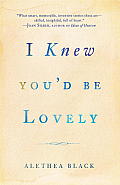
AB: I lead a fairly simple life. I live in a house on a lake with a wood-burning stove and a little dog (a dappled miniature dachshund) who’s sleeping beside me right now. I’m a night owl, which is too bad, because I’ve heard the sun rises over the lake. But the moon rises over it, too, so it all works out.
MW:How did you start writing, and how do you sustain your writing life?
AB: I started writing after my sister gave me a 1994 volume of The Best American Short Stories. Something about the stories in that anthology gave me a feeling of having come home. For many years I sustained my writing habit by proofreading for BusinessWeek, but I was laid off in 2009 when the magazine was bought by Bloomberg.
MW: What can you tell us about your writing process? What helps you nurture your work?
AB: I tend to write a lot when an idea is exciting to me and a project feels urgent — then I can really take the night owl tendency to extremes — and not to write very much when things aren’t hot. This is probably the exact opposite of what you’re supposed to do, so I wouldn’t necessarily recommend it, but it’s how things seem to work for me. I find ideas everywhere; the book I’m working on now takes its opening line from something a writer named Mo told me a couple of years ago at the all-night post office across from Madison Square Garden.
MW: Can you give us a view into your world of writing short stories? What makes the form of fiction interesting to you?
AB: I like intelligent stories with humor and heart, and that’s the kind I try to write. The thing I love about storytelling — I’ve been thinking about this lately — is that sense it can give you that everything is somehow okay, even when things are stupendously, outrageously not okay. There’s a mysterious sense of consolation that accompanies a well-told story.
MW: Your stories link through decisive moments. Each one looks to emerge from or respond to a slice of time that is significant for your characters. Did you always have that link or did that develop as you wrote?
AB: I had a teacher who told us that a writer should always be asking: “Why is this night different from every other?” I’ve tried to abide by that, even when it’s not Passover. The thing that interests me are those moments in life — even if they are subtle — when everything changes.
MW: How were you able to keep the stories fresh and engaging while keeping that common quality to them?
AB: Thank you for the compliment! I tend to write about everyday people in everyday situations but I try to find that spark of the extraordinary. If I can’t keep a story fresh and engaging, it goes in the trash and I start over. Life is short.
MW: The stories take place in the Northeast mostly—with my city being a shining exception! Do you see geography as important either for your stories in the collection or for your self as an author?
AB: Who doesn’t love Chicago? Actually, I’m not very interested in geography, and I don’t think of myself as a regional writer in any sense. When other writers start to talk about geography, that’s usually when I take a nap. The landscape that interests me is the human heart.
MW: What are you reading or about to read these days?
AB: I just read CORPUS CHRISTI by Bret Anthony Johnston; I’m partway through VOLT by Alan Heathcock; and I’m about to pre-order THE WORLD WITHOUT YOU by Joshua Henkin.
MW: Are you currently working on things you can talk about? If so, what? And how can my readers keep in touch with you?
AB: My agent has my next book, a short novel called THE KEY, about a woman who’s missing her dead father when a stranger in Grand Central Station hands her a key. The next next book is about two brothers, one successful and one feckless, who spend a weekend together. I love hearing from readers — it’s been my favorite part of the publishing experience. They can find me at http://aletheablack.com.
Now for the giveaway. If you’re interested in getting a free copy of Alethea’s collection, leave a comment with the title of the last book you read and a sentence about what you thought of the book. And maybe tell other people to do the same. Leave the comment by Friday 8, 11:59p.m. I’ll choose a winner sometime Saturday and email the winner for a mailing address.
Greg Hurwitz wrote a response to a friend who asked him his opinion about that friend writing a book. Greg posted his answer for the rest of us.
Strung together journal entries won’t work. They might make for a blog, but not a book. To write a book you have to write a book that is clearly a book and adheres to all the conventions and requirements of being a book. This is a shit-ton of work and will take drafts and time and sweat and blood until it’s either good enough to submit or you give up. As one of my writer buddies says: One of these will happen first.
Helpful to think about it, isn’t it? You should take a look at the entire post here.
Have you heard of Toni Morrison’s newest book, Home? This videos quickly covers the Medal of Freedom recipients and then offers an interview with the prizing-winning author. She talks, among other things, about “writing less to make it more.” Everything she says is worth hearing. Enjoy this enticing introduction of her latest novel.
I’m very grateful for you folks who read my posts. It’s bittersweet having to take an intentional break, but I have a stack of papers to read as my class finishes, a writing conference to attend, a retreat to participate in, and a revision to begin, along with the normal stuff.
Please come back and visit in a month when I resume blogging. Or, even better, subscribe over at the right so you can get the posts emailed.
I knew I’d lose people with the approach, but I was going to lose people anyway. That’s the nature of fiction: despite all our lofty claims of universality, no piece of art is for everyone—which is why we have so much art, so that everyone has a chance of finding something that moves them. I figured some people somewhere might connect with the tale even in second person.
Read more of Junot Diaz’s Q&A at the New Yorker by clicking here.
 I understand that titles are often changed throughout the publishing process. Tell us how your title came about.
 What are you reading these days?



 Michael Washington