I read Stephen King’s On Writing a while back, and I’ve been living this quote for the last little bit. It’s characterizing my days as I punch letters to make words and tell a story. From pg 269:
The scariest moment is always just before you start.
I read Stephen King’s On Writing a while back, and I’ve been living this quote for the last little bit. It’s characterizing my days as I punch letters to make words and tell a story. From pg 269:
The scariest moment is always just before you start.
 A couple months ago I mentioned that I had started writing again. I had been blogging. I had been reading. But writing was waiting. I hadn’t found the time, used the time, or took the time–whatever fits–to write. In October I had a conversation with Marisel Vera after she posted a few essays on Intersections, and I wrote daily after that chat.
After those months of consistent writing, I took a break for one month. I got tired. I had the holidays to deal with. I had to finish a semester at GETS, gathering grades and having final meetings. We had planning and things at the church. So it was a good time overall to pause.
My head was still working, but my fingers hadn’t been. I did some relevant-to-my-work-in-progress reading. I asked some questions to a few friends, questions which are behind some of my characters’ behaviors. I told folks that I was giving my unconscious a break, and it was actually the most misleading statement I could say about my writing process. In fact, my unconscious has still been working. It’s been grateful for the respite in key-punching if only because it wanted to flash images across my eyes, pull me into one or two critical scenes and not let me out easily.
The work has been different for the last month. I’ve been anxious. I’ve questioned how much pausing and thinking and reflecting and researching and interviewing were, indeed, a part of my writing process and whether it actually counted as writing. It has counted. At least so far as I can tell as I look forward. Every writer writes like this, including words and impressions and sights in, behind, and underneath the actual words in the story.
I’m restarting that part of writing which is really writing today. You may hear me reading my written words aloud. You may see me muttering over words when my laptop isn’t around. I might swipe your spiral bound journal and borrow a blank page. Don’t assume I’ve lost my bearings. I may be remembering something, on my way to a pen and a moleskin, alarmed that my memory may relax for an hour.
Starting today I’ll give myself a word count, though the count will be less than the 1,000 words per day I had done for the last round. I’ll work to meet it daily, breaking once per week and trying not to give myself any more off days until something like a first draft presents.
If you pray, pray for me that I’ll write well, that I’ll tell my story with integrity and depth and humor and all those other important parts. If you don’t pray, hope for me. That would be extremely generous.
The good people at WordPress.com prepared a 2011 annual report for this blog. I won’t post the one for my second blog, forfathers.wordpress.com, since it hasn’t seen a full year, but I would like to share this one. Perhaps you have feedback for me as well. I’m always open to reading suggestions–perhaps I can read and interview your favorite author–for example.
Whether or not you have feedback or suggestions, I appreciate that you follow, visit, and participate in the conversations and posts here.

Here’s an excerpt:
A New York City subway train holds 1,200 people. This blog was viewed about 7,900 times in 2011. If it were a NYC subway train, it would take about 7 trips to carry that many people.
These sentences sing to me. They’re from Andrew X. Pham.
It has been a long arduous road, filled with dark abysses, marvelous heights, gut-rotting doubts, exquisite joys, heartbreaks, piercing loneliness, lasting friendships, memorable feasts, and long stretches of hunger. The view ahead seems to promise more of the same.
I was browsing freshly pressed WordPress blogs about writing and saw Amy Nichols’ recent post. It’s an interview with her husband and it gives his perspective on what it’s like to live with a writer. I thought about a few similar experiences that me and the wife have had as I read it.
Because I wouldn’t ask Dawn these questions at this point–who has the time?–I’m forwarding a few of Amy’s questions and her husband’s responses. You can see the entire Q&A by clicking here.
Me: Am I a writer?
Him: Yes, but I think you spend more time being a writer than writing.
Me: Interesting. What is the difference between being a writer and writing?
Him: Doing all of the things that are trappings of the profession than the actual profession.
Me: Like what? What are those trappings?
Him: I would say mostly being online, doing things like blogs and facebooking and networking with people. That seems to happen far more of the time than actual writing.
Me: (gulp) Right. So how do you think that impacts a writer?
Him: What impacts a writer?
Me: Not writing.
Me: And what is your advice to a writer who isn’t writing?
Him: Write.
Me: Have you ever tried writing?
Him: Sure.
Me: And what did you think of it?
Him: It’s not a whole lot of fun. It’s fun to be done with it.
Me: What is it like living with a writer who is writing?
Him: Well, when you see them (laughs), it’s good because they’re excited, they’re energized by it. Mostly it’s they’re somewhere else, writing. Mostly it’s not seeing them. But when you do see them, they’re fired up and energetic and energized by it, so it’s good.
Me: Do you think it takes a special kind of person to be married to a writer?
Him: You know, I think it takes a special kind of person to be married to any other person. Everyone’s got their quirks, and a writer is just one way to be quirky.
Me: Would you prefer that I not be a writer?
Him: No, that would be worse. (laughs) I love the artistic part of you, and I would love to have the artistic part of you doing art all of the time and being happy about doing the art all of the time. The part I don’t like is the everything else that goes with it.
Me: The business side of it?
Him: Yeah.
Me: Do you think most writers would agree with that statement as well?
Him: I don’t know.
Me: What advice do you have for people who live with writers?
Him: I think the trick is to find balance. Say, this is your writing space, and when you’re not in that space, then you have to come out of that space. You can’t keep one foot in both worlds and try to be happy at all times. You need a sequestered time to work on it, and then you need a time when you’re going to interact with the planet.
Seth Godin is a careful observer, critical thinker, and creative mastermind. You should visit his site, learn about him, and draw, in your own way, from his genius. Here is a post he put up the other week. You can find Seth’s blog here.
Are you going to succeed because you return emails a few minutes faster, tweet a bit more often and stay at work an hour longer than anyone else?
I think that’s unlikely. When you push to turn intellectual work into factory work (which means more showing up and more following instructions) you’re racing to the bottom.
It seems to me that you will succeed because you confronted and overcame anxiety and the lizard brain better than anyone else. Perhaps because you overcame inertia and actually got significantly better at your craft, even when it was uncomfortable because you were risking failure. When you increase your discernment, maximize your awareness of the available options and then go ahead and ship work that scares others… that’s when you succeed.
More time on the problem isn’t the way. More guts is. When you expose yourself to the opportunities that scare you, you create something scarce, something others won’t do.
As I keep learning about publishing and writing, I continue to deepen my debt to a few people in the writing world. Today I’m nodding again to Michael Hyatt. He posted a great list of blog ideas for novelists.
Send your novel-writing friends to this if they’re interested in developing or continuing a blog. I’ve listed the first 5 ideas, and you can click below to keep reading.
- Excerpts from Your Novel. This is probably the easiest. It has the added advantage of allowing us, your potential readers, to “sample the brew.” Just write a paragraph to set up the excerpt. Oh, and be sure to link to your book, so we can buy it (duh).
- Backstory of Your Novel. Tell us why you wrote your novel. How did you settle onthis story? How did you come up with the main characters? Why did you chose the setting you did? What research did you have to do before you could start writing?
- A Behind-the-Scenes Look. Give us a sense of what it is like to be a novelist. How did you feel when you finally landed an agent? What does a typical writing day look like for you? What’s it like to see your book in print and hold a copy in your hand for the first time?
- “Directors” Notes. This is the kind of thing you occasionally see with extended versions of movies. Explain why you chose to start with a particular scene. Talk about the scenes you had to delete—or those you had to add to improve the story. Don’t underestimate the curiosity of your readers.
- Interview with Yourself. Authors often complain that professional reviewers haven’t read their book or don’t “get it.” Fine. Who knows your novel better than you? No one. So interview yourself. Have fun with it. What questions do you wish you would be asked?
To read the rest of Michael’s list, click here.
People are talking about our former governor’s sentencing, and I keep thinking about three things. I think about his family and how difficult this must be for them. I think about how this is an example, glowing or not, of our criminal justice system at work. I think about the book The New Jim Crow by Michelle Alexander.
 Professor Alexander’s book is thorough and full and dishearteningly descriptive of mass incarceration. I learned more than I’ll tell you in that book. I read it a couple months ago and became an immediate fan of Michelle Alexander. I didn’t plan to write a review of her book; in fact, I wouldn’t call this post a review but an expression of gratitude. I couldn’t arrange a blog interview with her unfortunately. But the fingers gripping the bars on that book cover keep looking at me. I keep thinking of what she wrote.
Professor Alexander discusses the War on Drugs primarily. She debunks the notion of the War, and she explains, in almost loving ways, how profit fuels the drug trade in our country and how the federal government rewards local and state political systems with money when they introduce people into the criminal justice system. If you’re interested in learning about the history of the drug trade, where police swat teams developed, and the rights you have when and if the police pull you over, those will be covered. There is a pervasive discussion of race in the volume. Men–and what’s happening to us–is discussed carefully and respectfully. She ties the excessive arrest rates in communities of color with policies from the 80s and threads the effects of those policies to the huge spikes in our prison population these days.
Professor Alexander does very little opining in the book. Instead, she tells stories. There are facts and facts and facts, but I couldn’t walk through the book with my highlighter. Even though I learned a lot, her book felt more like a kitchen table than it did a legal seminar. And I mean that in the most complimentary way imaginable. She places legal detail on an edible plate for her readers, and you can almost feel her hand on your shoulder while you swallow the truth when it gets nasty.
If you haven’t picked up this book and read it, you need to. I realize that I say that about many books. I realize that I interview authors on this blog and that their books have my highest recommendations. I tell you what I’m reading and sometimes why I’m reading it, along with what I’m learning from those readings. I get it. And you know that I like reading almost as much as I do eating because I need both to survive. And again, The New Jim Crow is one of those books that should be required reading. You should get it because it will teach you about the prison system. It will provide you a historical context for discrimination and help you speak well about justice and injustice and crime and restoration. It will give you a hunger, and perhaps a vision, for justice.
Be clear: the book is dismal because Professor Alexander is too good at what she does. She paints portraits and tells stories in ways that leave you sad and angry and frustrated. But you won’t close your nightly reading without feeling a little more grateful for people who pursue justice in the wide ways that people do. Even people who work and serve the cause of justice in ways that may not intersect with the criminal justice system.
You won’t look at a news story or listen to a conversation about jail and prison and justice in the same way. You’ll ask different questions. You’ll wonder why so many people who look like you continue to go overlooked when a former governor gets convicted and sentenced. You’ll wonder who will tell those stories. You’ll question who will raise their faces and those of their families. And then you’ll see those fingers gripping those bars on that glossy black book jacket. And you’ll smile and you just may write a post or an email to somebody and mention a scholar and activist and teacher named Michelle Alexander.
Visit Michelle Alexander’s website here to learn about her book.
 I’m pleased to give you an interview with Heidi Durrow, author of the New York Times Bestseller, The Girl Who Fell From The Sky. Heidi shares stories with others in great ways, and she’s given thoughtful answers about her first published novel.
Also, I didn’t ask about this in the interview here, but Heidi created in 2008 and continues to offer the Mixed Roots Film & Literary Festival. In addition to this interview, you can learn about Heidi’s work at her website by clicking here.
MW: Give us an idea of who you are. That’s broad, but you’re an author and who else?
HD: I’m a writer, and podcaster and festival producer and avid bendy-straw user, and Moleskine junkie, and storyteller.
MW: I think, in part, this story is about a well-loved girl growing up through pain. Would you comment on the ways Rachel was offered love by people in her life? How were those people part of her growth or development or healing?
HD: Rachel is very loved and so differently by all the people in her life. There’s her aunt who loves Rachel as if she’s a reflection of her young self and wants to get it right to give Rachel every possibility. There’s Grandma Doris who loves Rachel hard; she’s super-strict and believes that her strict rules express her love. And there’s of course her mother whose love is about keeping her safe. For Nella, loving her daughter means keeping her safe from every danger there is.
MW: What do you think your story says about memory and remembering? Certainly it is a story that must simply be read, but if it says something about how we remember, what might that be?
HD: It is very much a novel about the need for remembering. The story begins with Rachel denying her own memories of her life before the tragedy in which her family perishes. Forgetting–at least in Grandma’s mind–is the best way to move forward. And yet, Rachel discovers that her memory of her mother and siblings will not be denied. Essentially, she learns that it is only by acknowledging the truth of her past that she is able to move forward. The line between her past and future isn’t that stark.
MW: Writers draw from life, their own and those of others. To what extent did you draw from your life’s details, and what was it like emotionally to pull from your story to write Rachel’s?
HD: The things that happen to the characters in the book didn’t happen to me or people I know, but the emotional touchstone is very much a part of my own experience and that of those I know. It was extremely difficult for me to write the book — there is a lot of pain and grief in the story and it was what I was feeling as I wrote it. I’m in a different place now in my life and the new book I’m finding also has a very different emotional feel.
MW: Several of your characters enable Rachel to live in response to being abandoned or left by some of her family. Which character would you be most likely to tell a problem to and why?
HD: I would definitely confide in Brick. He’s so absolutely loving and non-judgmental. Here’s a character who has only known abandonment and abuse and yet, he’s always open to love. That’s his default even though it could be a horrible risk. I don’t know if he would know how to solve every problem folks share with him because he is so young, but you certainly wouldn’t feel alone in a dilemma with Brick on your side.
MW: You use multiple viewpoints effectively in the novel. They enrich the work and help me see the story from several angles. What aided you in writing the novel that way? How did you organize yourself while writing?
HD: I started the novel with just Rachel’s voice. I soon realized that she was an unreliable narrator and I needed add other voices in. The voices entered the story quite organically as I needed them.
MW: Talk about Roger. We get powerful glimpses of him. Why do you think he made some of the choices he did? Do you think he loved his family, his daughter?
HD: Roger loved his family and his daughter, but he just didn’t make the right choices. He is an alcoholic and made some very bad choices under the influence. But then even once he’s sober (after the tragedy) he still decides that the best way to be a father is to be absent. I think that’s a coward’s choice. I think Roger could have learned to be a good father–he was learning to be a better man. Unfortunately, many fathers make the choice to be absent (or present only monetarily) and we as a society should address this head-on.
MW: How has your novel encouraged or provoked language about race? Have you been able to carry on, or participate in, conversations from the story, if I can say it that way?
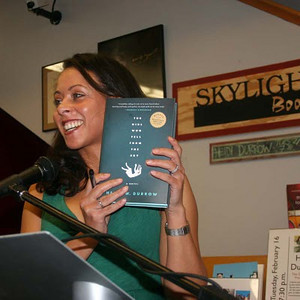 HD: It’s been very exciting to talk to readers about the book and inevitably about race and culture and what it means to be American. Having the story in their hand gives them a kind of permission to talk about these difficult issues and I think most people feel a great relief. I’ve had some exciting conversations — no answers — but I think the first step is always trying to come up with new questions about the issues — then maybe we can have new thoughts.
MW: What are you reading these days?
HD: I’ve been doing a lot of non-fiction reading for the new book about the theory of sudden change, evolution, Victorian spiritualism and the Impressionists. You’d be surprised how much all of those subjects have something to do with each other. It’s surprising me as I write.
MW: Are you working on projects you can talk about? How can readers keep connected to you?
HD: I’m working on a new novel inspired by the life of a Victorian era mixed-race trapeze artist and strongwoman who was super-famous in her time but is unknown today. (Degas did a portrait of her — one of his most famous.) I love to hear from readers. I will continue with more readings and speeches on the road in 2012. My appearance schedule is on my website; if you join my mailing list you can get an update every 6 weeks. And you can also find me on Facebook (http://www.facebook.com/author.heidi.durrow) and Twitter (@heididurrow).
Now for the giveaway. Leave a comment about why you’d like to get Ms. Durrow’s book. I’ll choose a winner from the comments after midnight, CST, Wednesday. Maybe you can give a gift in the form of The Girl Who Fell From The Sky. Either way do get your hands on this book.
Join me tomorrow for an interview with Heidi Durrow and a book giveaway of her novel The Girl Who Fell From The Sky. This is CNN’s Red Chair interview with Heidi.
 bell hooks is one of my favorite people. I have several of books. I heard her during my first week as a student at Hampton University, long before I knew what a great education was. And I listened to her at Northwestern a few years ago. She’s always engaging, insightful, brilliant, loving, and fearless. If you are a writer and haven’t met her printed work, you must. If you’re interested in learning about love, read her. Here’s a passage from Remembered Rapture: The Writer at Work. Her words would be considered opposite what I’ve read and learned relative to publishing, which makes her counsel all that more valuable when it comes to writing.
Writers should not dwell on the issue of audience. However, it is essential for any writer who wants to speak to a general audience without perpetuating structures of domination to write in a manner that welcomes any reader. Writers do not need to worry about whether our words can carry us across the boundaries of race, sex, and class. Words invite us to transgress–to move beyond the world of the ordinary. If that were not so the world of the book would have no meaning. This does not mean that writers should not be vigilant about the way we use words. Here the old truism “It’s not what you say but how you say it” holds. Irrespective of the subject matter, whether it reflects a common experience or not, readers are capable of great empathy. Writers must trust that readers are ready to receive our words–to grapple with the strange and unfamiliar or to know again what is already known in new ways.
Writing is not just jotting down ideas. Often we say, “I don’t know what to write. I have no thoughts worth writing down.” But much good writing emerges from the process of writing itself. As we simply sit down in front of a sheet of paper and start to express in words what is on our minds or in our hearts, new ideas emerge, ideas that can surprise us and lead us to inner places we hardly knew were there.
One of the most satisfying aspects of writing is that it can open in us deep wells of hidden treasures that are beautiful for us as well as for others to see.

 Michael Washington