Thurman on Christmas, 1 of 3

One of my favorite people, Howard Thurman, writes the following in Meditations Of The Heart.  It’s amazing how relevant his writings continue to be.  I hope this can be meaningful for you as you think about the irony of a greeting like “Merry Christmas,” whether you employ it or hear it.

There is a strange irony in the usual salutation, “Merry Christmas,” when most of the people on this planet are thrown back upon themselves for food which they do not possess, for resources that have long since been exhausted, and for vitality which has already run its course.  Despite this condition, the inescapable fact remains that Christmas symbolizes hope even at a moment when hope seems utterly fantastic.  The raw materials of the Christmas mood are a newborn baby, a family, friendly animals, and labor.  An endless process of births is the perpetual answer of life to the fact of death.  It says that life keeps coming on, keeps seeking to fulfill itself, keeps affirming the margin of hope in the presence of desolation, pestilence and despair.  It is not an accident that the birth rate seems always to increase during times of war, when the formal processes of man are engaged in the destruction of others.  Welling up out of the depths of vast vitality, there is Something at work that is more authentic than the formal, discursive design of the human mind.  As long as this is true ultimately, despair about the human race is groundless.

Acknowledging Culture, Favoring Sookespeople

My friend, David Swanson, reflecting on the saint who was Fred Shuttlesworth and the superstar who was Steve Jobs:

Relevancy is not always bad. We are culturally bound creatures who, whether we try to or not, will speak and act from the cultures that have formed us. But there is a considerable difference between acknowledging our culture and favoring its values and spokespeople as evidence of our ministry effectiveness.

Click here to read David Swanson’s article at our of ur.

Seth Godin and “your competitive advantage”

Seth Godin is a careful observer, critical thinker, and creative mastermind.  You should visit his site, learn about him, and draw, in your own way, from his genius.  Here is a post he put up the other week.  You can find Seth’s blog here.

Are you going to succeed because you return emails a few minutes faster, tweet a bit more often and stay at work an hour longer than anyone else?

I think that’s unlikely. When you push to turn intellectual work into factory work (which means more showing up and more following instructions) you’re racing to the bottom.

It seems to me that you will succeed because you confronted and overcame anxiety and the lizard brain better than anyone else. Perhaps because you overcame inertia and actually got significantly better at your craft, even when it was uncomfortable because you were risking failure. When you increase your discernment, maximize your awareness of the available options and then go ahead and ship work that scares others… that’s when you succeed.

More time on the problem isn’t the way. More guts is. When you expose yourself to the opportunities that scare you, you create something scarce, something others won’t do.

13 Blogging Ideas for Novelists

As I keep learning about publishing and writing, I continue to deepen my debt to a few people in the writing world.  Today I’m nodding again to Michael Hyatt.  He posted a great list of blog ideas for novelists.

Send your novel-writing friends to this if they’re interested in developing or continuing a blog.  I’ve listed the first 5 ideas, and you can click below to keep reading.

  1. Excerpts from Your Novel. This is probably the easiest. It has the added advantage of allowing us, your potential readers, to “sample the brew.” Just write a paragraph to set up the excerpt. Oh, and be sure to link to your book, so we can buy it (duh).
  2. Backstory of Your Novel. Tell us why you wrote your novel. How did you settle onthis story? How did you come up with the main characters? Why did you chose the setting you did? What research did you have to do before you could start writing?
  3. A Behind-the-Scenes Look. Give us a sense of what it is like to be a novelist. How did you feel when you finally landed an agent? What does a typical writing day look like for you? What’s it like to see your book in print and hold a copy in your hand for the first time?
  4. “Directors” Notes. This is the kind of thing you occasionally see with extended versions of movies. Explain why you chose to start with a particular scene. Talk about the scenes you had to delete—or those you had to add to improve the story. Don’t underestimate the curiosity of your readers.
  5. Interview with Yourself. Authors often complain that professional reviewers haven’t read their book or don’t “get it.” Fine. Who knows your novel better than you? No one. So interview yourself. Have fun with it. What questions do you wish you would be asked?

To read the rest of Michael’s list, click here.

Former Governor Sentenced & The New Jim Crow

People are talking about our former governor’s sentencing, and I keep thinking about three things.  I think about his family and how difficult this must be for them.  I think about how this is an example, glowing or not, of our criminal justice system at work.  I think about the book The New Jim Crow by Michelle Alexander.
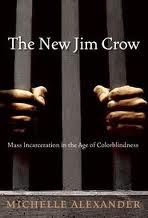
Professor Alexander’s book is thorough and full and dishearteningly descriptive of mass incarceration.  I learned more than I’ll tell you in that book.  I read it a couple months ago and became an immediate fan of Michelle Alexander.  I didn’t plan to write a review of her book; in fact, I wouldn’t call this post a review but an expression of gratitude.  I couldn’t arrange a blog interview with her unfortunately.  But the fingers gripping the bars on that book cover keep looking at me.  I keep thinking of what she wrote.

Professor Alexander discusses the War on Drugs primarily.  She debunks the notion of the War, and she explains, in almost loving ways, how profit fuels the drug trade in our country and how the federal government rewards local and state political systems with money when they introduce people into the criminal justice system.  If you’re interested in learning about the history of the drug trade, where police swat teams developed, and the rights you have when and if the police pull you over, those will be covered.  There is a pervasive discussion of race in the volume.  Men–and what’s happening to us–is discussed carefully and respectfully.  She ties the excessive arrest rates in communities of color with policies from the 80s and threads the effects of those policies to the huge spikes in our prison population these days.

Professor Alexander does very little opining in the book.  Instead, she tells stories.  There are facts and facts and facts, but I couldn’t walk through the book with my highlighter.  Even though I learned a lot, her book felt more like a kitchen table than it did a legal seminar.  And I mean that in the most complimentary way imaginable.  She places legal detail on an edible plate for her readers, and you can almost feel her hand on your shoulder while you swallow the truth when it gets nasty.

If you haven’t picked up this book and read it, you need to.  I realize that I say that about many books.  I realize that I interview authors on this blog and that their books have my highest recommendations.  I tell you what I’m reading and sometimes why I’m reading it, along with what I’m learning from those readings.  I get it.  And you know that I like reading almost as much as I do eating because I need both to survive.  And again, The New Jim Crow is one of those books that should be required reading.  You should get it because it will teach you about the prison system.  It will provide you a historical context for discrimination and help you speak well about justice and injustice and crime and restoration.  It will give you a hunger, and perhaps a vision, for justice.

Be clear: the book is dismal because Professor Alexander is too good at what she does.  She paints portraits and tells stories in ways that leave you sad and angry and frustrated.  But you won’t close your nightly reading without feeling a little more grateful for people who pursue justice in the wide ways that people do.  Even people who work and serve the cause of justice in ways that may not intersect with the criminal justice system.

You won’t look at a news story or listen to a conversation about jail and prison and justice in the same way.  You’ll ask different questions.  You’ll wonder why so many people who look like you continue to go overlooked when a former governor gets convicted and sentenced.  You’ll wonder who will tell those stories.  You’ll question who will raise their faces and those of their families.  And then you’ll see those fingers gripping those bars on that glossy black book jacket.  And you’ll smile and you just may write a post or an email to somebody and mention a scholar and activist and teacher named Michelle Alexander.

Visit Michelle Alexander’s website here to learn about her book.
How Do You Write A Poem

how do you write a poem

about someone so close

to you that when you say ahhhhh

they say chuuuu

what can they ask you to put

on paper that isn’t already written

on your face

and does the paper make it

any more real

that without them

life would be not

impossible but certainly

more difficult

and why would someone need

a poem to say when i come

home if you’re not there

i search the air

for your scent

would i search any less

if i told the world

i don’t care at all

and love is so complete

that touch or not we blend

to each other the things

that matter aren’t all about

baaaanging (i can be baaaanged all

day long) but finding a spot

where i can be free

of all the physical

and emotional demands and simply sit with a cup

of coffee and say to you

‘i’m tired” don’t you know

those are my love words

and say to you “how was your

day” doesn’t that show

i care or say to you “we lost

a friend” and not want to share

that loss with strangers

don’t you already know

what i feel and if

you don’t maybe

i should check my feelings

By Nikki Giovanni

Hooks and moving “beyond the world of the ordinary”

bell hooks is one of my favorite people.  I have several of books.  I heard her during my first week as a student at Hampton University, long before I knew what a great education was.  And I listened to her at Northwestern a few years ago.  She’s always engaging, insightful, brilliant, loving, and fearless.  If you are a writer and haven’t met her printed work, you must.  If you’re interested in learning about love, read her.  Here’s a passage from Remembered Rapture: The Writer at Work.  Her words would be considered opposite what I’ve read and learned relative to publishing, which makes her counsel all that more valuable when it comes to writing.

Writers should not dwell on the issue of audience.  However, it is essential for any writer who wants to speak to a general audience without perpetuating structures of domination to write in a manner that welcomes any reader.  Writers do not need to worry about whether our words can carry us across the boundaries of race, sex, and class.  Words invite us to transgress–to move beyond the world of the ordinary.  If that were not so the world of the book would have no meaning.  This does not mean that writers should not be vigilant about the way we use words.  Here the old truism “It’s not what you say but how you say it” holds.  Irrespective of the subject matter, whether it reflects a common experience or not, readers are capable of great empathy.  Writers must trust that readers are ready to receive our words–to grapple with the strange and unfamiliar or to know again what is already known in new ways.

Nouwen “Writing, Opening a Deep Well”

Writing is not just jotting down ideas.  Often we say, “I don’t know what to write.  I have no thoughts worth writing down.”  But much good writing emerges from the process of writing itself.  As we simply sit down in front of a sheet of paper and start to express in words what is on our minds or in our hearts, new ideas emerge, ideas that can surprise us and lead us to inner places we hardly knew were there.

One of the most satisfying aspects of writing is that it can open in us deep wells of hidden treasures that are beautiful for us as well as for others to see.

Warner and the “inner critic”

Brook Warner offers writers some compelling advice.  She talks about the writer’s inner critic and all the things the critic says.  She says that we should take it all in, breathe deeply, and ask if any of the critic’s messages are based in fear.  Brook’s words spill beyond the work and life of the writer…

Your inner critic is a loud mouth who sits on a pile of fear in hopes that you won’t risk yourself. If you don’t try, you can’t fail. If you never risk, you maintain the status quo. If you don’t stretch yourself, you stay safe.

Our writing pushes us outside of our comfort zone because it challenges us to be more visible, bigger, more truthful, to take a stand for ourselves and what we want.

I challenge you to write down your list of fears and hang it in your writing space this week. It’s amazing how giving voice to something lessens its charge. When you sit down to a message that says, “Your writing sucks,” rather than getting worked up about it, answer with, “Yes, it mostly does, but this is a content dump.” The point of SheWriMo is to write. It’s okay if it’s shit. The whole challenge is about getting yourself into the habit of writing and setting a pace.

So let it be shit. And do invite your critic into your writing space this week. By the end of the week you might just have a new friend.

Read Brook’s entire post over at She Writes.