For Future Generations

Have you seen this letter?  It’s rich with words that, I imagine, you will agree and disagree with given our increasingly divisive political discourse around marriage.  It is, in part, a completely pastoral letter, written by Catholic bishops for their flock in England and Wales, where pastoral has to do with the recognized church leadership giving sound, biblical, and/or theological guidance to those members in their care, particularly, and in this case, when it comes to the issue of marriage in the UK.

These letters are worn and read into the fabric of Christians, and people familiar with Christianity, no matter whether Catholic, Orthodox, or Protestant.  A portion of the Christian Scriptures are essentially pastoral letters which address timely concerns.  Of course, the “damaging pages” of our Scriptures make a broader impact since they are canonized within the Bible.

Take a look at the letter.  It’s a touch longer than you may be accustomed.  I found it originally here.

Do you learn anything from it?  Does it widen or shrink your own views about marriage?  Does it help you see what this church in the UK is passing on to future generations?

This week the Coalition Government is expected to present its consultation paper on the proposed change in the legal definition of marriage so as to open the institution of marriage to same-sex partnerships.

Today we want to put before you the Catholic vision of marriage and the light it casts on the importance of marriage for our society.

The roots of the institution of marriage lie in our nature. Male and female we have been created, and written into our nature is this pattern of complementarity and fertility. This pattern is, of course, affirmed by many other religious traditions. Christian teaching fills out this pattern and reveals its deepest meaning, but neither the Church nor the State has the power to change this fundamental understanding of marriage itself. Nor is this simply a matter of public opinion.

Understood as a lifelong commitment between a man and a woman, and for the creation and upbringing of children, marriage is an expression of our fundamental humanity. Its status in law is the prudent fruit of experience, for the good of the spouses and the good of the family. In this way society esteems the married couple as the source and guardians of the next generation. As an institution marriage is at the foundation of our society.

There are many reasons why people get married. For most couples, there is an instinctive understanding that the stability of a marriage provides the best context for the flourishing of their relationship and for bringing up their children. Society recognises marriage as an important institution for these same reasons: to enhance stability in society and to respect and support parents in the crucial task of having children and bringing them up as well as possible.

The Church starts from this appreciation that marriage is a natural institution, and indeed the Church recognises civil marriage. The Catholic understanding of marriage, however, raises this to a new level. As the Catechism says: ‘The matrimonial covenant, by which a man and a woman establish between themselves a partnership of the whole of life, by its nature is ordered toward the good of the spouses and the procreation and education of offspring; this covenant between baptised persons has been raised by Christ the Lord to the dignity of a sacrament.’ (para.1601)

These rather abstract words are reflected however imperfectly in the experience of married couples. We know that at the heart of a good marriage is a relationship of astonishing power and richness, for the couple, their children, their wider circle of friends and relations and society. As a Sacrament, this is a place where divine grace flows. Indeed, marriage is a sharing in the mystery of God’s own life: the unending and perfect flow of love between Father, Son and Holy Spirit.

We know, too, that just as God’s love is creative, so too the love of husband and wife is creative of new life. It is open, in its essence, to welcoming new life, ready to love and nurture that life to its fullness, not only here on earth but also into eternity.

This is a high and noble vision, for marriage is a high and noble vocation. It is not easily followed. But we are sure that Christ is at the heart of marriage, for his presence is a sure gift of the God who is Love, who wants nothing more than for the love of husband and wife to find its fulfilment. So the daily effort that marriage requires, the many ways in which family living breaks and reshapes us, is a sharing in the mission of Christ, that of making visible in the world the creative and forgiving love of God.

In these ways we understand marriage to be a call to holiness for a husband and wife, with children recognised and loved as the gift of God, with fidelity and permanence as the boundaries which create its sacred space. Marriage is also a crucial witness in our society, contributing to its stability, its capacity for compassion and forgiveness and its future, in a way that no other institution can.

In putting before you these thoughts about why marriage is so important, we also want to recognise the experience of those who have suffered the pain of bereavement or relationship breakdown and their contribution to the Church and society. Many provide a remarkable example of courage and fidelity. Many strive to make the best out of difficult and complex situations. We hope that they are always welcomed and helped to feel valued members of our parish communities.

The reasons given by our government for wanting to change the definition of marriage are those of equality and discrimination. But our present law does not discriminate unjustly when it requires both a man and a woman for marriage. It simply recognises and protects the distinctive nature of marriage.

Changing the legal definition of marriage would be a profoundly radical step. Its consequences should be taken seriously now. The law helps to shape and form social and cultural values. A change in the law would gradually and inevitably transform society’s understanding of the purpose of marriage. It would reduce it just to the commitment of the two people involved. There would be no recognition of the complementarity of male and female or that marriage is intended for the procreation and education of children.

We have a duty to married people today, and to those who come after us, to do all we can to ensure that the true meaning of marriage is not lost for future generations.

With every blessing

Most Reverend V. Nichols, Most Reverend P. Smith

Five Female Writers in Chicago Literary History

Thanks to David Swanson for pointing me to this fine article at chicagoist.com in celebration of a few female writers who have contributed to Chicago and world literary history:

March is Women’s History Month; for 31 days we celebrate the women who have made our employment, the oration of our opinions, and our lifestyles possible.

When it comes to contemporary authors, there’s plenty of strong female voices in Chicago. This wasn’t always the case. Women have had to fight for their spot in society at the very least, and still are still presented with threats against their equal rights in today’s political mess. The Christine Sneeds and Audrey Niffeneggers of Chicago can thank plenty of individuals for their publications, but here are a list of five Chicago ladies who paved the way for their success.

Harriet Monroe (1860-1936)

Poets of Chicago and the world in general can thank Miss Harriet Monroe for the work championing the genre. Monroe was the founder and editor of Poetry: A Magazine of Verse. After gaining some popularity as poet and freelancer for The Tribune, she became increasingly agitated over the lack of recognition—and funding—for poets. And so, in 1912, Monroe reached out to 100 head honchos in Chicago to pay for a subscription to her new poetry magazine. With this money, Poetry was launched. Its success wascolossal in the genre: poets such as Ezra Pound, T.S. Elliot, and Carl Sandburg were all edited at one time or another by Monroe, and it was her support that ensured the longevity of their reputations.

Ida B. Wells (1862-1931)

Ida Wells is Chicago’s First Lady of Civil Rights, and a pivotal player in the the Women’s Suffrage Movement, Wells’ influence was cast through the power of journalism. She dove straight into investigation and exploitation of lynching in the U.S. with her pamphlets: Southern Horrors: Lynch Law in All Its Phases and A Red Record. In 1893 she and Frederick Douglass, among several others, organized a boycott against the World’s Columbian Exposition, arguing that the Exposition did not work with the black community to fairly display African American life. They distributed their pamphlet, Reasons Why the Colored American Is Not Like the Columbian Exposition, in protest. The list of Wells’ articles and documentation is endless, but the influence remains: she asserted herself within Chicago’s windy politics, and made it an easier place for the rest of us women to do so.

To finish reading, click here.

Fathers Know Best #6

FF: Describe your family.

JS: I like to think of my family as ‘typical,’ though I’m sure most people think the same of theirs, no matter how that looks. My wife, Annie, an educator in Chicago Public Schools, originally hails from Western Kentucky. We’ve been married 4 1/2 years now, and we live in the Ukrainian Village neighborhood of Chicago. I am a white boy from the Chicago suburbs (though I try my best to dispel such notions) who transplanted to the city about 5 years ago. I work from home as a freelance market research analyst. Back in July, we welcomed our daughter Lisa into the world. She is now 7 months old, and ready to tackle anything—a trait we like to encourage in her. We also have two cats: Leroy (aka “Fats”) and Bianca. They have been surprisingly good with the transition from being the ‘kitty-babies’ to simply being pets who don’t get the attention they were accustomed to. They also have a healthy sense of anxiety around Lisa—she likes to grab and pull their fur, and they like to run away from her before she gets the chance.

As funny as it is for me to say it, we’re one of those ‘crunchy’ families. We (Annie, really) had an unmedicated home birth; we use cloth diapers; and we do a bunch of other ‘crunchy’ things. Annie is all about it because it’s healthier, better for the environment, etc. I’m mostly on board because it’s so much cheaper! Instead of buying 3500+ diapers for a kid through potty training, we have about 25 cloth diapers (and we can re-use them if/when we have more kids!). Instead of having to haul around formula, bottles, find a way to heat water, etc, Annie can just feed her at the “milk bar.” Plus, since we nurse, it means I don’t have to get up as much in the night!

 
FF: How has fatherhood changed you?

JS: I used to get very little sleep because I didn’t need it and wasn’t tired. Now, I need more sleep than I’m getting, and my waking time is not all by choice.  In a deeper sense, I worry more and hope more. I worry about the world in which my little girl is growing up. I wonder if our culture will twist her sense of beauty and self-worth, or even cause her to think that her value is only found in her appearance. I worry about whether gender stereotypes will limit her notions of what she can do–if she feels forced to wear pink and love princesses and unable to wear lab coats or be an astronaut. I worry about the gangs in our neighborhood and find myself paying attention to the tags, hoping that the most recent dis won’t be cause for shootings when the weather warms. I find myself encouraged by the neighborhood school (where I’m already involved as an LSC member), which is fantastic. I worry about the potential for flooding in the condo we’re about to buy, and trust that there isn’t harmful mold hiding under the carpets.

But I have hope too. I have hope that she will be a friend to others. I have hope that she will love the Lord. I have hope that somehow, my muddling fathering will help guide her into a full and vibrant person. I have hope that she will be an advocate for positive change in her world. I have hope that the best thing I can do–the strongest vote I can make and the loudest voice I can raise–is to trust that by bringing a life into the world, I am making the world better.

 
FF: What mistakes have you made as a dad? Name at least one and talk about what it meant to you.

JS: I think the greatest mistake I’ve made thus far is not investing enough time in my relationship with my wife over the past 7 months. We’ve both been busy with the routine of taking care of Lisa, preparing for the next day, working, and trying to find a moment of sleep to overcome exhaustion. We’ve not spent enough time on dates. We’ve not spent enough time just talking to each other. Because of this, our relationship has suffered–not in serious ways, but in subtle ones that lurk beneath the surface. I don’t ever want to get to a point, even years from now, where our lack of connection with each other causes us to have distance. And the better we are as husband and wife, the better we are/will be as parents.  We’re certainly nowhere close to this yet, but I don’t want my daughter to grow up in a home where good, healthy relationships aren’t being modeled for her. (Did I mention that I worry more these days?)

 
FF: What’s the most helpful advice you heard when you were becoming a father or advice you’ve gained since you’ve been a father?

JS: As soon as you find out you’re going to be a dad, start sleeping as much as you can. You’ll be glad for it later.

The best advice I’ve figured out since I’ve been a father is to get in your baby’s face. Let them feel your face and pull your hair and slobber on your nose. Blow raspberries on their belly and listen to them laugh. Sing to them. There is nothing more joyful and wonderful and awe-inspiring as seeing your child–this creature that was so utterly helpless and dependent–begin to respond to you and interact with you. Even before they have language, a kid will express so much emotion and share her love to you as a parent. Get close, and soak in as much of it as you can.

 
FF: How do you attend to your relationship with your wife outside of your being parents, and has parenting changed your marriage?

JS: Hah! I didn’t read ahead, and I feel like I already answered this one above. Parenting has definitely changed our marriage, simply by refocusing our attention on the little one rather than on ourselves. It’s so much *effort* to get away on our own, and so much of our lives are dictated by the baby’s schedule. Even when we do manage dates, there’s a sense of urgency to get back home to the baby, rather than linger and simply sit and enjoy each others’ company.


FF:  Talk about the role you want to play in teaching your daughter.  I imagine Annie will be a good educator to her, since she is an educator, but how have you taught her.  How do you hope to?

JS: I read to her. Probably not often enough, though she’s usually more interested in eating the pages than looking at the pictures. Her favorite books at the moment are “Moo, Baa, La La La,” “Oso Pardo, Oso Pardo, Que Ves Ahi?” and “Daddy and Me”. I love reading to her. Whenever I go on walks with her, I try to point out and talk about the things I see–dogs and trees and stores and cars and whatever else is around. She is wonderfully alert and just loves to take it all in.I must say, the notion of “teaching” Lisa seems a bit funny at this point. Most of her ‘learning’ is just a matter of her figuring out the world around her and how she can interact with it. My role in teaching her that sort of thing is more just a matter of exposing her to new situations, people, and things, and letting her figure it out. She has a wonderful ability to study objects in a measured way before picking them up or moving them or whatever she wants to do. She’s very thoughtful and deliberate; I don’t have to do much except get out of her way.

As she gets older, I hope to teach her in so many ways. I hope to teach her to be kind, loving, compassionate, encouraging, and friendly. I hope to help her gain a sense of God in her life. I hope to help her find the rhythms of family and spirituality by establishing traditions and sticking to them. When she gets to school age, I hope to help her with her homework and look for ways to challenge her and push her even more. I hope to expose her to a wide range of ideas and people and experiences and places. I hope to teach her to love the outcast, to be compassionate to the people around her to suffer. I could go on…

 
FF: What surprises are there along the way for parents? What do you wish you were told to expect?

JS: Well, there’s always the explosive poop while the diaper is off and baby is on the changing table. That’s always surprising.

I wish I had been told to expect that relationships would be so much harder to sustain after the baby comes. In the past 7 months of parenthood, I have not spent nearly enough time with my friends. Nor has Annie. As wonderful as it is to be a parent, there’s a sense of loss when it comes to the freedom I used to have to spend time with friends. If you can, really cultivate deep friendships with friends and get them used to coming to your home. It will be so much easier to maintain friendships if it’s already ‘normal’ for them to reach out to you and to come to you than it is to a) remember that you have friends you haven’t seen in a while, b) figure out when you can schedule to meet them, and c) actually muster the energy to pack up baby’s stuff, leave the house, and visit for a short while. If you think it’s hard to see your friends now, it’s 5 times harder once you’ve got a baby. Be intentional about your friends.FF: What is one recent memory you made with your child?JS: Every moment is a memory I’d love to hold on to. But one that feels especially cool at the moment is from last week. I had put Lisa in a sitting position in her crib for a moment while I went to prepare a diaper for her. A moment after I put her down, she grabbed the rail of the crib and pulled herself into a standing position–the first time she stood up completely on her own! I was simply shocked, but had the presence of mind to grab my mobile phone and shoot a video (http://www.youtube.com/watch?v=CoJUZyMbIls) when she did it a second time a few moments later. Such a great moment of pride for me (look how much she’s progressing!) and a cool ‘first’ for her!


Penguin, Mullet, Bread

Last night at the closing of the AWP, I listened to Nikky Finney read several of her poems, a few from her National Book Award winning collection, Head Off & Split.  It was my first time hearing her in person and while I listened to her, I wanted to keep leaning in and listening.

When Professor Finney signed my copy of her collection, she asked if I was a writer, if I lived in Chicago.  I told her yes to both, and saying yes, in the company of a woman, writer, communicator, and advocate so powerful was its own affirmation.  If you don’t know her work, it can offer you life and renewal and fullness.  Really, I wouldn’t suggest that you linger over her careful words unless they’d be worth it.

A Day With A Different Beginning

Today began a little differently than most.  Usually Dawn is up before God and slips out of the house having kissed me goodbye and having avoided saying say to the boy if at all possible for fear that he’ll actually wake up, which will signal that I too must wake up.

Today Dawn was home for the second day of two consecutive sick days.  A virus has been lurking in our home, starting with my mother-in-law, moving to the boy, and finding my bride.  The kid was supposed to be about done with it, but the sneaky culprit has returned with all its sloppy juicy evidence.  I’ve spent days wiping surfaces, spraying handles and knobs, smelling my wife’s favorite fragrance that is bleach.

Well, today Bryce slept well beyond his wake up time, which was just fine with me until Dawn who, again, was home (when she’s normally at work) went in to wake him, even though she told me that I shouldn’t do precisely what she went in to do.  I should say that I mentioned to her that I was going to wake him at 8:30AM.  She walked by me in the kitchen, telling me not to wake him, and went in to hover—or something.

I heard him chirping his first greeting.  His “good morning” is a combination that has become a sweet melody in my ears, a special mixture of glee for having met another day and joy for seeing someone he loves as part of that day.  He “hi”ed to his mommy.  He wouldn’t be jumping as usual; he didn’t have the energy, I suppose, after all that extra sleep.  He was dazed in my imagination because he expected me to be there not his mother.  He was also happier in my imagination because he secretly likes his mother more than me.

Dawn started him into the bathroom, onto his potty.  He finished his business and I got the baton to start his breakfast.  It was oatmeal.  It was already waiting on the table since I had prepared to wake him.  It was cooled.  So I sat him in the chair, instructed him to eat.  He took his time.  He took a lot of his time.  He hardly lifted the spoon.  He ate half the oatmeal.  This was usual, unexceptional.  Sometimes he slows breakfast down and makes me remember what life is all about.  I turned on music, which is also usual.

I heard him groan.  I went back near him and stood there, and asked him what was wrong.  He sat there, spoon lifted, eyes glazing I figured from sleep.

And he threw up.

I heard it coming up and by the time the first drops fell on him, I was lifting my hand to catch the rest.  I was never really good at catching balls or bottles of pop or keys tossed from the other side of the room.  But today, a day with a different beginning, I was really good at cupping my boy’s chin and catching all the oatmeal, more moist than I first made it.  I was good at wiping his mouth and doing the opposite of what my wife was doing (turning away and shedding a tear) because somebody had to be non-anxious in the room.  I was so good at it that after I helped Dawn clean up, I almost forgot that the pungent smell of puke wasn’t lotion for my hands.  I almost walked out of the door having cleaned him and taken the slop of his upturned bowels just like I did my work bag as I turned a disinfected door knob.

Urgency of Accomplishment

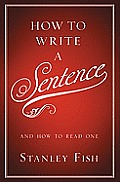
This is from Stanley Fish’s How To Write A Sentence.

Mortality is the condition of being able to die, regarded by many as a curse, but more properly appreciated as a gift, the gift of design and choice, of gain and loss, of hope and desperation, of failure and redemption, all modes of being that are available only to creatures who, like sentences (and novels), have a beginning, a middle, and an end.  It is the inevitability and shadow of death that provides life with a narrative arc, and provides moments in that narrative with a meaning; for the meaning of a moment–its distinctiveness–is a function of the place prepared for it by a past and the place waiting for it in a future that has (again, like a sentence) a terminal point… Without the specter and period of death, there would be no urgency of accomplishment, no expectations to be realized or disappointed, no anxieties to be allayed.  Each moment would bear an equal weight or equal weightlessness…

Read Fiction, Develop Empathy

A study by a Washington and Lee University psychology professor has demonstrated that reading a short work of fiction can lead readers to empathize with the work’s characters, to detect subtle emotional expressions more effectively and to engage in pro-social behavior.

Dan Johnson, assistant professor of psychology at Washington and Lee, published the results of his study in the November 2011 edition of the journal “Personality and Individual Differences.”

With the help of three W&L students — senior psychology majors Lauren Borden (Lake Leelanau, Mich.) and Grace Cushman (Wilton, Conn.) and sophomore Madison McCune (Nacogdoches, Texas) — Johnson had 200 subjects read a five-page fictional short story written specifically for the experiment, designed to elicit compassionate feelings for the characters and model pro-social behavior. The subjects then participated in exercises to measure the impact of the reading.

Based on the results of the post-reading exercises, Johnson concluded that the more immersed the readers were in the story, the more empathy they felt for the characters. In addition, he found that the heightened empathy led to an enhanced ability to perceive subtle emotional expressions such as fear or happiness. Individuals who experienced higher levels of empathy were also nearly twice as likely to engage in pro-social, or helpful, behavior as individuals experiencing low levels of empathy.

“An interesting component is that it really seemed to be a lot about the imagery and visualizing the face of the main character and the events they experienced,” said Johnson. “Those who experienced more inherent imagery were more likely to develop empathy for the characters and be more helpful.”

To finish reading Sarah Tschiggfrie’s article, click here.

Prepared For Manhood

I saw this post by Earl Hipp.  I think you’ll be interested in the work he’s discussing, in the film and follow up.  It may help you think of creative ways to heal your hurts or the wounds of folks you touch.

An engaged and loving father is the most powerful man-making force on the planet. The opposite is also true. When fathers are absent, physically or emotionally, the wound that results is profound. It touches a man to his core and forever leaves him with the question, “Am I good enough as a person and a man?” All men long to hear the biblical pronouncement from a father, “This is my beloved son, in whom I am well pleased.” The truth is that too many men and young males did not and do not hear it, and we are all paying the price as a result.

In my research for the Man-Making book, countless men offered up clear statements of their sense of masculine insufficiency as one of the barriers keeping them from being involved with and supporting young males. Too many men said they had been poorly prepared for manhood, their fathers had been unavailable, and as a result, they felt, as men, they didn’t have anything to offer boys. In the most tragic stories, some men felt such low masculine-esteem they believed their involvement with a boy would be damaging or hurtful to the young man. You can be certain that behind many of those stories is an invisible but still-open father wound.

In the Rite of Passage and group-mentoring work men are now doing with young males, an all too common story is about pathologically disengaged or abusive fathers or dads who were simply never part of a boy’s life. In the emotionally safe and supportive place that’s created, if it’s time, young males have the emotional room and permission to give up their deeply shielded and buried grief about their father wound. Often this shows up as powerful anger or deep sobbing. The tears in the eyes of so many of the men who hear these boy-stories are damp testimony to the pervasiveness of this father wound, and the core emptiness of the men that carry it. I have my own story about a present, but unavailable, shaming and emotionally terrorizing, alcoholic father.

To finish reading, click here.