The Country Where I Live

I think that if I didn’t have this outlet–which allows me to focus and have an ongoing passion–I would go crazy too. Whatever book I’m writing often becomes the organizing principle for my days–it’s what I think about from morning to night.  The book becomes the country where I live. Without it, I might go insane. That’s why vacation time is often really hard for me.

Samuel Park answering a question on Caroline Leavitt’s blog.

Bookman’s Alley Closing

I saw this on Chicago Tonight–another sad development in the literary life of the Chicago area.  Go here to see the segment on the show.

At Bookman’s Alley, the Evanston mainstay, the decorations—the top hats, the model ships, the presidential busts—are almost as important as the books. Toy airplanes are perched atop bookshelves, across the hall from a 19th century printing press.

When owner Roger Carlson opened the store more than 30 years ago, he wanted to finally open a used bookstore that didn’t have the same atmosphere as a soup kitchen.

“I was dressing the set, if you think of my shop as a presentation,” he said. “There are many fine used bookshops, but they tend to be pretty much devoted to displaying the books.”

Carlson likes to keep the decorations thematic. In the Western literature and history section, for example, “there’s a western saddle, and eight or nine hats and spurs,” Carlson said. “Everything but a cowboy sitting there, shooting at beer bottles.”

The creative decorating is part of why so many frequent the shop and why, as the store prepares to close in the news month or so, so many are interested in taking home a piece for themselves. Carlson says he’s holding on to most of it until the very end, but price tags have started popping up on gold bird figurines ($90) and black top hats ($85).

Carlson says declining sales at brick-and-mortar bookstores and recent health problems forced him to close. He’s been promising to close the store “soon” since December, but it’s taken him longer than he expected to liquidate his inventory.

To finish reading, click here.

Five Female Writers in Chicago Literary History

Thanks to David Swanson for pointing me to this fine article at chicagoist.com in celebration of a few female writers who have contributed to Chicago and world literary history:

March is Women’s History Month; for 31 days we celebrate the women who have made our employment, the oration of our opinions, and our lifestyles possible.

When it comes to contemporary authors, there’s plenty of strong female voices in Chicago. This wasn’t always the case. Women have had to fight for their spot in society at the very least, and still are still presented with threats against their equal rights in today’s political mess. The Christine Sneeds and Audrey Niffeneggers of Chicago can thank plenty of individuals for their publications, but here are a list of five Chicago ladies who paved the way for their success.

Harriet Monroe (1860-1936)

Poets of Chicago and the world in general can thank Miss Harriet Monroe for the work championing the genre. Monroe was the founder and editor of Poetry: A Magazine of Verse. After gaining some popularity as poet and freelancer for The Tribune, she became increasingly agitated over the lack of recognition—and funding—for poets. And so, in 1912, Monroe reached out to 100 head honchos in Chicago to pay for a subscription to her new poetry magazine. With this money, Poetry was launched. Its success wascolossal in the genre: poets such as Ezra Pound, T.S. Elliot, and Carl Sandburg were all edited at one time or another by Monroe, and it was her support that ensured the longevity of their reputations.

Ida B. Wells (1862-1931)

Ida Wells is Chicago’s First Lady of Civil Rights, and a pivotal player in the the Women’s Suffrage Movement, Wells’ influence was cast through the power of journalism. She dove straight into investigation and exploitation of lynching in the U.S. with her pamphlets: Southern Horrors: Lynch Law in All Its Phases and A Red Record. In 1893 she and Frederick Douglass, among several others, organized a boycott against the World’s Columbian Exposition, arguing that the Exposition did not work with the black community to fairly display African American life. They distributed their pamphlet, Reasons Why the Colored American Is Not Like the Columbian Exposition, in protest. The list of Wells’ articles and documentation is endless, but the influence remains: she asserted herself within Chicago’s windy politics, and made it an easier place for the rest of us women to do so.

To finish reading, click here.

Christian Fiction

Melanie C. Duncan provides a good summary of Christian fiction, describing why the overall genre is growing, and though I don’t write for the genre, her article is helpful if you’re interested in the area.  The full review is over at Library Journal.

Christian Fiction: A Born-Again Genre

With its focus on biblical values and traditionally low emphasis on profanity, sex, or violence, Christian fiction (CF) has long been popular with a certain readership, mostly white, female, and coming from an evangelical Protestant background. “I’m not sure I’d describe all of our readers as white women of child-bearing years or [suffering from] empty-nest syndrome,” says Harvest House publicist Aaron Dillon. “But our core demographic does seem to be middle-aged mothers, primarily white. We also have a large contingent of readers who homeschool their children.”

However, Christina Boys, editor for Hachette Book Group’s FaithWords and Center Street imprints, believes the CF audience to be much more diverse than the conservative stereotype held by the secular mainstream. “The core readers are said to be women in their 40s who like novels set in the United States. But there are CF readers who do not fit into this demographic, and there are women in their 40s who like to read about a variety of characters and circumstances different from their own.”

Preaching to the converted?

Often referred to as evangelical fiction to distinguish it from secular fiction, CF is still erroneously pigeonholed by some critics as simplistic storytelling or “gentle reads” that can’t compete with mainstream novels for complexity of plot and character development. Bethany House’s 1979 ground-breaking publication of Janette Oke’s Love Comes Softly, which combined an evangelical worldview with a historical romance, filled a niche long ignored by mainstream publishers, and is credited with pioneering modern inspirational fiction. However, the CF publishing industry could not have continued to thrive as it does today by offering a steady diet of bland novels under the guise of religious fiction.

Nor could the genre have expanded if it had followed a strictly fundamentalist path. While its early years were described in John Mort’s Christian Fiction: A Guide to the Genre (2002) as having “preached to the converted” and industry organizations like the Christian Booksellers Association (CBA) and the Evangelical Christian Publishers Association (ECPA) continue to prescribe guidelines for authors and publishers, today’s target CF audience has become more sophisticated and demographically diverse. There are more male and younger readers joining the fold and a steadily growing African American market.

A faith-based perspective remains at the core of evangelical fiction, but today’s fans are reading these books not just because of the Christian focus. They also love this genre because it quenches their inner thirst for knowledge, spiritual guidance, and, yes, entertainment.

To finish reading Melanie Duncan’s article, click here.

A writing prompt from a seasoned and always humorous agent about a query she received.

betsylerner's avatarBetsy Lerner

Got another query letter from prison today. It comes stamped on the back with a notice about what to do if you are receiving unwanted correspondence from an inmate. This particular prisoner quoted some of the best bits in The Forest For The Trees to impress upon me why I might like his work. Many writers have done this, but when it comes from the incarcerated it is unbelievably touching and a little scary. The letter was also hand written in the neatest imaginable block letters. Maybe I’ve seen Dead Man Walking too many times, but it amazes me to think that my book has found its way into a prison and a person there who wants or needs to write connected with it. I once read that a prisoner who was denied pencil and paper wrote sentences on the roof of his mouth with his tongue.

Did everybody write…

View original post 7 more words

Seth Godin and “your competitive advantage”

Seth Godin is a careful observer, critical thinker, and creative mastermind.  You should visit his site, learn about him, and draw, in your own way, from his genius.  Here is a post he put up the other week.  You can find Seth’s blog here.

Are you going to succeed because you return emails a few minutes faster, tweet a bit more often and stay at work an hour longer than anyone else?

I think that’s unlikely. When you push to turn intellectual work into factory work (which means more showing up and more following instructions) you’re racing to the bottom.

It seems to me that you will succeed because you confronted and overcame anxiety and the lizard brain better than anyone else. Perhaps because you overcame inertia and actually got significantly better at your craft, even when it was uncomfortable because you were risking failure. When you increase your discernment, maximize your awareness of the available options and then go ahead and ship work that scares others… that’s when you succeed.

More time on the problem isn’t the way. More guts is. When you expose yourself to the opportunities that scare you, you create something scarce, something others won’t do.

Warner and the “inner critic”

Brook Warner offers writers some compelling advice.  She talks about the writer’s inner critic and all the things the critic says.  She says that we should take it all in, breathe deeply, and ask if any of the critic’s messages are based in fear.  Brook’s words spill beyond the work and life of the writer…

Your inner critic is a loud mouth who sits on a pile of fear in hopes that you won’t risk yourself. If you don’t try, you can’t fail. If you never risk, you maintain the status quo. If you don’t stretch yourself, you stay safe.

Our writing pushes us outside of our comfort zone because it challenges us to be more visible, bigger, more truthful, to take a stand for ourselves and what we want.

I challenge you to write down your list of fears and hang it in your writing space this week. It’s amazing how giving voice to something lessens its charge. When you sit down to a message that says, “Your writing sucks,” rather than getting worked up about it, answer with, “Yes, it mostly does, but this is a content dump.” The point of SheWriMo is to write. It’s okay if it’s shit. The whole challenge is about getting yourself into the habit of writing and setting a pace.

So let it be shit. And do invite your critic into your writing space this week. By the end of the week you might just have a new friend.

Read Brook’s entire post over at She Writes.

Gardner and “…a dream in the reader’s mind.”

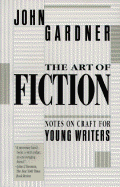
John Gardner in the Art of Fiction says a lot that writers should read.  For me his overall thrust is captured in a few helpful passages in his chapter on Basic Skills, Genre, and Fiction as Dream.  If you’re a writer of fiction and haven’t met this book, visit your nearest public library and thumb through it.

In any piece of fiction, the writer’s first job is to convince the reader that the events he recounts really happened, or to persuade the reader that they might have happened (given small changes in the laws of the universe), or else to engage the reader’s interest in the patent absurdity of the lie.  The realistic writer’s way of making events convincing is verisimilitude….

He must present, moment by moment, concrete images drawn from a careful observation of how people behave, and he must render the connections between moments, the exact gestures, facial expressions, or turns of speech that, within any given scene, move human beings from emotion to emotion, from one instant in time to the next….

…whatever the genre may be, fiction does its work by creating a dream in the reader’s mind.  We may observe, first, that if the effect of the dream is to be powerful, the dream must probably be vivid and continuous–vivid because if we are not quite clear about what it is that we’re dreaming, who and where the characters are, what it is that they’re doing or trying to do and why, our emotions and judgments must be confused, dissipated, or blocked; and continuous because a repeatedly interrupted flow of action must necessarily have less force than an action directly carried through from its beginning to its conclusion.

Five Questions For Writers

Jane Friedman is a gift for writers.  Her blog, There Are No Rules (which you can visit by clicking here) is full of resources, tips, summaries, and posts about writing, editing, publishing, marketing, and promotions.

In a recent post at Writer Unboxed, Jane offers writers five questions to ask when we wonder whether we have talent.  There are different questions, better questions, according to Jane.  Here is an excerpt with question 4:

4. What do you do after you fail?

Everyone fails. That’s not the important part. What’s important is what you do next. Are you learning? Are you growing? Is your experience making your heart bigger? Or is it shrinking you down, making you small? Beware of cynicism and bitterness, because if these emotions stick around too long, they will poison your efforts.

If you’re a writer or you know someone who is, pass these thoughts on.  If you’re interested to read more, see the full post here.

A Rabbi or A Novelist

I just finished Drawing in the Dust, the debut novel by Zoe Klein from 2009.  It’s a rich and detailed story about an archaeologist who has spent years working around Israel.  The main character, Page, spends her days unearthing artifacts from centuries prior, while the story takes readers through Page’s on personal and interior excavations.  She’s searching for answers, for connections, for her own heaven meets earth.  The story captures the sights, smells, and textures of places from biblical Israel to New York to a tiny cottage in Massachusetts and back to Israel.

In addition to the novel, the copy I have includes a Q & A with Zoe Klein who is the senior rabbi of Temple Isaiah, a large congregation in Los Angeles.  I wanted to post one question and Rabbi Klein’s answer.  She’s done a fascinating thing in writing this novel.  If you’re adding to your summer reading list or looking for something you can delve into, get Drawing in the Dust.

Though the two are not mutually exclusive, what do you consider yourself most to be?  A religious figure–a rabbi–who has written a novel, or a novelist who is also a rabbi?  While the answer to this question is clear in my heart, it is hard to answer it in words, but I will try.  I consider myself a novelist first, but this takes a bit of explaining.  While God is often referred to as the Author of All Life, I like to relate to God as the Reader of All Life as well.  Life is a love letter, written in logos deeper than language.  I am a novelist first, but I don’t always compose with pen and ink, or keyboard and monitor.  Rather, as a rabbi I help people compose with heartbeats and breath, identifying the myths and truths in their lives.  A community is a library of timeless tales and adventures, of grief that poeticizes, often darkly, and of redemption that fill the air with song.  When I officiate the life cycle ceremonies, I always feel as if I am trying to weave in something strong out of delicate fibers.  At weddings, I try to help build a solid foundation out of very feathery dreams.  At births, I try to infuse joy and light into an entirely mysterious future.  At death, I take the tiny strands of an infinitely complex life and try to thread them into something sacred.  Writing and serving as a rabbi are not too different to me.  In the end, it is about crafting stories, and helping people discover their grand themes and subtler metaphors.  It is about offering these stories skyward to the Reader of All Life.

Links to Interesting Posts

I’m recovering from my reflection on civil unions and from a long weekend that included a beautiful wedding, the Printers Row Literary Festival where I met one of my favorite writers, and an equally long and fun day with my son on Monday.  That said, I need a moment to recharge and get into my next posts.

In the meantime, take a look at these posts and articles from “friends-through-the-blog-world”:

  • David Swanson opens again his sermon preparation process and reflects on something called Roadside Sabbath.