Adjusting Your Dreams As Needed

Dream BIG, and pursue your dreams persistently… and be diligent in guarding yourself against anger, resentment, despair and blame when things aren’t going your way.

Don’t let the difficulty of the path convince you that you shouldn’t have BIG dreams and BIG expectations. But also, don’t let the difficulty turn you into a bitter person.

Instead, let difficulty make you ever stronger; let it guide you in adjusting your dreams as needed; let it spur you toward the path that will result in your success, no matter how close or far it is from your original dream.

I’m finished saying “manage your expectations.” Now I think a better approach is this: Keep your expectations high, but manage your response to adversity.

Read the full post from Rachelle Gardner here.

Perspective, Depression, and Hope

Mental illness is one of the most overlooked problems in the community from which I come and through which most of my theology has been formed.  I’m talking about the black community.  There’s probably not much difference in other communities either, especially faith communities.  I’ve learned in a multicultural church that mental illness is more understood but still less discussed.  It is accepted intellectually more quickly, but I rarely hear the community holding and loving through the rough times which decorate the lives of those struggling with illness.

When I was growing up, I heard nothing about mental illness.  I heard about people being crazy.  Met some of them too, but that’s another post.  I heard of demons and about demonic possession from time to time.  But nothing about mental illness.  I’m glad I’ve learned more.  I’m glad I’m been able to see and notice and respond to spiritual matters when appropriate and to mental and emotional matters when necessary.

Of course, I’m cut from the cloth that stitches the mental and emotional and spiritual.  I connect or integrate them.  I am not interested in slicing them apart but in seeing their interconnections.  I’m a pastor and conversationalist about divine things.  Divine things come forward in human things.  So, for me, these things overlap and interlace.

I’ve learned along the way that the complexities inside the minds, hearts, and souls of people are all reasons to be believe in the beauty of God and the pain of sin.  And I’ve come to believe that the complexities which are beautiful people are reasons to try hard to listen really well and to tell people about hope.  This is, in part, something that Paul Prusyer talks about–in my reading of him–as coming to terms with the implications of my office.  Prusyer said theology doesn’t deal with a slice of life, “a slice of reality but with all of it, always.”

A Sobering Sign in a Beautiful Place

I’m told that October is one of the awareness months where we point to depression and to mental illness.  So, here’s my quick attempt to point to it, like other days and months of my work, but to point to hope as well.

Hope is light in dimness.  It is the sparkling smile of a stranger who looks at you long enough to communicate that you matter.  It is a meal with a good friend you haven’t seen in a while, his ability to remember things with you and to turn you easily to tomorrow.

Hope is the crack of splendor in the middle of all that dreariness.  It is a plate-sized piece of pie shared with someone you love.  A walk in the cool afternoon, watching once brown leaves falling like little pieces of the sun.

Hope is the ability to notice health even when it comes as a confusing picture of someone’s yesterday.  It is the staying hand of belief when you worry that the future looks dismal.  It is the power that tells the truth that all our tomorrows can be brighter because the clouds will roll in another direction.

Hope is the enduring mercy that all of reality is wonderful even if sometimes difficult and that the next breath is miraculous.  It is the way we keep at a thing in the midst of its sharp cuts and crippling cracks.

I know you folks aren’t into making comments, so this is an invitation: How do you describe hope?

Voting As a Matter of Faith

Nelson Pierce, an Ohio pastor, recently wrote about voting as a sacred act in this post at Colorlines.  I hope his theological reflection can add to your own, whatever your view of voting, sacredness, and the interplay between the two:

In 1984, Reverend Jesse Jackson declared his candidacy for the Democratic Party’s nomination for the president of the United States. I was six at the time, but I remember my parents’ anguished conversation over the dinner table. Both of my parents had been involved at different levels of the Civil Rights struggle in the United States. My father was one of the first African-Americans to attend what was then Louisiana State University in New Orleans. My mother had been involved with the Black Panther Party in Detroit. By 1984, all of that was a lifetime ago to them. They had met and married in the late 1970s, both of them eager to build a life and raise a family; they had become deeply reconnected to their Christian faith, both of them taking on positions of leadership within the church. And, perhaps most surprisingly, they both had become Republicans.

At the time, my parents were part of the Religious Right that was growing all over the United States. They believed that the morals and tenets of the Christian faith was embodied by the Republican Party. They also were strong supporters of the work that Rev. Jackson had done, both in the Civil Rights movement, and with corporations. They felt that Rev. Jackson could best speak to the needs and hopes of people who had been marginalized, not just by racism, but by sexism and classism as well. Should they vote for their faith or should they vote for their community?

I grew up believing in that same tension. At one point in my life, I rejected my community responsibility as an attempt to fully own my faith. During another point in my life, I put my faith on the back burner to fully present in my community’s struggles. At best, I thought that these were two trains that ran on separate tracks. It may have been convenient to do civic engagement with the community out of a church, but I did not see it as a part of the life of the church.

I was operating in this “separate track” mindset when I started seminary. On the first day of my Old Testament class, my professor began with the following text, and it was like I read the Bible for the first time when I came upon Exodus 3:7-8a:

Then the Lord said, “I have surely seen the affliction of my people who are in Egypt and have heard their cry because of their taskmasters. I know their sufferings, and I have come down to deliver them out of the hand of the Egyptians and to bring them up out of that land to a good and broad land, a land flowing with milk and honey […].

In Egypt, God was concerned because the government became unjust. God became active because the people were crying. So God sent Moses to change Pharaoh’s labor policy. God worked on behalf of those who had the greatest need. Later, when the children of the people whom God set free from Egypt were forming their own society, they would be warned to remember that their parents were once vulnerable, and that they should always provide for the vulnerable, because God cares about what happens to the vulnerable.

Ohio’s 2004 election process was the source of national ridicule. Long lines forced many people to make a choice between voting and going to work on time, or voting and picking up their children on time from school or daycare. Machines broke down, causing already long lines to be still for hours at a time. In addition, many people were told that they were not eligible to vote, much to their surprise and dismay. As I saw reports of what was happening, and I heard the frustration and disbelief of United States citizens and Ohio residents who were kept from the voting process, I could not help but imagine that the same God who called Moses to speak to Pharaoh was not pleased with what was happening in Ohio.

As it turned out, God was not the only one not pleased. The external pressure by the media and voting rights organizations helped create internal pressure by the state government. A bipartisan effort to reform the voting process got underway and by 2008 many positive changes occurred. Among these changes were the advent of early, in-person voting and the expansion of vote-by-mail or absentee voting. These reforms made it possible for our state and nation to live up to its responsibility of hearing the voices of all of its citizens.

The sad news is that it was not long before the positive changes began to slowly erode. The in-person early voting hours were cut back in 2010, again in 2011, and most surprisingly even further in 2012. I believe that this is the reason why so many clergy from across Ohio have been engaged in conversations with the Boards of Elections over voting hours. I believe that this is why 50 clergy representing different cities and denominational traditions gathered as a part of Ohio Prophetic Voices to meet the Secretary of State Jon Husted about his decision to cut the early, in-person hours back from what they had been in 2008. It is not simply because we have access to so many people, and it is not just because we care about the people. I am in this fight because of what my parents did not realize as they debated across the dinner table: that there is no distinction, let alone a difference between the claims of my faith and civic engagement within the community. I am in this fight because I believe that God is concerned about what happens to the most vulnerable in our society, and I want to help our elected officials to be concerned about the very same thing that God is concerned about.

Assembly Required

I posted this on my other blog this morning, and it feels like it fits here too.

Bryce is good at getting gifts.  And people are good at being generous to him.  Often the generosity of others means things for my time.

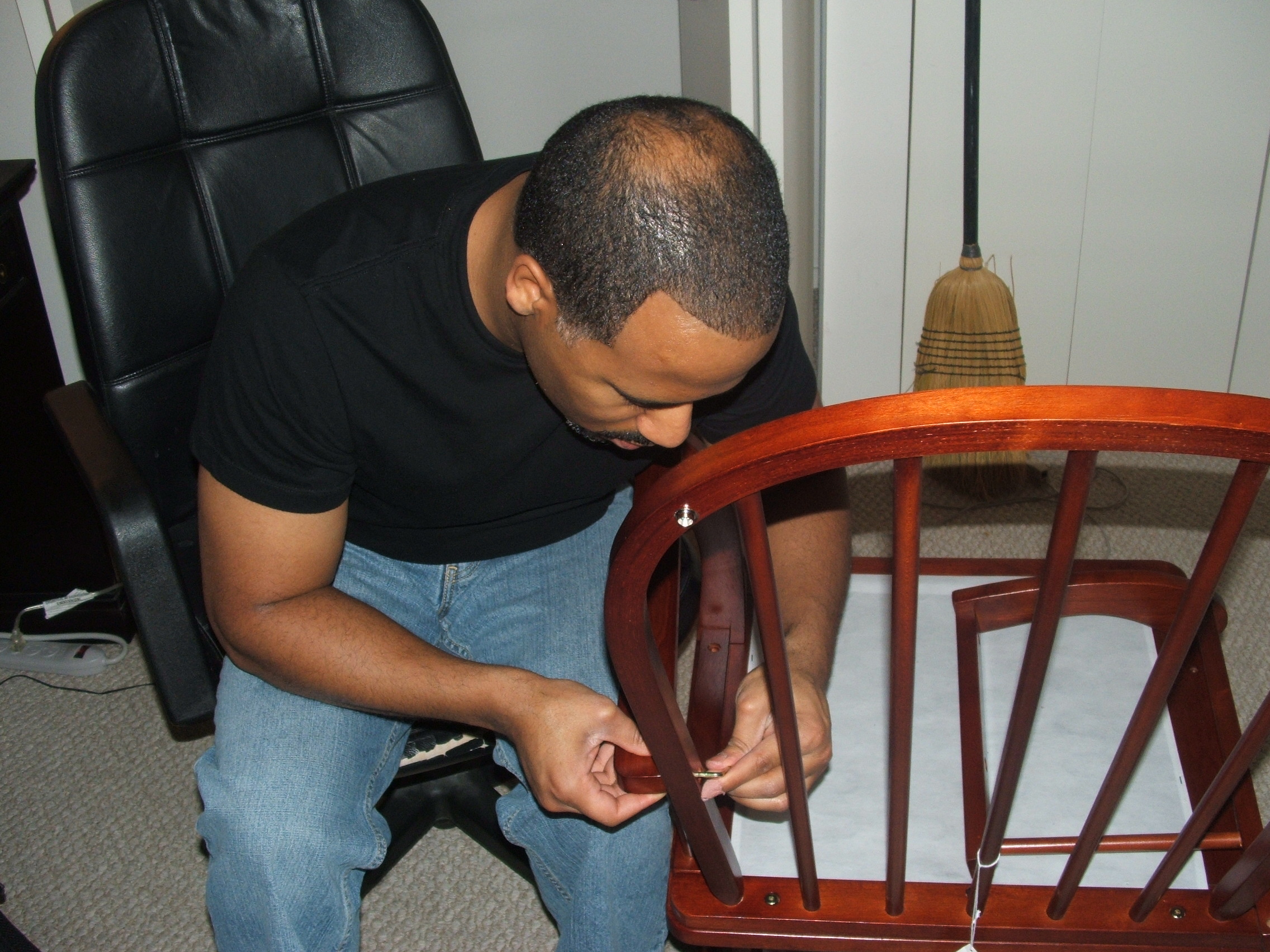
For instance, when Bryce was given a mini car—the kind he would see at the playlot and never release for others to play with—I had to put it together.  Of course, Dawn hadn’t explained that that was my responsibility until Christmas Eve night, before I was set to preach at church the following morning.  I wouldn’t have given my mechanic that thing, it was so complicated.

Here are a few things I don’t quite like when assembly is required.

  1. The box is so deceptive.  It’s shiny and colorful.  The picture of the thing is inspiring.  It touches the imagination of the boy so that he goes on and on about the car or the big wheel in the recent example.  But the picture never tells the story, does it?
  2. There are so many pieces.  Looking at the box, you’d think the thing could be put together without so much drama.  There I am, holding the instructions, opening small plastic bags, and trying to keep my son from walking through three piles of variously sized implements.  Slowly I begin to appreciate inventors and builders and craftspeople.  After I use other words under my breath.
  3. I always have to read the directions.  I’m a reader.  I’m happy about that.  But I secretly want to be one of those men who open up a box of boards, screws, and tiny pins and who make something by looking at the picture only.  I never claimed to be one of those guys.  I’ve only envied them.  And secretly hated them too.  While I like reading, it’s a different experience reading something that explains something else, when it takes you reading it fourteen times to grasp the point.
  4. I hate sweating.  Putting things together makes me sweat.  It requires a kind of concentration that I’m not used to.  I am fine with paying attention.  I’m good at listening and am even all right with taking cues, but putting pieces together is a large, monstrous task to me.  It makes my armpits stream, my forehead shine.  It makes my butt hurt for sitting in the same spot for longer than I really should.  I get up and have to change my clothes, like I’ve surfaced from a workout.
  5. The noise is unhelpful.  There’s pounding.  There’s language I wouldn’t generally use in public.  My son is walking around in circles singing about a new this or that.  I imagine my neighbors, trying to be nice because they know I’m hard at something for the boy.  But they tire of the hammering.  They’re exhausted because I’m racking at the kitchen island since it substitutes for the flat surface of the wood wedge I don’t have.

Finish the list by clicking here.

Heard Enough?

I’ve accepted the fact that when I’m on my bicycle I’m doing more prayerful work than I am exercise.  When I do get to it, I maintain the same distance, about 18 miles, and even pedal within the same time frame, approximately 1.5 hours.  But I’m pretty sure that I get more spiritually out of cycling than I do physically.

Of course, I also resist such artificial splits.  I think physical exercise is spiritual.  I think God relates to us through our physical frames.  God made those bodies, knows them well, and wouldn’t have us detaching our selves from them.  I’ve written about this in pieces before, but the more I think of it, the more riding becomes a time of prayer.

The other day I wasn’t riding as well.  The wind was against me.  It was, at least, in my face.  I resolved that there was a difference.  After about four miles, I conked out, slowed down, got off the bike, and walked for a minute.  Then I turned around, got back on the bike, and rode home.

I was frustrated.  I wasn’t tired.  But I didn’t have the normal course in me that morning.  I listened to my body.  It wasn’t saying much.  My legs felt heavy.  The air around me was loud.  I heard myself during all those similar days when I felt the same way, back when I would mutter a mantra like, “Keep pedaling.”  Or, “You can slow down, but don’t turn around.”

I’m not good at turning around.  I’m not good at changing course.  I’m excellent at seeing an end and getting to it.  Detours, changes, adaptations, and enhancements–terrible things they are–though I’ve learned how to do them with some facility, are not what I’m naturally constituted for.  I am the person who gets to the destination.  With screaming feet or aching legs or a throbbing head, I don’t turn away from the path.

So, on those days when I’ve quit, I’ve bemoaned such failures.  That’s what they are to me, failures.  Because I tell myself, when I begin, what the day’s ride will be.  The minimum is always what I did last time.  I don’t make allowances for weakness, for less sleep, for crankiness, or for the weight of the two dozen things I’m thinking through while I ride.

The other morning, I rode back and felt the wind gently pushing behind me.  It was as if I was finally riding in the right direction.  When I trailed around the Point, I stopped at sat in a circle of rocks and listened to the water lapping against the stones, trading claps with green leaves overhead.  The wind and water sang to the tunes of the birds flapping around the area.  I stretched my legs and took an unnecessary breath.  I told myself that I hadn’t quite earned a seat.  I had more riding to do.  The message coming inside the wind said to me quickly, almost sharply, that there are things that I can’t do.

I got up, hardly motivated to listen to more than that.  It was an answer to many things.  I didn’t need to hear the voice of the wind.  I didn’t want to hear the voice of the Spirit.  I had heard enough.  And I didn’t have to travel my normal course for it.

A Prayer For Writers #4

Periodically I write and post a prayer for writers and for others.  These prayers come out of my writing life, out of my hopes for the writers among us, and out of my desire for this blog to sit at the intersections between faith and writing.  Pray them or a line from them, with and for the writers you read, know, and support.  This prayer is about paying attention.  Join me, if you will.

Dear God,

It’s hard to hear, see, and write the stories in us.  It is often harder to attend to the you behind, under, and around those stories.  The temptation to distraction is immeasurable.  Our resolve to try is weak.  Turn us in so we can wonder through the maze of ourselves and find good words.  Turn us out so we can live full lives and feed the bellies from which strengthening words come.  Writing is impractical.  Make it so much a part of our days that we do it without thinking.  Grant that living and writing become synonyms so we can say in truth that we live well or we write well, and so that either statement identifies the other.  Spur us to focus on the important way of life, way of writing, you’ve given us.  Narrow the long, wide fields of our worlds.  Identify our purposes as rooted in this work.  Give us joy in doing less better and in, therefore, doing more.  Capture our minds with something sustainable, a character we can’t forget, an act that returns again and again.  When our attention falters, gently get it back.  When our energy wanes, lure us back.  Help us continue looking, considering, telling, and and doing all these with better language and increasing elegance.  In the name of the One who wrote lost words in the sand, Amen.

A Detour Off The Bike Path

The other day I took a detour off the bike path, turning down to where I usually see pedestrians walking close to the edge of the water near the Pier.  I had cycled by this spot many times and once was even intrigued to stare into the tunnel where people were going.  So I rolled around a flagpole and pedaled into the unknown corridor.

It was a gateway to the riverwalk, which happens to be one of my favorite places in the city.  I spend no time on the riverwalk.  I’ve been down there before, for a boat tour, for a short walk.  Perhaps I love the place so much because I haven’t spent time there.  Because it’s so out of the way.  Nonetheless, I pedaled through the tunnel.

A couple sat on the hard sidewalk on a blanket with a brown bag between them.  They were too good-looking to be homeless; that’s the thought I had as I watched them for those moments.  Around us was pictorial of the city’s history.  I think that’s what it was.  I didn’t stop and read the tiny words under the blocks of beautiful images.

A different but joyful detour from a few years ago

I pedaled on, saw a cafe dedicated to Monet, felt a hundred water sprinkles on my arms, my shirt, and my face.  There were places people could eat.  I thought of the couple behind me, the pair that sat on the ground instead at one of the tables.  I saw a dog who saw me as I rode by.  I spoke to the walkers on the walk.  Everyone was smiling.  I thought to capture a photo of a sculpture but didn’t.  I thought about something someone told me once that God had told them to tell me.  I made a note that I’d return to see the sculpture, to take that picture, to remember what God may have been saying to me.  At the end of my little stint–because I turned around at the Dusable bridge–was the architectural boat tour office.

I rode the same path back to the Lake, saw the same rain-soaked tables, the same couple with a burrito between them.  I felt the same water spraying me, refreshing me with what I needed.  I was on my way to park for a while.  The half way point would give me a marker to spend some time in prayer.  But riding through the riverwalk, I had already felt that I had been with God, that I had been praying all along.  And it was true.  I had been praying.  Those moments, even the eye contact with the chocolate lab, were prayer-filled.  And I told myself that all that had come from a detour off my path.

How to Walk

Among the hardest walkers for me to watch are small children being hauled along by their wrists.  Parents tell me that this is sometimes necessary, but since I have never been a parent I would not know.  I do know that most of the adults doing the hauling do not mean to be unkind.  They are simply used to walking, while the child is not.  The child has only recently learned how to walk, so she still knows how.  She feels the heat radiating up from the sidewalk.  She hears the tapping of her shoes on the cement.  She sees the dime someone has dropped in the crosswalk, which she leans toward before being yanked upright again.  The child is so exposed to the earth that even an acorn underfoot world topple her, which may be why her adult is hanging on so tightly.  But the speed is too much for her.  Her arm is stretched so far it hurts.  She has to run where her adult walks, and if that adult is talking on a cell phone, then really, she might be better off in jail.

Events That Require Attention

My spiritual director told me, among many other precious things, that there are some events in life that require our attention.  She said that those events don’t necessarily care when they get attention just as long as they get what they deserve.  They interrupt us, sometimes an inconvenient times.  They vie for a spot in our field of vision.

We were discussing my father’s health and my recent visits to see him.  She had mentioned that her mother was ill for years before she died and that she too had some dementia.  Then, she said the most appropriate thing.  These things are in our peripheral vision.  They’re always present, though not always in front of us.  Whatever we do, they are present, waiting, and, often, off to the sides of our lives.

There are other things to pay attention to.  There is the work of ministry, work that seems to flow against common boundaries.  There is the immediate family, in my case a rambunctious two-year old and a wife who studies part-time in grad school.  There is the rest of me.

And the normal events trade places with the peripheral ones, and the pieces of my life dance around until I see what I need to see.  There are moments when what we’ve been changes because of who’s around us.  There are similar moments when we change because who isn’t.

And the event of my father’s health.  The series of moments I’m holding regarding what can only be seen as tentative progress and expected deterioration.  These moments are changing me.

I’ve never been the sporadic type.  I’ve never been impulsive.  I’m comfortable with slower rhythms, with taking care, with intention.  But the slow movement in front of me, and in front of my father, scratches at who I am.  And I’m left with a deepening knowing that, sometimes, attending to the needed things is dreadful.