Embodiment is the content of what we teach. We cannot teach without being what we teach.
Brita L. Gill-Austern in Feminist & Womanist Pastoral Theology


Embodiment is the content of what we teach. We cannot teach without being what we teach.
Brita L. Gill-Austern in Feminist & Womanist Pastoral Theology

I’ve been sitting with the image and thought of Jesus being abandoned by the Father on Calvary. It’s been with me since I read a letter from a friend almost two years ago. It returned to me, this image and thought, in explicit form when someone else sent a text about the man of sorrows last fall.
I’ve turned to this basic question: when did the Father betray the Son? When did God abandon or forsake Jesus? Can we know the moment? Is it possible to distinguish that deep isolation within the Trinitarian community?
According to our sacred text, Jesus raises the question about abandonment while he’s dying. It is among the most sobering of sentences in the Bible.
It’s not sobering because he’s quoting it, though that incorporation of Israel’s material at that terminal time is meaningful. I’m struck by the soberness of it for its timing.
Jesus is dying. At the moments when he needs whatever this Father brings, Jesus is forsaken, abandoned, left. Whenever it happened, the chill of it crossed the chasm to make Jesus’s suffering special and intense.
Rather than be surrounded at death, he felt a startling aloneness. And as the song says, he would not come down. He did not call back that fatherly member by refusing to go forward. He kept at dying, even though the (literally) unthinkable had happened.
With Jesus on the hill and on the tree, it wasn’t his death that was incredible, though I respect the long evangelical stream that accents the dismal moment and its consequences. It really was that the Father had abandoned the Son.
What was unthinkable is that God could actually do that, enact that bruising isolation upon a part of God’s own self.
Sometimes I listen to what people say in the elevators at the hospital where I work. Sometimes I secretly write these things down. Sometimes I just remember.
I didn’t write this down but I remember the other day when I was in the elevator with a group of three physicians, a resident (the one with the most authority in the circle) and two interns (two student physicians, if you will).
The resident was asking the interns questions. From what I could tell, they were heading to see a patient whose procedure they were discussing. The resident listened to the intern’s answer to his first question, which was something like, “What are you going to do?”
The intern was answering, and the resident asked again, “What are you going to do?” It was light-hearted; they were comfortable with each other. Still, the resident asked the same question in a different way the third time. “How are you going to do it?”
The intern improvised, gestured like he was pushing a tube up his own noise. And to the how are you going to do it question, he added a description until his mentor was satisfied.
He grasped something about his imagination, his hands, and his intent and how they communicated to his teacher that he’d both get the procedure accomplished but in a way that was not harmful.
Knowing what you’ll do gets you part of the way. Sometimes it helps to use your own noise to imagine a push from a press from a shove.

I’m thinking about spiritual pain, the inside pain not the outside pain.
I’ve said this to students and to patients, and it’s been said to me. Those pains don’t leave you. They’re there.
In a class with Dr. Butler the other week he said it, which made me write it up and throw it onto the blog. He was telling us that what happens to us, by virtue of it happening, never goes away.
Pastoral care as an effort is about learning how to recognize the pain, integrate the pain, and maybe, live with the pain. But it’s there.
You can hold it in a new way, but you won’t rid yourself of it. Of course, it may go away, and if it does, celebrate.
If it lingers, recognize it, pour a cup of tea.
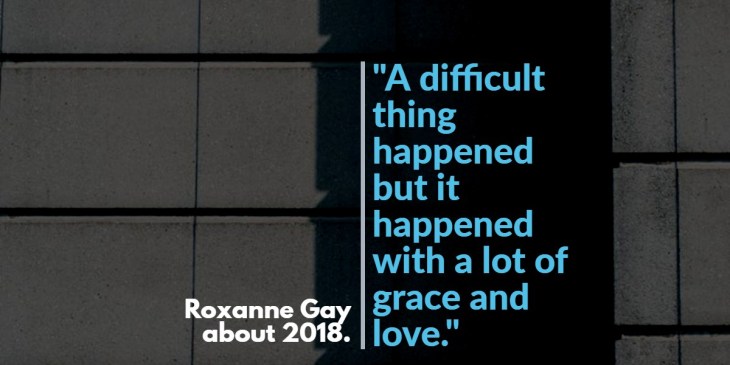
Read Her Full Description of the Year: https://medium.com/@rgay/my-2018-in-reading-and-writing-741dfa0dd374

Jussie Smollett was attacked in Chicago last week–and because he is gay and black. According to published reports, his injuries occurred while he was walking home in the early hours.
He was insulted during the assault, called names during the severe attack, and thankfully he received medical attention. Brother Smollett yesterday spoke out and his words are being widely reported and underscore his work with the police to find those responsible for his attack.
According to a piece in the SunTimes, he opens his greetings, “Beautiful people. Let me start by saying that I’m OK.” Despite the ugly words spoken over him and the terrible beating given him, he can address a beautiful people. What an image of resilience.
In the last week, folks have been searching for answers about the attack the way the Chicago Police Department searches for the assailants in an attack, developing theories, turning over possible motivations, and questioning every known thing that’s been said in the media.
Black and nonblack people are invested in knowing what happened, appalled at what happened, and engaged in making sure justice comes. That said, I want to encourage you to, among other things, notice the deep and long ways that Brother Smollett’s situation is a part of a historically potent way of harming individuals and disarming a people, namely black people.
Whoever the attackers are, Brother Smollett’s trauma links to the dismal history of harm that comes from personalized aggression that forms in the United States of American context that makes violence and murder an acceptable way of dealing with anger, fear, and difference.
Chicago, like other places, participates in the ways lynching and murderous assaults have kept black people under the ever-present possibility of violence. Living after an assault, anyone’s assault, makes the person living and the community living after that assault a part of the trauma. Everyone is implicated in the pain of the violence.
In other words, Brother Smollett’s sexual life made him a part of the history of assaults occurring against gay and lesbian people. Second, his blackness made him participant, in a similar way, of the history of violence against black folk. Of course, the obvious interconnections between race and sex and gender, and even class, formed a historical and contemporary storm that contributed to this situation.
The offenders participated as well. They had choices to let the man be, to pass him on the street as he walked home, and they chose differently. They participated as offenders in what Womanist theologian Kelly Brown Douglas called an “aggressive assertion” of Smollett’s “guilty black body.”
As Elizabeth Weise says in her brief USA Today piece, “Lynching may seem like something out of the distant past, but the use of lynching symbolism to terrify, intimidate and curtail the lives of black Americans is very much happening today.” Think of that noose around Brother Smollett’s neck.
Brown Douglas studies this past and current violence in her book Stand Your Ground and locates lynching symbolism in slavery, emancipation, the Black Codes, and Jim Crow laws. “Essentially, the more the black body is free, the more intense the war against its body,” says Brown Douglas.
Weise and Brown Douglas offer a point that peace and justice-loving people have been promoting for more than a century. This crime in Chicago is one that the country is intimately acquainted with, and I mean to be descriptive, in the saddest of ways. The lineage of laws and customs are deeply rooted in the United States, the corresponding trauma exacerbated by how long these violent acts have plagued black people.
The connection between being wrapped with a noose near a Chicago bridge echoes on the many men, women, and children who were hanged, burned, tortured, and killed in days and decades past. Cornel West wrote in his popular Race Matters, “One of the best ways to instill fear in people is to terrorize them.”
Hasn’t this happened again for black people as one black man, Brother Smollett, has been terrorized? Thankfully as he wrote, he’s okay, which points to a well-walked path in these hard situations. He was hurt and he will continue to act, continue to pursue his offenders, continue to live his life. And with him, the rest of us. I hope we will continue to pursue justice with the same interest that we are wondering about who did what to whom and when.
Finally, here is a prayer that I’m praying for him and for us, those who are traumatized by extension, traumatized by having been a part of the black community or other badly treated communities. As a straight man and pastor, I write it hoping it is an invitation for us to pray together for justice to come, even if you’ll pray beyond your own particular borders of prayerfulness:
You are the One who heals all manner of illness.
The worst conditions shudder at your presence.
Pain, anguish, and brutality while felt by you are not stronger than you.
You know what happened to Brother Smollett.
You know the deep pains he bears.
And you aren’t far from the pains we feel as a community of supporters.
Black and nonblack crowd around the country and world to pull for his wholeness.
Grant the affirmation and recognition that we need.
Help us to know that we are made by and belong to you,
One that heals in the face of trauma.
Notice his offenders and do what only the Divine can by seeking justice.
Work in and through detectives and citizens so that moral laws are embodied.
Bring healing to Brother Smollett from every sacred space, from sanctuaries and prayer closets, from chapels and prayer rugs.
Bring hope for us all after another incident of unmistakable violence.
Make and claim this city and every one for holy purposes.
Live in this city and make it your habitation.
Bring with you whatever comes with your nearness.
Answer us with change in Chicago and the United States.
Give us strength in our efforts to see justice occur.
Give us wisdom for every next step.
Give us deliverance from every present evil.
And we’ll keep seeking.

I walked in as normal, being greeted with a few hellos and the characteristic, “What are you reading today?”
I carry a book everywhere, even if I can’t read over lunch. My habit is acknowledged at my Thai spot around the office corner.
Usually I don’t take a menu because I order from a list of six things. I get the question what will it be unless I bring students or friends, and then the menus come for them. That day it was the steamed vegetables without rice.
My server brought my dish and a set of chopsticks. In four years, I’ve never eaten with them. They asked at first and I declined. I did this for a few visits. They stopped bringing them.
I looked at them and accepted them, saw them as an invitation. I was up for it, but the change of ritual stuck out.
I ate my lunch. I thought how glad I was that I didn’t order rice. I know how to eat with chopsticks but I’ve never learned how.
The difference for me is that you know how to eat with chopsticks when you can navigate broccoli florets and bell peppers cut in squares the size of your thumb. You’ve been taught, tutored, and educated–you’ve learned–when you can navigate rice.
I know how to eat the plate of vegetables. Four of six of my personal menu, I can eat with chopsticks. I pulled it off and had a pleasing, nourishing plate. But the educator in me thought of all the people who have tried to teach me how to use those sticks and how I couldn’t learn from them.
They were patient people, gracious people, kind people. Vivian, Gerald, Peter, Angela, Grace, and a server at a spot in the great Chinatown restaurant that Monica and Conway sent me to around the time they were wedded.
I thought about the first Chinese (not Thai) restaurant I went to with Bishop and Laurice for Laurice’s birthday, when I was introduced to hot mustard and to Chinatown and when we saw Cage. Gosh, was I ten? Did Reese turn nine then?
There are some things you’ll do without truly being educated. You can get by. You can pass. You can eat. But you’ll know that the nuances are lost on you. You’ll know that, in a different deep way, you have failed. And you’ll be okay with that failure. You’ll be okay with getting by.
Because next to you, at your left, as is on all the tables of your Thai spot, is a fork wrapped in napkin for people who have never learned how to eat rice with chopsticks.

My oldest son wasn’t going to win the bet we made and I knew it even as I crafted the challenge to him in the grocery line.
His hand was on a bag, a nicely packaged offering of sugar and fat and a list of things we couldn’t pronounce. Now, it helps to know that since he was his younger brother’s age, I’ve been teaching the boy how to conduct himself in a kitchen and a grocery store. He cooks with me. He has shopped with me. We’ve been to South side farms to see dirt and crops and farmers.
Aside from the fact that his memory is as poor as his pockets–he has no money and no memory–I’m banking on the faith that these lessons about meal preparation, taste, seasoning, contamination, and presentation are going somewhere.
Occasionally I test him. I ask, “What do you taste?” And his average gets better and better. The more I expose him, the better he gets. At least once way back in the day, he could use his taste buds and not his eyes to list the ingredients of a soup that I threw a dozen things in. And with 70% accuracy.
“If you can tell me how to make donuts, you can have it.”
The boy has not met a challenge that he hadn’t already met.
I tell him, in moments like these, “Use all your powers.”
“I’m going to ask Grandma,” he said.
“I don’t think my Mama has ever made donuts,” I said.
“It’s has to be like making cornbread.”
He went into the story that we laugh at about when Mama came over last year to show us how she makes her cornbread. It’s one of his ways of saying that he knows I can make cornbread but that Mama’s is better. The story is funny but that’s for another post.
I laughed and I decided at that moment where our Saturday afternoon would be. I whispered it to the littlest among us because he wouldn’t tell the secret. Then, we paid for our groceries and finished the first half of the day.
The second half included a visit to the Oriental Institute for my budding Egypt scholar. Then, I told them that we were getting dessert before dinner. I have learned to say these things upon knowing we would. We went to the place where we could buy the best donuts in Chicago, Old Fashioned Donuts. We stood across the street waiting for cars to pass, and I told them, “This is the place where you will eat the best donuts in our great city. And you’ll learn how they’re made.”
It was a really bad bet that I posed that morning. Going to Roseland and looking into that window while Mr. Bulloch worked his magic was everything. I didn’t forget the bet, but the boys did.
After all, I set the one up anyway. I wanted to take the boys to South Michigan, among that sea of South side wonder. I wanted to hear the older boy say, to the licking and smacking of the younger one, “This is the best donut in the city.”

I learned something again about myself that I knew, but the learning came across in a way that I was ready for. It was feedback.
The basis of it was in my leaving a person feeling like there was, for that person, more to do, more to accomplish.
As I heard it, I settled in and I started to like that. I have learned this but the way it came felt like a gift.
I’m unwrapping it and it fits.

When I was in a committee meeting a little more than a year ago in Atlanta, a colleague challenged me to sit with my feelings. The meeting was an hour and a half appointment, and we were twelve minutes in. That wasn’t a great sign, his kind challenge.
It was a terrible meeting in select ways which would take months of posts to unfurl. The committee’s evaluation of me would either keep me in what ACPE calls supervisory education or the result would change my status so that I could offer clinical pastoral supervision as an independent educator. I’d be done with the learning process officially.
I was less concerned about the result for that reason actually. My job was supportive, my manager understanding. Of course, I had conceptualized a dozen directions after having thought through a list of if/then possibilities. That’s the kind of planner I am.
There was something beyond the result about that meeting. Opening to me was, in my work and in the rest of my life, something significant. I knew in my soul that what they said mattered. I had grown to trust the people I met in my process to that point.
I knew that their critique of me, their feedback for me, and their way of being with me were all represented by every previous encounter I had with supervisors and mentors through my process.
I knew that the kind challenge to sit with their feedback and to what it was doing to me was an invitation to some kind of good. I was angry about things in that meeting. I was uplifted by things in that meeting. I was exhilarated when I passed. Surprised too at first.
I celebrated and having finished the process completely one year later, the next November in the same city, Atlanta is still a second home in good ways.
So his challenge was an opening. I didn’t know then that sitting with things and then responding would be a new way for me to step forward as a pastoral educator and person. I have practiced parts of that my nature of my personality, and the committee’s work enriched that part of me. It’s really re-making me and how re-making how I’m trying to be.

You may not be able to do much about the deeply embedded reality of another person, system, or structure. It’s sad and may be cynical, but it’s also real.
The deeply embedded knowings, truths, or realities of others mean that they have made commitments that they aren’t likely to release.
When someone commits to something so strongly, they have cultivated a way of being that they naturally protect. They hold it tightly. After all, what’s a commitment if you don’t keep it?
You may be able to reframe what you see. You may be able to affirm that the system is seeking familiarity or that the person is doing what’s familiar. You may stretch in your imagination and see the fear of change that is present.
But those are reframes, imaginative attempts for you to adjust to what’s real, and that is that some situations don’t change. Some people don’t change. Some structures have to end on their own choking path.
Maybe your critique is better suited for who and what can accept it, house it, and respond to it. Maybe.

My friend said something to me years ago that I can’t remember. He says things I like to remember but the way he phrased his words slips me. What I haven’t forgotten is what I’ve done with what he said.
In my mind, what I’ve done is try to pull together the strands of fatherhood and contemplation. I do remember leaving that conversation thinking, “How can I be a contemplative father?”
I think back to his words, said to me on the street in our neighborhood and just outside our mechanic’s office, when I hear people say of their own child-rearing, “The years run by.” Or something like, “Don’t blink. You’ll look up and they’ll be leaving home.”
When people say this, I think of contemplative parenting. I think of my conversation with my friend. In my mental world, contemplative parenting brings together being a parent and being in the moment. Contemplation means being where you are. It means being centered and keeping your weight over that center. It means to be present.
Pulling together contemplation and parenting, it’s impossible to miss moments. Your practice is to be in those moments. You certainly don’t remember them all. Your brain does things with memories that you and I can’t understand. There are things that you lose or let go of. You forget. You will forget but that doesn’t mean you will have missed the moments.
You will have lived them. You will have participated in them. In that sense, those moments as a father (for me) will always be there (in the present), have been there (in the past), and left me available for being there (in the future). If my orientation is to be in the moment, I miss nothing. To be sure, it is exhausting, this orientation.
It’s easier to obsess about a future. It’s easier to fume over yesterdays. It is hard to be right where I am. May God continue to help me.
 Michael Washington