It’s Renee’s birthday. I called her this morning, but I wanted to mark a spot on the blog to echo what I said this morning: Happy birthday, Sister!

Happy Birthday, Renee

It’s Renee’s birthday. I called her this morning, but I wanted to mark a spot on the blog to echo what I said this morning: Happy birthday, Sister!
Happy Birthday, Renee

 What did it take from you to create A Teaspoon of Earth and Sea, and what are a couple things the creative process gave you? In addition to an engaging book. The process of writing this book gave me an entirely new perspective on my life and my purpose. I became a writer while creating this novel. I had other published projects before, but this was the first time I threw myself into a work completely, immersing myself in research, in my characters, and in the imagined world I wanted my readers to inhabit. In some ways I lost myself in the process, spending days just listening to Iranian music, reading books on the region, watching videos. I certainly let my personal life falter, and there were days when I barely did anything but work and drink espressos. So this novel took a lot from me. But it also made me who I am as a writer. In addition, the process taught me to value rigor and brevity and detachment in my writing. It taught me to dig for the most important details and to present them concretely and imaginatively. These skills will always be valuable to me.
You describe yourself as an exile. How has your exilic condition impacted your writing? Mostly in the themes that capture my attention. I often write about home, about displacement, and fear. These are familiar topics for me because of my experiences as an exile. They are like obsessions. I can’t get away from them.
To quote Saba’s reflection, “This story is about fathers and daughters.” As much as the novel is a large story between sisters and their mother, isn’t it as much about a father and daughter? I think it’s even more about a father and daughter, because theirs is the only relationship that isn’t already dead. With the other members of her family, Saba has only memories and her imagination. She can turn those over in her mind, but she can’t have anything new. With her father, she has a flesh and blood person who loves her and wants to be allowed into her world.
Part of my experience reading was in learning Saba’s opinions about the differences between American and Iranian men. How might American fathers be different from Iranian fathers? I think fathers are fathers. To love and protect your children are universal instincts. The cultural differences seem minor compared to that.
Talk about how Saba’s life became an echo of her twin sister’s. Where did that come from in your writing process? How did you connect with both Saba’s experience and Mahtab’s? I consider their stories representations of the two ways that my own life might have gone. I was raised in America and so the Mahtab stories mirror my own. But the Saba stories are the Iranian experiences I might have had, if I had stayed behind. To parallel them seemed like a natural exercise, and something I took great pleasure in.
Where would Saba call “home”? Cheshmeh, Iran
 The novel returned to themes of desire, hunger, memory, and love. Did you learn particular things about such themes in writing or revising? Did you develop a love or appreciation, for instance, of your own family history? Absolutely. The research alone gave me a great appreciation for the richness of my own history and roots. But, obviously, I also used many of my own emotions and experiences in writing Saba and Mahtab’s stories. In doing so, I deepened my understanding of the themes you mention.
What are you reading these days? “The Woman Destroyed” by Simone De Beauvoir.
How can readers connect with you and support your work? You can like my Facebook fan page: http://www.facebook.com/dinanayeri
And you can visit my website: http://www.dinanayeri.com
I’ve noticed these three things over the last two weeks with the boy’s transition from daycare to preschool:
A couple years ago, I asked Sonia Wang, a teacher and friend to write about the importance of parental involvement. I’m sure you’ll enjoy her post again for its continued relevance.
Advocacy. This word is often seen as a job of someone else. But I think we forget that advocacy is merely being “in the know” so that we can speak up and respond appropriately as needed. One thing that our students, especially in urban environments, are lacking is having an ample group of advocates.
Where does this absence of advocates stem from? Often it starts with the students’ parents. It is argued that students spend the majority of their day in school, however, the more important truth is that students need consistency in their lives.
Consistency must be obtained in two ways—from home to school and from school to home. When a student is told in school that they need to read at least 30 minutes at home, but they are expected to cook dinner, watch their younger siblings, and then manage their work without a space to do work, there is a mixed message sent to the student. At the same time, when students are told at home that helping out with the family day care program holds priority in their lives and that message is overturned at school, students are flooded with mixed messages.
How do we as adults integrate into the lives of our students to best support them? As a classroom teacher, I strongly believe that there are two main sources for support—parents and mentors, which include teachers.
The role of parents in a student’s life is invaluable. A teacher can only impart so much when it comes to skills, content, and values, but if that is not reinforced by what happens at home, it becomes obsolete to the child. From my years of teaching, I cannot count how many times a student has referred to their parent’s indifference or absence in their academic achievement as a reason for their own indifference or absence of care for their academic progress or goals. The attitude and tone a parent holds for their child sets the baseline for the child’s personal expectations and hopes.
When a student knows that his/her parent knows what’s going on in their lives, especially in their school life, it not only sets a new tone to the importance of this thing known as “school” but it also redefines the student’s approach to school. Suddenly their work in school matters because what they do in class matters to people who matter to them. Reading a chapter and jotting personal thoughts on what was read isn’t just homework but it is an opportunity to show the parent what’s happening in class, what is being learned, and what thinking is happening.
Furthermore, let’s consider an example situation:
If a student is reading a novel that is perceived to be at a lower level than the student’s ability, his/her parent is now able to advocate for their student. This can lead to multiple outcomes:
1.)If the book is in fact easy, the teacher is now held accountable to meet the learning needs of the student in order for the student to GROW!! and
2.) If the book is actually at the student’s reading level because he/she is struggling, then there can be an honest conversation about where the student is at in their reading progress, what supports are in place in the classroom to monitor and assure growth, and what strategies can be implemented at home to support the student’s growth.
Regardless of what the outcome might be, the more important fact here is that the student has multiple advocates in his/her life; no longer is their education a passive one but one that is active and purposeful.
Parents must be involved in their student’s educational journey. Involvement does not mean teaching algebra in fourth grade or having the student comprehend Beowulf in middle school. I would actually discourage this type of involvement.
Instead, knowing your child’s syllabus, asking what he/she is learning, and checking in about their academic strengths and weaknesses are ways to be involved in his/her life. By doing so, our young people know they have advocates, people who will not allow them to be invisible in our current education system where too often our students are reduced to an ID number or a test score.
With advocates, our young people begin to see the importance of knowledge and voice. And in turn, they become our community’s most effective advocates.
I like myself when I’m sick. I don’t like to be sick. But I’m a better person when I’m sick. I don’t argue much. I try to be an easy patient. I don’t like asking for things because I don’t make a big deal over being sick.
I almost appear aloof because like my body, my mind concentrates on getting better. Though I usually have to focus on feeling worse for a while before skipping to all the things I must ingest to get better. It’s so easy to focus on getting better.
I’m good at that–at focusing on ridding my body of the badness than I am at connecting with, feeling, and accepting that badness. Perhaps, for a moment, I’m closer to the basic human impulse to fall into a small space of helplessness.
I’ve been drinking everything from hibiscus tea to concoctions from a loving, older Indian couple who I met with the other day. But no matter what I do, the cold or the virus will take whatever time it will take in me.
Being sick. Accepting the wall that is a stuffed head, an endless stream of yuck in my nose and sinus cavity, a roll of toilet paper on my car seat just because I’d rather use that than the little nice packages of kleenex I bought to replenish things at home.
Being hot but never quite cold, seeing the look in my wife’s eyes that accuses me of doing too much when I’ve only been able to accomplish a few things well. The swell of my head when I move too quickly, my constantly open mouth because I’d suffocate if I tried to breathe through my nose. A penetrating glance of grace in the form of my son’s prayer and of many other people’s acts of compassion.
I hate it when I’m sick, but I am probably much closer to being right when I’m being sick.
You, neighbour God, if sometimes in the night
I rouse you with loud knocking, I do so
only because I seldom hear you breathe;
I know: you are alone.
And should you need a drink, no one is there
to reach it to you, groping in the dark.
Always I hearken. Give but a small sign.
I am quite near.
Between us there is but a narrow wall,
and by sheer chance; for it would take
merely a call from your lips or from mine
to break it down,
and that without a sound.
The wall is builded of your images.
They stand before you hiding you like names,
And when the light within me blazes high
that in my inmost soul I know you by,
the radiance is squandered on their frames.
And then my senses, which too soon grow lame,
exiled from you, must go their homeless ways.
While it was not my idea to capture this with a camera, my wife’s pictures come in handy for this blog. These are more than a week behind the actual taking of the photos, but it is helpful for those of you who still have that first tie to tie or cinch or clip or press in case there’s a nifty slice of velcro like there is with my boy’s necktie.
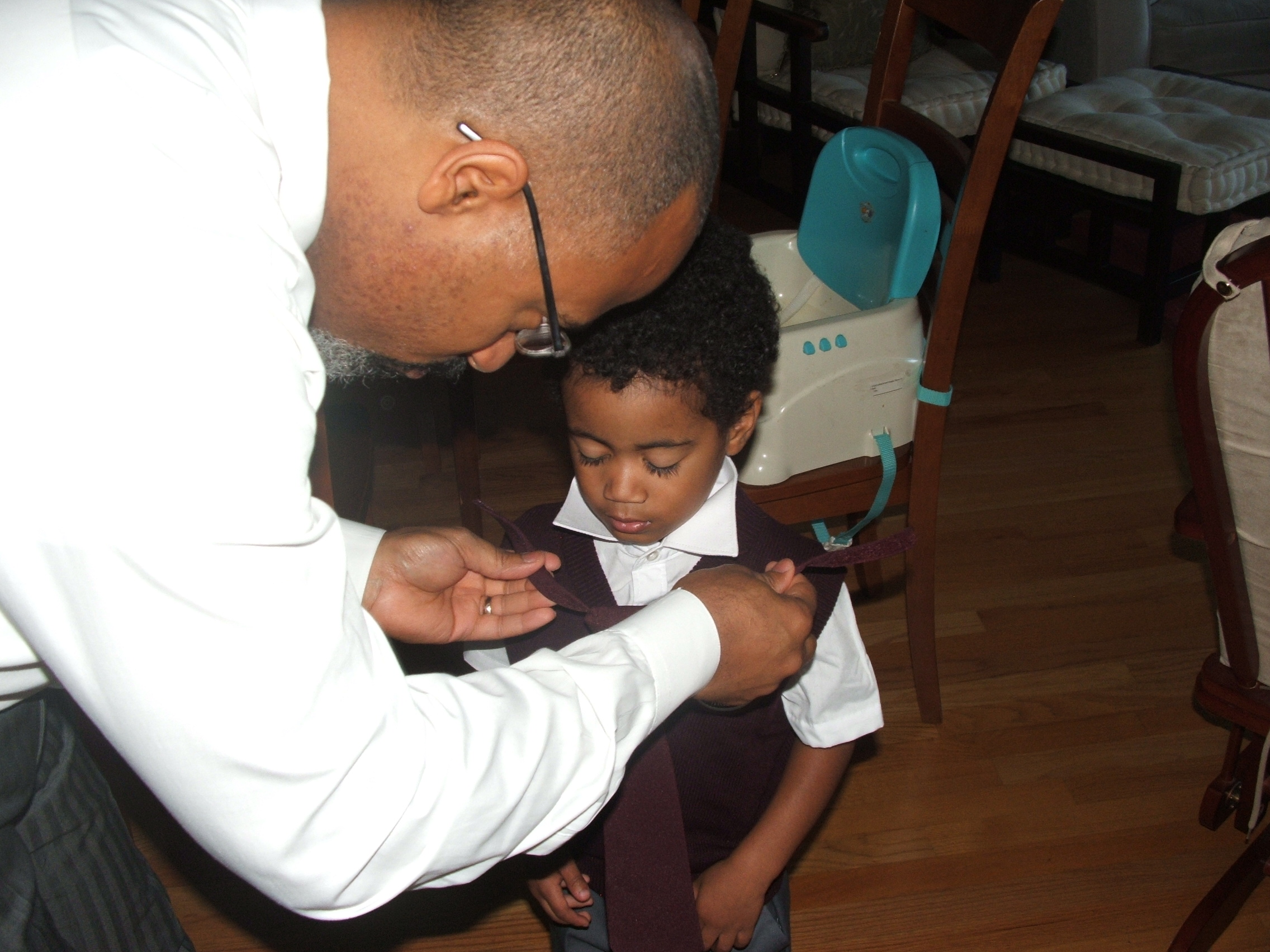
Lifting the collar, lining up the bulging knot, attaching the velcro lines

Pulling the tie down the middle, over the stomach, and lining it up behind the vest

One classy kid
Sometimes you hear that Voice, speaking through people, and were it not for the proximity of their words, the identical nature of those sentences, you’d put off the emerging truth. It can jump off the page of poem, scream through an essay, or whisper through conversation over tea or wings or johnny cakes.
The Voice may come through the often misunderstood tones of a faithful friend whose so dependable that he’s overlooked. But it will not relent.
Like a burn it sears something on your skin, a purple bubble of skin that can’t be avoided. There’s no pain in it. The scar that’s left will be a memorial to the power of that influence you thought took flight.
Speaking, reminding, and convincing is the terrible and deeply comforting Voice saying one thing or another. Then there’s the choice to turn and listen, or try to, or to walk away from the words spoken. To walk away is to return a gift. To listen is to enter into an unknown world of faith. Indeed, hearing that Voice is hearing a melody of faith.

Walking in a foreign place
Sundays too my father got up early
and put his clothes on in the blueblack cold,
then with cracked hands that ached
from labor in the weekday weather made
banked fires blaze. No one ever thanked him.
I’d wake and hear the cold splintering, breaking.
When the rooms were warm, he’d call,
and slowly I would rise and dress,
fearing the chronic angers of that house,
Speaking indifferently to him,
who had driven out the cold
and polished my good shoes as well.
What did I know, what did I know
of love’s austere and lonely offices?
The unrepeatable, searing Javon Johnson:
Matt Walsh is worth sharing on these salient points.
***Update, August 1: In response to the thousands of people who, after reading this entire post, decided to harp on one single phrase (“I’m no feminist”), I wrote this. If you want to know how I can say all the things I say here, yet still reject “feminism,” click the link and I’ll explain. Otherwise, carry on. Thanks for stopping by.
Our country dangles on the precipice of starting a third World War. We are on the verge of a completely unnecessary conflict where the United States will fight along side Al Qaeda and the Muslim Brotherhood. This, in another day and age, might earn the crown as the Most Controversial Story of the Week. But we’re in the year 2013, and this is America, so a young pop star’s dance moves on an MTV awards show have predictably overshadowed the prospect of global chaos and bloodshed. I wrote…
View original post 1,262 more words

 Michael Washington