Milestones That Matter Most

It’s not surprising that well-intentioned parents cultivate cognitive intelligence and individual achievements as assiduously as we do. These are, after all, such important markers of success in modern-day America. But our focus on outcomes is leading us to look at milestones all wrong — as a series of boxes and achievements to check off a list on our way to a goal. We focus on our kids’ ability to read when they are at an age when we should be focusing on their kindness and character. We worry about overburdening them with chores because they have to do their homework, when we should be cultivating self-help skills that will make them self-reliant, and sending them a clear, unambiguous message: yes, academic achievement is important, but becoming kind and responsible is, too. These are all milestones we don’t want to miss.

See Christine Gross-Loh’s full piece here.

Sounds of Sickness

Moaning coming from the boy’s bed

Groaning rising from the boy’s throat

Whimpering which always irritates me

Gurgling that was a bit dramatic

Splattering that sounded like one thing, or how ever many things were eaten that night

Running from my chair

Slapping for my glasses

Whispering firm enough to rouse Dawn from falling sleep

Being questioned as she woke to follow my shadow and steps

Lifting him with a thin yelp, Dawn meeting us and waiting with pain on her face

Splashing as more of the same fell like a long sheet of water

Groaning as I held him

Crying as we took him to the bathroom

Calling for ease and for sleep

Pulling for towels

Rinsing of sheets

Squeezing warm water from a washcloth

Moaning for rest from the little baby who was a big boy moments ago

Lying down, saying nothing

Patting his back like a song

Falling asleep in a family bed against my normal wishes

Rustling sheets and placing new towels

Tapping on the laptop

Gulping water by the cup-full

Starting a new tradition of asking for liquid and chucking it

Telling myself it was 4am

Deciding about a doctor’s visit

Boiling water in my kettle so I could clear my throat

Waking up to a flinch or a stomach rumble

Being laughed at by my wife

Trying to calm her down

Spraying water and bubbles foaming in a machine to clean things

Vomiting again and again and again and one more time

Convincing Dawn that I was fine, though she felt unsettled in her stomach

These were the noises of our night.  These were the noises of our son’s sickness.

Considering Ways aka Timeouts

Bryce was thrilled by the time our company came Saturday night.  He didn’t speak to any of them as they walked down our hall or while they stepped into our unit.  He gave them—or himself—a few minutes to acquaint with his home.  He let them look around the space, see what was his.  Then he warmed up.

He jumped around.  He leaped and fell to the floor.  He got his microphone and sang.  He pulled in the little blue keyboard and played.  His voice rose with excitement.  He was fine until I told him to have a seat.  All the little wind blew from his sails.

He stared at me as if to judge whether I was serious.  I held his little eyes with my own, saying nothing for a long enough moment for his head to tilt in question form.  The image of his black hair moving, the rest of his body upright, was the image of a question mark.  I asked if he heard me.  He nodded.  I offered my predictable, “Well?”

I knew what would happen.  All those onlookers made it too interesting for him to comply.  I imagined all the questions running in his mind, all of his body’s little needs which his brain burst from left to right.  Why obey when the command from the big guy was to sit?  He can’t really expect me to sit.  There’s too much to be done.  Circles to run in, leaps to jump, people with arms to rush.  So much to be done.  My daddy must be playing.

I wasn’t.  My look was not ambiguous.  I asked better questions: would you like a time out?  Do you need a timeout?  No was his reply to these.  Again, he was predictable.  Often, when I talk about timeouts, I use the language of Bryce considering his ways.  My question may be: do you need a moment to consider your ways?  Or, would you like to sit and consider things?

So I invited him to a conversation.  Sometimes I send him to the chair to consider.  Sometimes I talk to him first.  Saturday, before sending him to the space where he could, alone, consider how soon he should respond to his father, I brought him to the other room.  We talked, together.  I explained what he knew.  He yessed in the form of several nods, his head moving up and down with the only interruption being occasional glances to the room where everything fun was happening without him.

We went back into the room.  He sat down immediately.  He had heard me.  He had understood me just like his nodding said.  But it all started again moments later.  All the same questions.  All the same answers.  Except that there was no additional consultation.  There was only high-pitched screaming as he walked away from the social climate that he loved and traded it for the lonely spot he didn’t.

Acute Otitis Media

From the good folks at wedMD:

The typical ear infection, called otitis media, occurs when a cold or allergy causes swelling of the baby’s eustachian tube, causing blockage that allows bacteria to grow in the middle ear. Otitis media is particularly common in babies because their immune systems are immature and their eustachian tubes may not effectively drain fluid from the middle ear. There are two types of middle ear infections. Acute otitis media often causes pain, fever, and a bulging red eardrum. Otitis media with effusion (OME) occurs when the middle ear doesn’t drain properly and fluid is trapped behind the eardrum.

From our experience yesterday:

Whining, crying, and not cooperating at daycare; holding his ear during playtime and refusing comfort; parents being called twice, until parents confer to change schedules—so one can keep an appointment and the other can worry over making up work; an afternoon doctor’s appointment where the doctor said she’d be crying with this infection; ice cream from Brown Sugar Bakery mostly for the parents (somewhat unrelated); and the blessing of pain killers that taste like strawberry and a ten-days supply of grape-smelling medication (for the boy, of course).

Gerald Liu’s Fathers Know Best Interview #8

FF: Describe your family. 

Zoe, Vivian, and Gerald Liu

GL:  The family is made up of my wife Vivian and I (both 33 y.o. married almost 7 years), daughter Zoe (10 1/2 months), and our soft-coated wheaten terrier Colbie (4 years or is that 28 in dog years?).

FF: How has fatherhood changed you?

GL:  I think fatherhood has enhanced my interpretation of joy.  Through the challenging early goings of being new parents (with my wife Vivian BY FAR doing the most heavy lifting!) I think we grew to appreciate the small victories like when she first cooed, giggled, or slept through the night.  Even just returning home from after a long work day and seeing my daughter’s face or just dancing with her in the living room bring me the most satisfaction and joy.  I think it also helped me to have a higher appreciation for my own mom and dad and has given me a new viewpoint of the immense love of God.  I sometimes find myself pondering how my love for Zoe is completely eclipsed by God’s mighty love for me and that truth blows me away every time.

FF: What mistakes have you made as a dad? Name at least one and talk about what it meant to you.

GL:  Over protectiveness is one of my many mistakes.  I guess another result of fatherhood for me is an increased sense of fear for my daughter’s well being.  There have been situations where in my anxiety and panic I have spoken a bit harsh or unfairly to Vivian.  For instance if I thought a piece of food was too big for Zoe to swallow, I would in a panicked-tone question Vivian why she would give that to her (clearly it probably wasn’t too big.  I’m just a freak!).  I’m trying to get better, thanks for being patient Viv!  I think another mistake would be to take better care of my wife Vivian.  I think I some arguments we’ve had stemmed from communication or just the lack of simply asking Viv on how I can help.

FF: What’s the most helpful advice you heard when you were becoming a father or advice you’ve gained since you’ve been a father? 

GL:  I think people gave us a healthy fear of anticipating the challenges in the first few months.  I think that helped us prepare for the nightly feedings and sleepless nights.  A realization for me was understanding the statement “they grow up so fast!”.  Zoe’s only 10 1/2 months and everyday it seems like she has learned to do something new or something about her has changed (i.e. teeth).  So advice I give now to parents is “Don’t blink or you will miss something!!”.

FF: How do you attend to your relationship with your wife outside of your being parents, and has parenting changed your marriage?

GL:  People told us how important “date-nights” are for parents and we try to set aside time to connect and concentrate on our relationship.  When there is time we try to do things together like workout in the house, take walks, or watch a favorite show.  I definitely think our relationship has changed as a result of being parents.  I think we both cherish the time we have alone and are more communicative.

FF: What are some of the things you’ve struggled with as a relatively new father?  What are some of the things that have given you the most joy?

GL:  I think adjusting to new routines as a result of fatherly responsibilities is a general struggle.  Also another big struggle is balancing my friendships.  I think it takes much more planning and intentionality to get together with friends and its hard at times to relate to friends that live generally care-free lives.  The most joy I experience is in small things as I mentioned before.  When Zoe learns how to wave, or clap, or just laughs and giggles it makes me proud and happy.

FF: Would you be willing to talk about how your faith has been shaped or changed in the process of you and Vivian becoming parents?

GL:  There were some really dark times for us as we struggled for a number of years with our inability to conceive.  As couples around us became pregnant and other families grew, we often times felt envious, isolated, and alone in our struggles.  It was a load to bear and our focus and anxiety on conceiving became an unhealthy obsession that damaged our faith.  It was only after we begun to share our difficulties with others that we realized our situation was not uncommon and as we reached out to others for support we felt the “body of Christ” and its loving embrace for us in our time of need.

During one Sunday (Check out the podcast on thenewcom.com from 11/21/2010 towards the end 45 min or so in) where Viv and I were probably feeling the least hopeful, Pastor Peter preached on Jonah and talked about “rival gods” and how anything that we tell ourselves we “must” have is our real God and idol.  As he was preaching, I could not help to think that even our “good” and “reasonable” desires to have children was keeping our selves away from God.  Our “idol” was in having a baby and I realized that my hope was in our future family and not Christ.  After the sermon, Peter asked for people to come up and pray.  Without talking to each other or hesitation, both Viv and I stood up, walked to the front, and were in tears.  That moment confirmed to Viv and I where our hearts and minds were and that we were going to try to be, from that point on, ok with whatever God had planned for us.  Child or no child.  We both wanted God without condition and with an undivided heart despite our circumstances.

Little did we know, God was about to give us miraculous news.  Three days later, right before thanksgiving we confirmed that we were expecting.  God has a funny sense of timing and I truly believe that our journey was meant to be a testimony of how even the “good” things we naturally desire have the ability to wrestle our hearts away from the God who loves and desires our undivided hearts.

Now when I think of God while holding my daughter I am reminded of our family’s journey and know that as much as I love Zoe that my ultimate source of my joy, love, and salvation is in my God.  I hope to teach my Zoe that truth one day.

FF: What surprises are there along the way for parents? What do you wish you were told to expect? 

GL:  I would say that the surprises are in the amount changes to your own life, personality, and character are so many that after being a parent you may never comprehend how life was before your baby.  I wish I was told to expect how much baby stuff costs!  Yowzas!

FF: What is one recent memory you made with your child?

GL:  Swimming with Zoe for the first time.  While on vacation in Florida I’ll never forget how Zoe loved being in the pool and her enormous smile as she splashed the water with her hands.


Repeated Rituals of Domestic Life

Later, after I married and had a child, I learned to find equal meaning in the repeated rituals of domestic life.  Setting the table.  Lighting the candles.  Building the fire.  Cooking.  All those souffles, all that creme caramel, all those daubes and albondigas and gumbos.  Clean sheets, stacks of clean towels, hurricane lamps for storms, enough water and food to see us through whatever geological event came our way.  These fragments I have shored against my ruins, were the words that came to mind then.  These fragments mattered to me.  I believed in them.  That I could find meaning in the intensely personal nature of my life as a wife and mother did not seem inconsistent with finding meaning in the vast indifference of geology and the test shots; the two systems existed for me on parallel tracks that occasionally converged, notably during earthquakes.

From Joan Didion’s The Year of Magical Thinking, 190-191

3 Ways to Stay Engaged

I saw this here and wanted it on my blog.  What would you add to Maria Lloyd’s list?

Over the years, it has become increasingly difficult to work a full-time job and raise a family- especially as a single parent. Thanks to technology, we’re plugged into work even when we’re at home. It’s imperative to balance your life in a way that is rewarding for you and your children. Spending quality time with your children is imperative for your role as a parent and also for their growth as a child. Although I do not have children of my own, I am someone’s child, so I can relate to the need for attention from parents. Below are 3 ways you, a working single parent, can stay engaged in your child’s life:

1. Eat with them.

You have to eat. Instead of eating breakfast before your child wakes up or putting your child to bed and having dinner alone, eat with them. Children have a wealth of information to share with you about their day. Listen to them very closely. There may be some negative, external influences that you may need to remove them from.Time allotted: 30-45 minutes

2. Read with them.

Share your favorite bedtime story with your child. It is a memory that you and him/her can cherish together for the rest of your lives. It can also become a tradition in your family, so that when your child has his/her own children, they will read the same story and share the same appreciate for it with their own family. Time allotted: 20-30 minutes

3. Give them “homework” in your absence

I strongly encourage you to consider another career if spending face-to-face time with your child is impossible; however, if you’re temporarily unable to spend face-to-face time with your children due to a short-term assignment at work, give them “homework” in your absence. It can be as simple as having them journal their day or as complex as writing a book report. Whichever assignment you give them, make sure you actively check it and leave them feedback on their work. This “homework” helps them to remember that although you’re not physically in their presence, you’re still actively involved in their life. Time allotted: 10-20 minutes (checking the assignment and providing feedback)

Steps of Their New Life

Our children often grow away from us.  How painful it is to realize our children grow away from us, asserting independence from our wisdom and wishes.  However deep the wounds and anxieties of these experiences, our children’s growth and self-determination speak to our love, care, and concern we invested in them.  The end of this delicate dependence speaks to the setting of the course to which their lives must steer.  The greatest example of this is marriage.  In that union, our children become who they’re meant to be and step out on the foundation we have provided for them.  It is our continuing prayer that the voices of their past and the voice of the Eternal attend and order the steps of their new life.  There is perhaps no joy to match that of harmonious love in family where two generations are able to live not only in peace, but also in love.

From Gardner C. Taylor’s Faith in the Fire (pg. 110)

Embarrassments, Discipline, & Love

Pastors and their spouses who are parents have been in the media lately for doing nutty things.  In the last few months, I’ve listened to stories about ministers who’ve physically abused their kids.  Spouses have sexually molested their foster children.  And there have been mentionings about corporal punishment, malnutrition, and deprivation.  The latest story I’m aware of was written last week when a Georgia pastor was arrested because his daughter called the police after he hit her.

It seems that the teenage daughter disrespected her father and probably hit him.  It seems that the father responded by hitting her.  There are probably many details.  I’ve read a few responses to what happened.  It’s unavoidable on the pages of some of the things I peruse.

My conflict has been over the fact that the father hit his daughter.  My double standard’s coming up there, sure.  But I just can’t wrap my head around a man hitting a woman, a girl.  My conflict hasn’t exactly been over the hitting itself.  I keep wondering about the mother’s proximity to the escalating situation that landed the father in jail.

I guess the current question is, is this an embarrassing moment for the pastor.  He told his congregation that he should have never been arrested.  He relied on that long historical parental practice of physically disciplining your child.  People feel a lot of things about physical discipline.  Me among them.

Yesterday in this article on Essence, Demetrius Lucas wrote

Our collective cultural acceptance of beating our kids is not for their benefit or in their best interest. It’s primitive, a symptom of our own inability to handle frustration constructively. It is not okay to treat our children this way, nor should we sweep it under the rug when others allegedly do it too.

I agree with much of the article and all of the spirit beneath and around it, my disagreements being apparent in this post.  The last thing I want to do is enter the discussion on the merits of physical discipline.  My flat answer is of course there’s merit.  I happily tell people, if I’m asked, that I’m raising a black child and that I am using every possible way to parent him.  I am loving him with everything available to me, and if that child of mine requires me putting my hands on him to restrain, spank, check, or correct him, I will.  I did it this week when he pinched a little girl in a birthday party pool.  The physical discipline was me pulling him to me, holding his arms, opening his hands, and telling him not to pinch the girl again.

Of course, I will respect the laws around physical discipline (though I don’t stay up on them).  Indeed, I will even read beyond the language of the laws because in the collective experience of the people from whom I come, laws are tricky.  Laws enabled my forebears to be physically punished in a gross assortment of ways.  So the idea of someone saying what black parents should do needs some room in my approach.  I’m first among them who say that that history complicates the practice of punishment.  It does, but our history doesn’t require dispensing with it as a good option either.

I think the general wisdom in scripture is like all the proverbs; they are general principles that can be practiced in general.  That’s the mistake we make with quoting proverbs and basing our entire parental philosophy on one reading of this or that.  We go too far.  I don’t want too go to far.

I want to parent in a way that my practices aren’t hidden.  In a way that my ways are seen.  Like my love for the boy, I have little issue with my closest people, those who watch my life, telling me what they think, pressing me with hard questions that make me change.  They will know my love for the kid.  They will recognize my familiar refrain from time to time, when I tell my son that he will obey his parents, that he will not go to prison, that he will be a good person.  I tell him that he is great and that great people listen to the folks who love him.  I tell him these and other things.  I pronounce them over him, often.

I suppose it would be embarrassing to you, if we were eating together in a restaurant, and you heard me go into this for Bryce.  Chewing your chicken, I go on telling him to stop doing something silly like throwing a fork, and I say, you will obey me little boy.  You will not go to prison.  But, alas, that’s a part of the potential picture, isn’t it?

I usually don’t need to touch my son to restrain him.  He responds mostly to what I say.  But the objective of my life concerning him is to love him well.  And love brings results.  When my words don’t, I improvise and do what’s next.  That’s not always punishment; sometimes it’s doing something with him.  We may have to put our forks down together.  We may have to sip water instead.  But sometimes the next thing is punishment.  And sometimes that punishment gets physical.  I may need to snatch the fork he’s gripped inside his little hand.  That may hurt him, but it may also be necessary.  I may need to restrict him when he’s running from me on the sidewalk by clenching (in his physical experience it would be that) his hand while explaining that cars are big and he is small.  None of these options would be an embarrassment for me to engage in because all of them would be done with love.

You have anything to say on the matter?  I really do have thick skin.

Being Watched, Motivation, & Growth

My son watches me.  He does.  In fact, it’s become one of the most haunting and motivating parts of being a father.

I didn’t grow up with my father at home.  And I still struggle getting to know my dad.  His distance, with him living in Arkansas now, makes it harder.  Our shared temperament for quietness at best and disinterest at worse makes it nearly impossible.  So we’ve been building what we can with occasional visits and regular phone calls.  I don’t see him, but I do see my son up close.

I’ve noticed how he, simply, pays attention to me.  He does this less and less, but his interest is still there.  He’s interested in other people, picking up details on life and living from a dozen places and people a day.

I remember how when he was really small, when we clicked him in the infant carrier, before he was too long to fit, I would turn around to check that he was breathing.  I was nervous.  I was afraid that I’d drive too fast for his lungs to catch up.  So I drove slowly, and I turned around to ensure that his head was moving, his eyes open.

Bryce Over My Shoulder

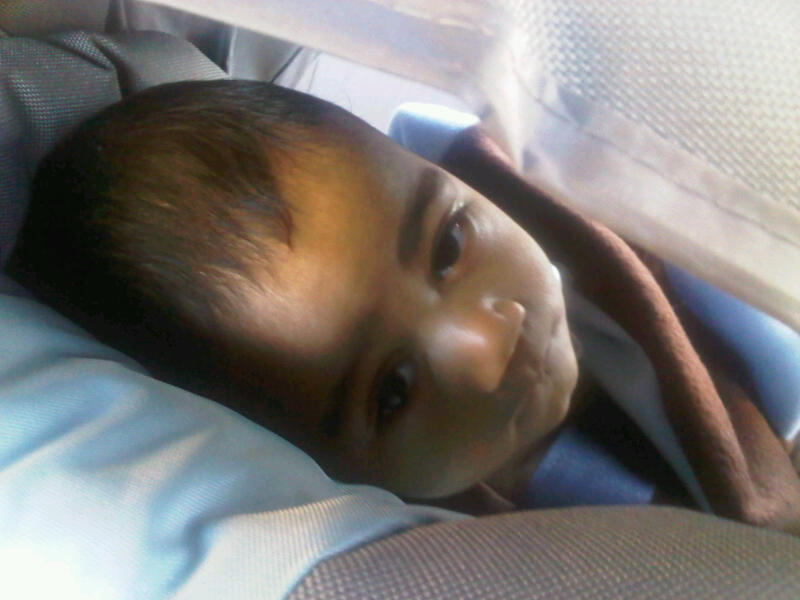
One day I turned around and saw him doing what he’s doing in this picture.  I snapped it at a red light.  I had turned to look and he was staring.  I jerked, thrown off.  I said something aloud like “He’s looking at me.”  We were in the car alone, probably going to get his grandmother from home to bring her back to our place.  When I turned around at the light, he was still steadily seeing my shoulders.  He watched my head, the arm from my glasses, the profile of his father.

It launched me into a spiritual experience, and not the kind I enjoy.  That stare made me conscious, technically self-conscious.  Those almond eyes had a love in them that left me with a thousand questions.  The questions have motivated me.  Together, his watching me, the questions I’ve “heard” in his stare, make me want to grow.

It’s funny because I’m a pastor.  I’m pretty sensitive to growth, especially in others.  I’m not completely unaware of the topic.  But I had to admit then–and, often, still–that I’m less aware of the reasons to grow until moments like the one behind this picture.  Even as a Christian.  Even as a preacher.  The fact is I care less about God.  I mean that literally.  I care more about this kid.  I care more about screwing up so daily that he conceives of life is a twisted way.  I care more about doing something well so that he can see accomplishment and fruit and benefits.

Somewhere in my head I tell myself that God will get along well if I mess things up, that God might even show mercy to me.  Of course, that is a motivating message in my ears.  But it also makes me less vigilant.  With my son, with my family, and with the people I love, they might not be so merciful with their glances.  They just might expect me to live up to things.  Indeed, they do, and just like my son’s stare, like his current habit of repeating exactly what I say, they make me want to live well.  Or, at least, better.  …I really have to watch what I say to cab drivers in the loop.

Jeff Johnson Writing For the Children

I know that many of you heard the story yesterday about the custody battle between Halle Berry and Gabriel Aubry for their  four-year-old daughter. Media reports state: “a custody evaluator — a psychologist — wrote the report after extensive interviews with the family and others. The report raised issues not about Gabriel’s ability to love but to care for Nahla, in part because of personal issues.  A judge will decide the custody arrangement later this month, and whether Halle gets to move to Paris with Nahla — something Gabriel opposes.”

Now, before we begin to take sides, which countless numbers of people have via social media, we need to look at the bigger picture. It is the very process of taking sides that is a reflection of the challenge that many of us who are trying to co-parent face daily. The challenge where one question is lifted over that of the very welfare of the children we claim to want to love and develop. That question is who is more right.

As the country faces increased divorce rates and more children, especially in our community, are being raised in single parent homes, the notion of co-parenting becomes more and more important. Co-parenting; or separated/divorced parents finding ways to collectively and cooperatively raise children they have brought into the world, is for many more difficult than trekking Mt. Kilimanjaro backwards with a blindfold. We carry as men and women so much pain, anger, shame and regret (did I say anger?) as a result of failed relationships that we can often never see beyond it in the name of providing a healthy space for our children.

Children are like beautiful flowers. They need ideal conditions in order to properly grow, bloom, and mature. What I see so often is parents attempting to fight for the position of greatest provider of light and water. “I can provide for them better than you” or “you can’t love them or address their emotional needs the way I can”. And what we fail to realize is that no matter how true either or any of the statements you can come up with to describe how great you are at parenting, it is secondary to the environment in with the parenting is done. By that I mean you could provide the greatest light since the sun to your babies, and provide care like spring rain, but if the soil that your babies are in is contaminated, all that great light and water still can’t stop the flowers from being infected.

And my beloved family, so many of us are further contaminating the soil even in our well doing.

To finish Jeff’s article, visit Black America Web by clicking here.

Fathers Know Best #7

Please read other interviews here if you haven’t.  Thanks to Tim for participating.

FF: Describe your family.

TW:  I have a beautiful wife (Kristi) of almost 8 years. I have two wonderful children, Kayla and BJ. Kayla will be 4 and BJ is 2.

FF: How has fatherhood changed you?

TW: Fatherhood has given me a greater understanding of how God loves and disciplines His people. I love and care for my kids, even though they don’t always appreciate it. I still feed them and clean up their bodily waste, even when they protest cleaning up their toys. Fatherhood has given me a greater appreciation for and understanding of how my parents raised me.

FF: What mistakes have you made as a dad? Name at least one and talk about what it meant to you.

TW: Since my children are at home with mommy all day, they are always screaming for mommy. When I come home from work, I enjoy brief celebrity status, then all attention switches back to mommy. So, at times, it was easy to distance myself emotionally, given that they didn’t seem to need me for anything. They are young and that’s usually how it works, but I would sometimes allow the pain of that to become an excuse to just let Kristi bear the burden of meeting their needs, instead of taking initiative. This was a big mistake that I used to make. I have progressed beyond that, and even forced them to come talk to me about something. I’m pretty confident that many fathers deal with this same issue.

FF: What’s the most helpful advice you heard when you were becoming a father or advice you’ve gained since you’ve been a father?

TW: My dad always taught me how important it is for Kristi and I to be in agreement and to keep our love for each other strong. When children come into the picture, it’s easy to put all the focus on them and neglect each other.

FF: How do you attend to your relationship with your wife outside of your being parents, and has parenting changed your marriage?

TW: Kristi and I always try to maintain some sort of a date night, even if we are just at home. Now that we are living in the city, we have greater access to babysitters. This has allowed us to go out more frequently than ever. Of course, parenting has changed our marriage. It’s forced us to be more creative and intentional with our time together. It’s something that we always need to balance.

FF: What are some of the things you’ve struggled with as a father?  What are some of the things that have given you the most joy?

TW: As for struggles, I mentioned one earlier. That’s been the main one. It’s very discouraging when they choose to get attitudes and disobey. What gives me the most joy is to watch their personalities develop as they mimic what Kristi and I do and say. I love watching them as they play and converse with each other.
FF: Describe adding a second child to the household.  Does having two children feel differently than one?

TW: Adding a second child presented new excitement and new challenges. Having two feels very different because these are two little human beings with very different personalities, issues, joys, needs, etc. It’s definitely more work. They both require individual attention in different ways. Different things make them upset or frustrated. So as we teach them, they are also teaching us.

FF: What surprises are there along the way for parents? What do you wish you were told to expect?

TW: Children have extremely different personalities. It’s also interesting to see them do and say things that remind you of yourself, or other family members. I wish there was an entire book in the Bible or at least a few chapters that were completely dedicated to raising children and what to expect. When we experience the challenges of parenting, I jokingly say to Kristi, “The Bible doesn’t say anything about this.” I love the word of God, I just wish that God would have put a lot more content regarding the “spiritual gift of parenting.”

FF: What is one recent memory you made with your child?

TW: We are currently potty-training BJ. One moment, we are congratulating him on going pee pee in the toilet. The next moment, we are reminding him that we go pee pee in the toilet, just after he has an “uh oh” moment. Sometimes we’ll ask him if he needs to go pee pee, and he will say “no”. The next minute, what does he do? He pees in his underwear. It’s been a fun and challenging experience. We’ve only been at this for the past 2 weeks. I think he’s getting it, slowly but surely.