Why We Have So Much Art

I knew I’d lose people with the approach, but I was going to lose people anyway. That’s the nature of fiction: despite all our lofty claims of universality, no piece of art is for everyone—which is why we have so much art, so that everyone has a chance of finding something that moves them. I figured some people somewhere might connect with the tale even in second person.

Read more of Junot Diaz’s Q&A at the New Yorker by clicking here.

Meg Wolitzer “On The Rules…”

Have you seen this essay, The Second Shelf, by Meg Wolitzer, over at the NYT?  You can read the entire essay by clicking here.

If “The Marriage Plot,” by Jeffrey Eugenides, had been written by a woman yet still had the same title and wedding ring on its cover, would it have received a great deal of serious literary attention? Or would this novel (which I loved) have been relegated to “Women’s Fiction,” that close-quartered lower shelf where books emphasizing relationships and the interior lives of women are often relegated? Certainly “The Marriage Plot,” Eugenides’s first novel since his Pulitzer Prize-winning “Middlesex,” was poised to receive tremendous literary interest regardless of subject matter, but the presence of a female protagonist, the gracefulness, the sometimes nostalgic tone and the relationship-heavy nature of the book only highlight the fact that many first-rate books by women and about women’s lives never find a way to escape “Women’s Fiction” and make the leap onto the upper shelf where certain books, most of them written by men (and, yes, some women — more about them later), are prominently displayed and admired.

This is a tricky subject. Bringing up the women’s question — I mean the women’s fiction question — is not unlike mentioning the national debt at a dinner party. Some people will get annoyed and insist it’s been talked about too much and inaccurately, and some will think it really matters. When I refer to so-called women’s fiction, I’m not applying the term the way it’s sometimes used: to describe a certain type of fast-reading novel, which sets its sights almost exclusively on women readers and might well find a big, ready-made audience. I’m referring to literature that happens to be written by women. But some people, especially some men, see most fiction by women as one soft, undifferentiated mass that has little to do with them.

Recently at a social gathering, when a guest found out I was a writer, he asked, “Would I have heard of you?” I dutifully told him my name — no recognition, fine, I’m not that famous — and then, at his request, I described my novels. “You know, contemporary, I guess,” I said. “Sometimes they’re about marriage. Families. Sex. Desire. Parents and children.” After a few uncomfortable moments he called his wife over, announcing that she, who “reads that kind of book,” was the one I ought to talk to. When I look back on that encounter, I see a lost opportunity. When someone asks, “Would I have heard of you?” many female novelists would be tempted to answer, “In a more just world.”

The truth is, women who write literary fiction frequently find themselves in an unjust world, even as young single women are outearning men in major American cities and higher education in the United States is skewing female. As VIDA, a women’s literary organization, showed in February in its second annual statistical roundup, women get shockingly short shrift as reviewers and reviewees in most prestigious publications. Of all the authors reviewed in the publications it tracked, nearly three-fourths were men. No wonder that when we talk about today’s leading novelists — the ones who generate heat and conversation and are read by both men and women — we are talking mostly about men.

Exploring Amazon, I came across a category called “Women’s Fiction” where I am listed, along with Jane Austen, Sophie Kinsella, Kathryn Stockett, Toni Morrison, Danielle Steel and Louisa May Alcott. (Needless to say, Amazon fits us into other categories as well.) If there is a stylistic or thematic link to be found among us, it’s hard to see. It should be noted that Amazon puts the occasional man in this category. Tom Perrotta is there, and so is Jonathan Franzen (albeit the Oprah’s Book Club edition of “Freedom”), which should provide yet more fodder for those who complain of his ubiquity. Both men write about relationships and also about suburbia; is that why they’re included?

Amazon is clearly trying to help readers find titles they want. But any lumping together of disparate writers by gender or perceived female subject matter separates the women from the men. And it subtly keeps female writers from finding a coed audience, not to mention from entering the larger, more influential playing field. It’s done all the time, and not just by strangers at parties or by various booksellers that have no trouble calling interesting, complex novels by women “Women’s Fiction,” as if men should have nothing to do with them. A writer’s own publisher can be part of a process of effective segregation and vague if unintentional put-down. Look at some of the jackets of novels by women. Laundry hanging on a line. A little girl in a field of wildflowers. A pair of shoes on a beach. An empty swing on the porch of an old yellow house.

Compare these with the typeface-only jacket of Chad Harbach’s novel, “The Art of Fielding,” or the jumbo lettering on “The Corrections.” Such covers, according to a book publicist I spoke to, tell the readers, “This book is an event.” Eugenides’s gold ring may appear to be an exception, though it has a geometric abstraction about it: the Möbius strip ring suggesting that an Escher-like, unsolvable puzzle lies within. The illustration might have been more conventional and included the slender fingers and wrist of a woman, had it not been designated a major literary undertaking.

I took semiotics back at Brown University in the same heyday of deconstruction in which Eugenides’s novel takes place (he and I were in a writing workshop together), but I don’t need to remember anything about signifiers to understand that just like the jumbo, block-lettered masculine typeface, feminine cover illustrations are code. Certain images, whether they summon a kind of Walker Evans poverty nostalgia or offer a glimpse into quilted domesticity, are geared toward women as strongly as an ad for “calcium plus D.” These covers might as well have a hex sign slapped on them, along with the words: “Stay away, men! Go read Cormac ­McCarthy instead!”

I sometimes wonder if book length, intentionally or inadvertently, signals to readers a novel’s supposed importance. Certain novelists who have achieved high literary profiles, like David Foster Wallace, Haruki Murakami and William T. Vollmann, have all published extremely long books — in the case of Wallace and Vollmann, over 1,000 pages. With some notable exceptions, women have not published many well-known doorstops since Doris Lessing’s “Golden Notebook.” As it happens, we live not only in the era of the abbreviated attention span, but also in the era of the book group, whose members often set a strict page limit. Yet does the marketplace subtly and paradoxically seem to whisper in some men’s ears, “Sure, buddy, run on as long as you like, just sit down and type out all your ideas about America” — what might in some extreme cases be titled “The Big Baggy Book of Me”? Do women reflexively edit themselves (or let themselves be edited) more severely, creating tight and shapely novels that readers and book groups will find approachable? Or do they simply not fetishize book length one way or the other? (And for that matter, would most long-form men say they were just letting content seek form?)

All this isn’t to say megabooks are necessarily better; in their prolixity perhaps it’s easier for them to in fact be worse. But they are certainly louder.

Over centuries, the broad literary brush strokes and the big-canvas page have belonged mostly to men, whereas “craft” had belonged to women, uncontested. It’s no wonder that the painted-egg precision of short stories allows reviewers to comfortably celebrate female accomplishment, even to celebrate it prominently in the case of Alice Munro. But generally speaking, a story collection is considered a quieter animal than a novel, and is tacitly judged in some quarters as the work of someone who lacks the sprawling confidence of a novelist.

My sense is that like most men, most women are writing at the length they want to write — but they’re not always getting the same reward. Men like Ian ­Mc­Ewan and Julian Barnes have written very short, highly regarded and widely read books in recent years. Yet if a woman writes something short these days, particularly if it’s about a woman, it risks being considered minor. (“Spare” is the oft-used word of faint praise.) Yet if, on the other hand, a woman writes a doorstop filled with free associations about life and love and childbirth and war, and jokes and recipes and maybe even a novel-within-a-novel, and anything else that will fit inside an endlessly elastic membrane, she risks being labeled undisciplined and self-indulgent.

Sure, Hilary Mantel’s “Wolf Hall” is pretty massive, but I suspect that a historical work — one that teaches the reader about a subject (in this case a male one) — is considered more acceptable from a woman than, say, the kind of long “sensibility” novel written more frequently by men. Julia Glass, who won a National Book Award in 2002 for her novel “Three Junes,” said: “Many readers ask why I write so often from a male point of view. I have theories, but I don’t really know. I don’t game my books toward a male audience, and yet the point of view may help their reception. I think men are more accepting of my books than they would be if the points of view were always female.”

Characters matter to a great extent, and novels that involve parents and young children seem at first glance to be considered the potentially sentimental province of women. Except, of course, when those parents and children are male, as is the case in “The Road” and “Extremely Loud and Incredibly Close,” both of which feature father-son duos and have been praised enthusiastically by men and women.

But some of the most acclaimed female novelists have written unapologetically and authoritatively about women. And the environment needs to be receptive to that authority, recognizing and celebrating it in order for it to catch. It seems no coincidence that some of the most esteemed women writing today — Toni Morrison, Joyce Carol Oates, Margaret Atwood, Doris Lessing, Marilynne Robinson — came to prominence at an unusual moment in time when the women’s movement could be felt everywhere. Stories, long and short, and often about women’s lives, suddenly mattered to the cultural conversation. This period, the 1970s and to an extent the early ’80s, initially appeared to create an entirely different and permanent reality for female fiction writers. Men were actively interested in reading about the inner lives of women (or maybe some just pretended they were) and received moral kudos for doing so. Whereas before that a lone woman might be allowed on the so-called men’s team, literary women began achieving critical mass and becoming more than anomalies. But though this wave of prominent authors helped the women who followed, as time passed it seemed harder for literary women to go the distance. As Katha Pollitt, the poet and literary critic, says: “I think there’s always space for a Toni Morrison or a Mary McCarthy, but only one of them at a time. For every one woman, there’s room for three men.”

Finish reading this essay by clicking here.

How Amina Gautier Became A Writer

I follow Kelcey Parker’s blog, phdincreativewriting, and Kelcey recently posted this interview with Amina Gautier.  I hope you find it interesting and inspiring.  You can visit Kelcey’s blog to see her other interviews by clicking here.

How Amina Gautier Became a Writer

This is the next installment in the How to Become a Writer interview series, which will post here at Ph.D. in Creative Writing every other Sunday until I run out of writers to interview, or until they stop saying yes. Each writer answers the same 5 questions. Thanks to Amina for saying yes!

1.     Why did you want to become a writer?

I came of age during the anti-apartheid movement in the US; I was an adolescent when Stevie Wonder recorded his anti-apartheid song, when the play Sarafina!toured New York, when the Cosby spin-off A Different World was weaving anti-apartheid material into its episodes, and when Nelson Mandela was not yet free. At home, my mother had a copy of Kaffir Boy and when I entered ninth grade, Nadine Gordimer’sJuly’s People was selected as the book in common, the one text all incoming students would have to read and discuss communally. I was surrounded by adult and peer discussions of apartheid, which also led to conversations wherein which it was easy to draw parallels between the restrictions placed upon native (black) South Africans during apartheid and on African Americans during slavery and after the Reconstruction, one of the most obvious being restrictions upon literacy and education. This atmosphere impressed upon me the importance, power and danger of literature. When factions attempt to create oppressed societies, one of the foremost ways they go about doing so is by banning thought-provoking literature. It is no accident that slaves were forbidden to read and write, or that women were long kept out of universities. Knowing this so early on made me believe that being a writer was the best thing one could be and that writing literature was the most revolutionary, dangerous, powerful, empowering and important thing a human being could do.

2.  How did you go about becoming a writer?

Short Answer: I have always been a writer.

Long Answer: I played with dolls and listened to music. When I was a child, I imbibed many elements of craft without any conscious effort on my part, learning quite a bit about writing stories from playing with my toys and listening to music. Any child who has played with toys—be it Barbie or Transformers—has the makings of a fiction writer. As any kid knows, there’s no game without a premise or story. Playing with dolls went a long way to helping me learn the intricacies of plot. No matter what I had in mind for Barbie and Ken, Midge or Skipper could always interfere. Enter subplot. Enter characterization. Enter forward moving action motivated by a character’s wants or desires.

The first stories I ever recognized as stories were actually songs. There was no way to live in my childhood home and not be exposed to music. When I was younger, I was part of an extended family and I had only to walk from one room to another to hear a different song i.e. a different story. My grandmother played gospel, my cousin favored hip hop, and my uncle preferred rock, but it was in my mother’s room, where she played soul music that I first absorbed stories. The songs I heard: Ashford and Simpson’s “Hi-Rise” The Temptations’ “Just My Imagination” and “Since I Lost My Baby,” Luther Vandross’s “Superstar/Until You Come Back to Me,” The Stylistics’ “People Make the World Go Round” and “Children of the Night,” Aretha Franklin’s “Jump to It” and “Jimmy Lee,” Natalie Cole’s “Just Can’t Stay Away,” Blue Magic’s “Sideshow” and Roberta Flack and Donny Hathaway’s duet “You Are My Heaven” were complete and linear narratives set to music. They had beginnings, middles, and ends. If you took away the musical accompaniment, you would have short stories.

In the more formal sense, I began with writing poetry, in the way that most elementary school kids in Brooklyn begin with writing poetry. My language arts teacher exposed us to poetry around the fourth grade and made us kids in the gifted class enter a variety of poetry contests. My poems won a bunch of these school-wide, district-wide, borough-wide, city-wide contests. One particular win allowed me to meet the mayor (Koch, at the time) and shake his hand. All of the contest wins came with trophies and savings bonds. All in all, it was a good deal and it wasn’t anything I thought very much about. When I got to Stanford, I majored in English with a Creative Writing Emphasis (the precursor to the minor which the university now offers). The creative writing courses were all taught by Jones Lecturers (former Stegner Fellows who stayed on to teach) and entry into the courses was by lottery only.

As lottery would have it, my number came up for the fiction workshop first, though I continued to write poetry. My fiction instructor shared an office with one of the poetry instructors and one afternoon I brought some of my poetry to Chris Wiman for some feedback. After showing him my poems, he promptly shot me down. And—here’s the thing—I let him. I realized that I had no desire to be a poet if I had to train to do it. This was partly because the rewards of it had come too easily to me as an adolescent and partly because I just wasn’t interested enough. That’s how I knew I was a fiction writer. I’d only been in the workshop for one quarter, but I already knew that if I’d shown my fiction teacher my stories and he told me I would never make it and advised me to quit, I would not have been meek and walked away with my tail between my legs. I would have ignored him, marched to my dorm, written ten brand new stories, and made him choke on his words. After only weeks, I was fully invested. There was no one in the world that could discourage me. In order to be a fiction writer, I was willing to be in it for the long haul, to work as hard as it took, to write as many hours as it required, to dump as many boyfriends as it necessitated and to lose as much sleep as I could afford.

3.  Who helped you along the way, and how?

Odd as this may seem, my Latin teachers helped me to become a good writer. I started studying Latin in fifth grade and continued with it all the way through high school to AP Latin my junior year, after which there was nothing left to study until college. The rules of grammar, which I found confusing or irregular in English, made sense to me when I viewed them through the lens of this non-native language. Exposure to Latin will, of course, improve anyone’s vocabulary, but the focus on word formation, etymology, derivatives and nuanced language will serve the fiction writer a good turn. Since no one expects secondary school Latin students to prepare for lives as theologians or priests, much of the material students learn to translate is secular rather than ecclesiastical. Thus, Latin exposed me to rhetoric and poetry. Although I learned first through another language, I was already well-versed in scansion, metaphor, synecdoche, metonymy, hyperbole, irony, litotes, caesuras and all of the other rhetorical devices long before I ever got to AP English. My study of Latin made me hyper-aware of language, syntax, diction, and rhetoric earlier than I might have been expected to care about the formal qualities of language. Thank you—ago tibi gratias— Mr. Doddington, Mr. Schroeder, Mr. Mulgrew, Miss Bennett, Barb Watson and David Demaine.

4.  Can you tell me about a writer or artist whose biography inspires you?

I’m not particularly interested in any fiction writer’s biography. Perhaps I would be if I were reading poetry or autobiography, but when it comes to fiction all I need to know about the writers that I read is that they write damn good stories and don’t cut corners. Just as Allen Iverson, Kobe Bryant and Michael Jordan never met a shot they didn’t like, I’ve never met a story I didn’t like. For just a small investment of my time—somewhere between five and thirty minutes depending on the story’s length—I can read a story that will make my heart and mind grow by leaps and bounds. That’s a great return on investment if ever I’ve heard of one. Unfortunately, I’m not as open-minded when it comes to novels. Given the tendency of many contemporary novels to disintegrate three fourths of the way through, I’m hardly willing to invest hours or days of my time into one unless multiple trusted sources can vouch for it. If, by some chance, I am roped in to reading a novel that dies midway through, I make it a point to never read anything else by that author ever again. You never get a second chance to make a first impression.

I am, however, inspired by lines and passages in stories. If I’m in a funk, reading the last line of James Baldwin’s “Sonny’s Blues” or the opening paragraph of Stanley Elkin’s “A Poetics for Bullies” or the “Be a Martin” scene in Philip Roth’s “The Conversion of the Jews” will always bring me back to a better frame of mind.

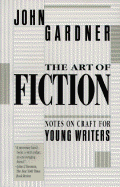
I have always been inspired by the section of John Gardner’s Art of Fiction, in which he says:

To write with taste, in the highest sense, is to write with the assumption that one out of a hundred people who read one’s work may be dying, or have some loved one dying; to write so that no one commits suicide, no one despairs; to write, as Shakespeare wrote, so that people understand, sympathize, see the universality of pain, and feel strengthened, if not directly encouraged to live on. That is not to say, of course, that the writer who has no personal experience of pain and terror should try to write about pain and terror, or that one should never write lightly, humorously; it is only to say that every writer should be aware that he might be read by the desperate, by people who might be persuaded toward life or death. It does not mean, either that writers should write moralistically, like preachers. And above all it does not mean that writers should lie. It means only that they should think, always, of what harm they might inadvertently do and not do it. If there is good to be said, the writer should remember to say it. If there is bad, to be said, he should say it in a way that reflects the truth that, though we see the evil, we choose to continue among the living.”

Gardner’s suggestion that literature can soothe the desperate and that good literature is a matter of life and death rings true with me. Literature has certainly saved my sanity. Therefore, whenever I write, I am always mindful of Gardner’s inspiring advice. It reminds me that my reader has many faces. He or she is not just a person with leisure reclining on a sofa. He or she is also a nursing home patient, the quiet teen who turns to books when shut out of reindeer games and socializing and reads late at night in corners of the house/apartment when parents are asleep, an infirm person who rarely has visitors, the adolescent who closes the bedroom door and buries himself or herself in a book to drown out the noise of adults fighting, the retiree who has been waiting decades to read literature at leisure. Knowing this prevents me from cutting corners and taking shortcuts as a writer, it deters me from writing gimmicky material, veers me away from sentimentality, forces me to write however many drafts the story requires.

5.  What would you say in a short letter to an aspiring writer?

Dear Writer,

1.     Get Out of Your Own Way:

In his rap “Bad” LL Cool J rhymes “You want a hit? Give me an hour plus a pen and a pad!” Bravado aside, his lyrics boil the writing process down to its bare essentials. In terms of accoutrements, all a writer needs in order to write is pen and paper. All of other the niceties are a bonus, like sprinkles on ice cream, nice but not necessary. Real writers can write anywhere, anytime, anyplace. You don’t need a certain time of day, peace and quiet, the right circumstances, the correct placement of the constellations in the sky, green apples or any type of rituals. You don’t even need a muse. These esoteric needs are actually self-imposed obstacles and roadblocks aspiring writers place in their paths. If you spend your time awaiting optimal conditions to begin writing, you are setting yourself up to fail. Writers are not picky. When we need to write, we will write on whatever is handy. I have written on computers, typewriters, and word processors. I have written by hand. I have filled spiral notebooks, Trapper Keepers, legal pads. I have written on index cards, construction paper, receipts and cereal boxes. I have even written on myself. I am a writer. I write.

2.     Don’t try to write something ‘new.’ Just try to write something good.

Although fiction is not as old as poetry in terms of genre, it is at least four hundred years old (if not older), if we date it back to 1605 with Cervantes’s Don Quixote, which many cite as the “first novel.” Plenty of stories have been written since then and most, if not all, stories have already been told. Writing a short story as a series of emails is neither new nor innovative, since it is based on the premise of writing a short story as a series of letters, a technique which is at least as old as Samuel Richardson’s novels Pamela (1740) and Clarissa (1748). Same thing goes for writing the story in the form of a photo album, homework assignment, map, radio broadcast, telegram, or PowerPoint presentation. Ditto for writing the story in second person, first person plural, or the point of view of an animal/inanimate object/ghost. This is not to say that the writer should eschew experimenting with these forms or any others; it is merely to say that the writer who does so in the belief that adopting any of these forms makes the story “new” is a writer who is not well-read enough to discern. There has been a tendency among aspiring writers and workshop students (at least in my own classes) to offer the following commentary as praise when discussing a fellow student’s story: “This is good. I’ve never seen it before. It’s very original” which erroneously conflates quality, originality and lack of exposure, when all it really means is that the person making the comment needs to read more and read better.

3.     Remember what Yoda told Luke: “Do or do not. There is no try.”
First Drafts

A first draft is a funny thing.  A stack of questions waiting to be answered.  Seven thousand, one hundred twenty lines to be reviewed with patience you don’t have.  Words to be heard aloud, doubted like a thief walking through your favorite room, turned over in the mind, changed for something tighter, or left alone like that one lavender flower growing in a field of green.

All the judgment sits in that pile of paper.  You see it differently when it’s paper.  As a file it’s just like anything else on that tap tap tap laptop.  It’s something in a screen.  It’s real but still less real.  When it’s printed, it zips across your all-in-one and each scrimp of the printer is a question and a hope and a prayer about you taking every letter to the next level.  The articles, verbs, and characters join together into a choir, one you love and hate.  They sing to you as the printer forms their melody in the faint, terrible background.  You’re enchanted and afraid of their music.

Lift the language.  Tighten the plot.  Excise the unnecessary.  Describe.  Take your time.  Strengthen the dialogue.  Add this scene.  Delete that.  Say it better.  They sing things like that, and their collective voice takes the tone of a friend.  Their instructions and encouragements collapse the way jazz does, unexpected and delightful.  Go.  See.  Soar.

You wait because you gave yourself a waiting period.  A break.  It’s helpful even if it claims the three ounces of sanity you think you still have.  You hate waiting, at least, for the work of revision.  You remember that conference workshop where the presenter said revision was seeing again, looking again, searching again.  And her broad smile finds you while you wait. She was a white woman, her face plumped like the rest of her body.  She wore red and, though red was a color for fire and heat and summer, you imagined her cool as stood at the podium to speak.  She was joyous as she spoke.  Joy was calming, cool.  Joy was the collection of possessing your words and your characters and your vision for the story.  You thought of her as you waited because her coolness was what you needed while you watched that stack, the pile with 96,504 expectations.  Each word commanding to be the best.

You got tired thinking of those words.  You cherished them.  But they made you a little sick.  You wanted time to pass before you saw them.  Even when you clicked the manuscript open, you couldn’t read.  You saw the blur of that first page and closed it quickly.  The X from Microsoft Word pressed into your mind.  There would be enough time to do what needed to be done.  It just wouldn’t be now.

Granta Interview with Catherine Chung

Granta interviewed Catherine Chung, author of the novel, Forgotten Country.

Catherine Chung, author of Forgotten Country

Catherine Chung was one of Granta’s New Voices in 2010. Her first book, the novel Forgotten Country, is published this month by Riverhead.Granta’s Patrick Ryan talks with the author about the inception of her novel, and how stories from the past, a fascination with sisterhood and math came into play.

PR: What is the ‘forgotten country’ in the book? Is there more than one possible meaning in the title?

CC: I came up with this title around the time when I was doing a lot of research into the Korean War, which is also sometimes called the Forgotten War. The idea of that blew my mind – just how something as large as a war can be forgotten, and how in forgetting it you’re also forgetting the country that fought it and was divided by it – the title came from that and then seemed to resonate with the history of the particular family in Forgotten Country.

They’ve lost their homeland – not just the Korea they leave behind, but also the Korea that existed and was lost before it: before the split from the Korean War and before Japanese Occupation, when it was still a whole country. That initial loss echoes in all the others. In a similar way, I liked how the histories of the family – the national and the personal ones – are encompassed by this title, which is also – I think – about the lost unity of the family itself.

Sibling rivalry plays a large part in the novel. One of the major arcs involves the narrator and her sister and their struggle to come to terms with both their past and present. How important was it to you that this rivalry be resolved? And do you have a sister?

I don’t have a sister – I have an older brother, but I have always been really interested in sisterhood, which is filled with such complexity of emotion. There’s the possibility of so much intimacy, but also competitiveness and dependency and blame. It’s so fraught.

It was important to me that the rivalry or the issues between Janie and Hannah be engaged, that they would both be forced to face up to One day my aunt disappeared, and my family thought she’d been kidnapped by North Koreans who were raiding dorms and taking girls.their longing for closeness as well as the ways in which they’ve both made it so difficult for their family to be together – but I don’t know if I ever expected an actual resolution to come out of that, not in the sense that everything is good now between them. I don’t believe that real relationships between anyone actually work like that. I wanted there to be hope for that though, for the possibility of it to be real and clear between them.

To finish reading the interview, click here.

Read Fiction, Develop Empathy

A study by a Washington and Lee University psychology professor has demonstrated that reading a short work of fiction can lead readers to empathize with the work’s characters, to detect subtle emotional expressions more effectively and to engage in pro-social behavior.

Dan Johnson, assistant professor of psychology at Washington and Lee, published the results of his study in the November 2011 edition of the journal “Personality and Individual Differences.”

With the help of three W&L students — senior psychology majors Lauren Borden (Lake Leelanau, Mich.) and Grace Cushman (Wilton, Conn.) and sophomore Madison McCune (Nacogdoches, Texas) — Johnson had 200 subjects read a five-page fictional short story written specifically for the experiment, designed to elicit compassionate feelings for the characters and model pro-social behavior. The subjects then participated in exercises to measure the impact of the reading.

Based on the results of the post-reading exercises, Johnson concluded that the more immersed the readers were in the story, the more empathy they felt for the characters. In addition, he found that the heightened empathy led to an enhanced ability to perceive subtle emotional expressions such as fear or happiness. Individuals who experienced higher levels of empathy were also nearly twice as likely to engage in pro-social, or helpful, behavior as individuals experiencing low levels of empathy.

“An interesting component is that it really seemed to be a lot about the imagery and visualizing the face of the main character and the events they experienced,” said Johnson. “Those who experienced more inherent imagery were more likely to develop empathy for the characters and be more helpful.”

To finish reading Sarah Tschiggfrie’s article, click here.

Possibilities of Fiction

Robert Alford’s article at Pop Matters is a conversation with Jennifer Egan.  He asks several questions that are worth asking and gets responses worth reading.  Here’s one question, about the form of fiction, to whet your interest in the interview:

You use a variety of narrative perspectives, shifting tenses, styles and even a power point presentation to present the stories in A Visit from the Goon Squad. Is the book in some way a comment on the aesthetic form of fiction itself and all of the various things that it can accomplish?

I didn’t think of it that way. The way I imagined it was just — if I’m writing this in parts, why not get the maximum advantage from that that I can? In other words, why not create a much bigger range of experience than I could possibly get away with in a more centrally oriented novel? Maybe I’m saying the same thing in a different way though, because in some ways it is a celebration of all these possibilities, and I do feel that way about fiction. One of the things that’s so great about it is its flexibility. That’s why I sometimes do feel impatient with the question of whether it’s a novel or a story collection. I feel like, who cares about those names? Aren’t they only there to serve us, and if they’re not doing that job, then let’s put them to the side for a moment. I do feel energized by the many things that fiction can do and has done from the very beginning. If you look at the early novels, they’re these really exciting, elastic grab bags of possibilities.

To finish reading Robert’s article, click here.

13 Blogging Ideas for Novelists

As I keep learning about publishing and writing, I continue to deepen my debt to a few people in the writing world.  Today I’m nodding again to Michael Hyatt.  He posted a great list of blog ideas for novelists.

Send your novel-writing friends to this if they’re interested in developing or continuing a blog.  I’ve listed the first 5 ideas, and you can click below to keep reading.

  1. Excerpts from Your Novel. This is probably the easiest. It has the added advantage of allowing us, your potential readers, to “sample the brew.” Just write a paragraph to set up the excerpt. Oh, and be sure to link to your book, so we can buy it (duh).
  2. Backstory of Your Novel. Tell us why you wrote your novel. How did you settle onthis story? How did you come up with the main characters? Why did you chose the setting you did? What research did you have to do before you could start writing?
  3. A Behind-the-Scenes Look. Give us a sense of what it is like to be a novelist. How did you feel when you finally landed an agent? What does a typical writing day look like for you? What’s it like to see your book in print and hold a copy in your hand for the first time?
  4. “Directors” Notes. This is the kind of thing you occasionally see with extended versions of movies. Explain why you chose to start with a particular scene. Talk about the scenes you had to delete—or those you had to add to improve the story. Don’t underestimate the curiosity of your readers.
  5. Interview with Yourself. Authors often complain that professional reviewers haven’t read their book or don’t “get it.” Fine. Who knows your novel better than you? No one. So interview yourself. Have fun with it. What questions do you wish you would be asked?

To read the rest of Michael’s list, click here.

Interview With Heidi Durrow & Book Giveaway

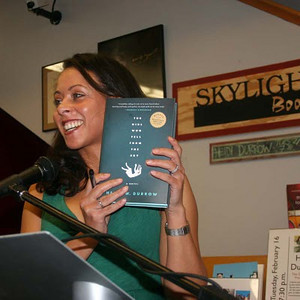
I’m pleased to give you an interview with Heidi Durrow, author of the New York Times Bestseller, The Girl Who Fell From The Sky.  Heidi shares stories with others in great ways, and she’s given thoughtful answers about her first published novel.

Also, I didn’t ask about this in the interview here, but Heidi created in 2008 and continues to offer the Mixed Roots Film & Literary Festival.  In addition to this interview, you can learn about Heidi’s work at her website by clicking here.

MW: Give us an idea of who you are.  That’s broad, but you’re an author and who else?

HD:  I’m a writer, and podcaster and festival producer and avid bendy-straw user, and Moleskine junkie, and storyteller.

MW: I think, in part, this story is about a well-loved girl growing up through pain.  Would you comment on the ways Rachel was offered love by people in her life?  How were those people part of her growth or development or healing?

HD:  Rachel is very loved and so differently by all the people in her life.  There’s her aunt who loves Rachel as if she’s a reflection of her young self and wants to get it right to give Rachel every possibility. There’s Grandma Doris who loves Rachel hard; she’s super-strict and believes that her strict rules express her love.  And there’s of course her mother whose love is about keeping her safe.  For Nella, loving her daughter means keeping her safe from every danger there is.

MW: What do you think your story says about memory and remembering?  Certainly it is a story that must simply be read, but if it says something about how we remember, what might that be?

HD:  It is very much a novel about the need for remembering.  The story begins with Rachel denying her own memories of her life before the tragedy in which her family perishes.  Forgetting–at least in Grandma’s mind–is the best way to move forward.  And yet, Rachel discovers that her memory of her mother and siblings will not be denied.  Essentially, she learns that it is only by acknowledging the truth of her past that she is able to move forward.  The line between her past and future isn’t that stark.

MW:  Writers draw from life, their own and those of others.  To what extent did you draw from your life’s details, and what was it like emotionally to pull from your story to write Rachel’s?

HD:  The things that happen to the characters in the book didn’t happen to me or people I know, but the emotional touchstone is very much a part of my own experience and that of those I know.  It was extremely difficult for me to write the book — there is a lot of pain and grief in the story and it was what I was feeling as I wrote it.  I’m in a different place now in my life and the new book I’m finding also has a very different emotional feel.

MW:  Several of your characters enable Rachel to live in response to being abandoned or left by some of her family.  Which character would you be most likely to tell a problem to and why?

HD:  I would definitely confide in Brick.  He’s so absolutely loving and non-judgmental.  Here’s a character who has only known abandonment and abuse and yet, he’s always open to love.  That’s his default even though it could be a horrible risk.  I don’t know if he would know how to solve every problem folks share with him because he is so young, but you certainly wouldn’t feel alone in a dilemma with Brick on your side.

MW:  You use multiple viewpoints effectively in the novel.  They enrich the work and help me see the story from several angles. What aided you in writing the novel that way?  How did you organize yourself while writing?

HD:  I started the novel with just Rachel’s voice.  I soon realized that she was an unreliable narrator and I needed add other voices in.  The voices entered the story quite organically as I needed them.

MW:  Talk about Roger.  We get powerful glimpses of him.  Why do you think he made some of the choices he did?  Do you think he loved his family, his daughter?

HD:  Roger loved his family and his daughter, but he just didn’t make the right choices.  He is an alcoholic and made some very bad choices under the influence.  But then even once he’s sober (after the tragedy) he still decides that the best way to be a father is to be absent.  I think that’s a coward’s choice.  I think Roger could have learned to be a good father–he was learning to be a better man.  Unfortunately, many fathers make the choice to be absent (or present only monetarily) and we as a society should address this head-on.

MW:  How has your novel encouraged or provoked language about race?  Have you been able to carry on, or participate in, conversations from the story, if I can say it that way?

HD:  It’s been very exciting to talk to readers about the book and inevitably about race and culture and what it means to be American.  Having the story in their hand gives them a kind of permission to talk about these difficult issues and I think most people feel a great relief.  I’ve had some exciting conversations — no answers — but I think the first step is always trying to come up with new questions about the issues — then maybe we can have new thoughts.

MW:  What are you reading these days?

HD:  I’ve been doing a lot of non-fiction reading for the new book about the theory of sudden change, evolution, Victorian spiritualism and the Impressionists. You’d be surprised how much all of those subjects have something to do with each other.  It’s surprising me as I write.

MW:  Are you working on projects you can talk about?  How can readers keep connected to you?

HD:  I’m working on a new novel inspired by the life of a Victorian era mixed-race trapeze artist and strongwoman who was super-famous in her time but is unknown today.  (Degas did a portrait of her — one of his most famous.)  I love to hear from readers.  I will continue with more readings and speeches on the road in 2012.  My appearance schedule is on my website; if you join my mailing list you can get an update every 6 weeks.  And you can also find me on Facebook (http://www.facebook.com/author.heidi.durrow) and Twitter (@heididurrow).

Now for the giveaway.  Leave a comment about why you’d like to get Ms. Durrow’s book.  I’ll choose a winner from the comments after midnight, CST, Wednesday.  Maybe you can give a gift in the form of The Girl Who Fell From The Sky.  Either way do get your hands on this book.

Gardner and “…a dream in the reader’s mind.”

John Gardner in the Art of Fiction says a lot that writers should read.  For me his overall thrust is captured in a few helpful passages in his chapter on Basic Skills, Genre, and Fiction as Dream.  If you’re a writer of fiction and haven’t met this book, visit your nearest public library and thumb through it.

In any piece of fiction, the writer’s first job is to convince the reader that the events he recounts really happened, or to persuade the reader that they might have happened (given small changes in the laws of the universe), or else to engage the reader’s interest in the patent absurdity of the lie.  The realistic writer’s way of making events convincing is verisimilitude….

He must present, moment by moment, concrete images drawn from a careful observation of how people behave, and he must render the connections between moments, the exact gestures, facial expressions, or turns of speech that, within any given scene, move human beings from emotion to emotion, from one instant in time to the next….

…whatever the genre may be, fiction does its work by creating a dream in the reader’s mind.  We may observe, first, that if the effect of the dream is to be powerful, the dream must probably be vivid and continuous–vivid because if we are not quite clear about what it is that we’re dreaming, who and where the characters are, what it is that they’re doing or trying to do and why, our emotions and judgments must be confused, dissipated, or blocked; and continuous because a repeatedly interrupted flow of action must necessarily have less force than an action directly carried through from its beginning to its conclusion.

Wangerin, Writing, and “…the shape of my days.”

I’m celebrating the work of writing and revising and wrestling with words.  This is partly because of National Novel Writing Month and partly because I need to think about writing more than I allow myself.

I came across a delightful conversation between Mark Neal and Walter Wangerin.  Walter Wangerin is a retired writing teacher and pastor and author of more than thirty books, a few of which I’ve read.  His writing is wide, deep, mystical and searching.

In the conversation, Wangerin talks about the five covenants of writing.  He says of beginning a project that he starts “with something that has possibility,” something he can pursue.  He says, I’m sure for those of us learning from his long record as a writer, communicator, and teacher, “In order to see truth or reality as clearly as you possibly can, you have to empty yourself. And that means emptying yourself of any preconceived interpretive factors.”

He discusses his views of technology and how it’s impacted his own way of writing.  Then Wangerin mentions a friend, Eugene Peterson and how he has ended book writing and taken up letter writing.  Wangerin says,

And his mind is my mind. I’m sure there are authors who do consider what they are sending out, even by email, to be of literary value. But I think letter writing has been profoundly undermined by email. Letter writing used to be a genre of its own that was just a delight. You didn’t have to go back and forth and revise it; you could allow your mind to wander and be shaped by the relationship you had with the person you were writing. And I am sorry that that has been diminished. Because email simply gets deleted.

Is that true in your world?  Do you think that your communications have changed, or, more pointedly, that your writing has lost value because of technology?  When talking about how many people can’t live without devices and gadgets to get things like writing done quickly, he says that “writing shouldn’t be easy or fast.”  And he offers advice to writers and the theme, if I can call it that, is nurturing one’s soul.

When answering one of the last questions in the interview, one having to do with a recent book, Letters From the Land of Cancer, Wangerin talks about what motivates him to keep writing.

But it takes somebody who knows how to write it so the commonality can be discovered and experienced. And that always is the sweet slip of the sea along my boat, the pleasure of that. Why would I stop that? I mean that’s why I’m telling you all this. Not just because it’s a thing I can do, but larger than that, it’s my identity. There are a number of things that make up what I would call myself. I would say all of them are relational. And certainly I am defined by my family, my heritage, just as in the Old Testament, nobody was an individual. But I’m also defined by this thing I can do. This is not a profession, this is a characteristic that reveals the soul, the core. I write, I am a writer. In fact, it has become the shape of my days, which is a pleasure.

To read the full conversation with Walter Wangerin, click here.