A Spiritual Hero

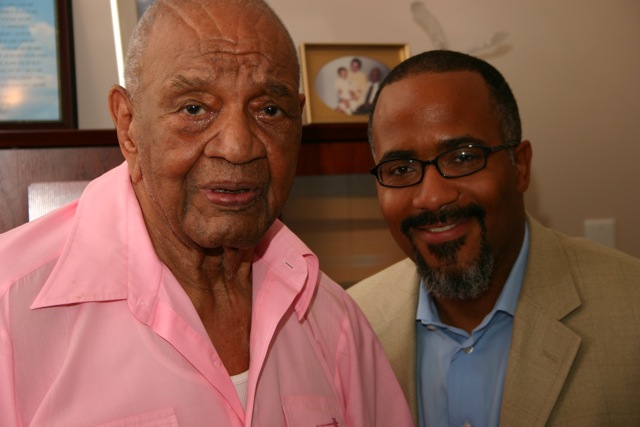
Michael and Gardner C. TaylorYesterday afternoon, the afternoon of Easter, Dr. Gardner C. Taylor died. I will reflect more on his passing, particularly as I said to Dawn on the poetic nature of him dying on Easter. It was fitting in many ways. But here is a quote from our interview with him in 2011, when his voice was as strong as a few months ago when he and Mrs. Taylor wished us a Happy New Year.

I’m literally numbering my days. I’m approaching what in my childhood we would have called my “commencement day.” My stage of life means to be aware that we all are just strangers and pilgrims. We can make this place home sometimes. Our danger is the false notion that it is home.

All in all, life’s a great experience. But by faith we believe there’s a better one. It’s hard to imagine what it can be like. At the point I have reached, one ponders more and more what it’s like. It does not yet appear. But this we know, the Bible says, that “we shall be like him, for we shall see him as he is.”

Those are tremendous things to wrestle with. Not too much for the human mind to ponder, but too much for it to have. I cannot picture this. The best I can do is try and understand the crude symbolism that we’re given. Our home will be far richer, far finer than anything we can think of. The maker of that home is God.


Alive, Alive, Alive

Bryce sang alongside good friends last Sunday on Easter.  All that practice on the way from daycare, all those times at home when Dawn sang and he didn’t, when the “Alive, alive, alive” sounded in my ears.  Bryce had me nervous that he wouldn’t do the thing.  But he seems to have gotten it.  Eliot, Hadassah, and Victoria did too.

As I pressed pictures with the camera, not far from Dawn who captured this video, I was reminded that what I saw was the whole purpose of what churches do.

Season of Lent, pt. 7, Easter

Today ends the Season of Lent and begins the Season of Easter.  Easter is the day we celebrate what one of my favorite pastors called “that great public victory,” when Jesus Christ rose from the grave and changed everything.  I imagine a lot of my colleagues across the world will be sensitive to, thinking about, listening to, and preaching from the Gospels.  A few will look back to Isaiah 53 as this time closes.

Certainly the themes in Isaiah have returned to Christians and other interested people over the last days of the Lenten Season.  This is one of those chapters in the Scriptures that should come back over and over in one way or another.  There are others, perhaps more triumphant verses as well, of course. Here is Eugene Peterson’s translation of the prophet’s words.

Isaiah 53 (The Message)

Who believes what we’ve heard and seen? Who would have thought God’s saving power would look like this?  The servant grew up before God—a scrawny seedling, a scrubby plant in a parched field. There was nothing attractive about him, nothing to cause us to take a second look.  He was looked down on and passed over, a man who suffered, who knew pain firsthand.  One look at him and people turned away.  We looked down on him, thought he was scum.  But the fact is, it was our pains he carried—our disfigurements, all the things wrong with us.  We thought he brought it on himself, that God was punishing him for his own failures.  But it was our sins that did that to him, that ripped and tore and crushed him—our sins!  He took the punishment, and that made us whole.  Through his bruises we get healed.  We’re all like sheep who’ve wandered off and gotten lost.  We’ve all done our own thing, gone our own way.  And God has piled all our sins, everything we’ve done wrong, on him, on him.  He was beaten, he was tortured, but he didn’t say a word.  Like a lamb taken to be slaughtered and like a sheep being sheared, he took it all in silence.  Justice miscarried, and he was led off—and did anyone really know what was happening?  He died without a thought for his own welfare, beaten bloody for the sins of my people.  They buried him with the wicked, threw him in a grave with a rich man, Even though he’d never hurt a soul or said one word that wasn’t true.  Still, it’s what God had in mind all along, to crush him with pain.  The plan was that he give himself as an offering for sin so that he’d see life come from it—life, life, and more life.  And God’s plan will deeply prosper through him.  Out of that terrible travail of soul, he’ll see that it’s worth it and be glad he did it.  Through what he experienced, my righteous one, my servant, will make many “righteous ones,” as he himself carries the burden of their sins.  Therefore I’ll reward him extravagantly—the best of everything, the highest honors—Because he looked death in the face and didn’t flinch, because he embraced the company of the lowest.  He took on his own shoulders the sin of the many, he took up the cause of all the black sheep.

Season of Lent

The word Lent comes from a word related to the lengthening of days in the movement from winter to spring.  The season begins with Ash Wednesday and lasts for forty days, excluding Sundays.  While Lent is thought of as a time for Christians to give up something or to sacrifice something, it is more than that.  Lent is a time for us to stretch our lives before God as we stretch from one season to another.  We move toward Easter, the time where we celebrate the death and resurrection of Jesus Christ. 

Lent comes before that monumental time in the Church’s life.  It is a marker in the liturgical year where we welcome not the highlights but the sufferings of the world and of its people.  Lent is another opportunity for us to remember that the follower of Jesus is a person walking the path of personal suffering and suffering endured for the sake of others.

Lent is a time of reflection and consideration.  This is a reflective and penitential season, when Christians are called to examine ourselves as we remember the suffering and sacrifice of Jesus on our behalf and on behalf of the world God created.  It is a time to consider how we are following the Suffering Servant who is Jesus or, perhaps, how we aren’t.  We mourn our lack of faithfulness.  We reflect upon it.  And we, by God’s grace, change.

When I was a boy at St. John De La Salle, I got convinced that Lent was about giving up something.  Meat.  Chocolate.  Commercials.  In some ways the season is about giving something up, but that something is harder than the temporary offering of something like cartoons or food or phone calls.  Lent is a time of repentance.  Like a good gardener clipping weeds or yanking decayed roots, during this season, we pull up sinful roots that have wrapped our feet.  The Spirit enables us to cut away at our old selves and things which bind us so that we can turn toward God who gives us new life.

Finally, Lent is a time of both daily and delayed celebration.  The Gospel of Jesus Christ comes to say that we are unconditionally accepted and loved by a God who is more powerful than sin and suffering and death.  As much as Lent is a time of suffering or repentance, it is also a time where we say over and over what God already knows—that people suffer daily and outside the bounds of a particular season.  People suffer in Japan.  People suffer in Haiti.  People suffer in the Congo.  We could write a long list. 

The church says to itself and to the world around it that God is concerned about the suffering of people, that God has done something about that suffering.  We celebrate God’s acts.  We do so while we continue to trust that God who has acted will continue to act.  We celebrate now for all God in Christ, and through the Church, has done.  And we celebrate for what God will do as we look toward the next big, holy season.