A Man’s Very Systems

“In essence, the brains of new fathers had become hardwired to respond when they hear their babies’ cries.”

…Parenting instincts are often assumed to be innate, or disproportionately under the dominion of the mother, but the truth is neither parent is born with the neural structure for the role — their brains evolve for the function. And the brain isn’t shape-shifting in isolation. Researchers have a term for when neurological changes alter behaviour while the new behaviour simultaneously alters the brain — it’s called “bi-directional,” and makes sense. As our environment changes us, we change our environment.

…“Once you’re a dad, you can be a lousy dad, walk out on your children, fail to deliver for them, but from that point on, you’re a father,” he continues. “For social, psychological and even biological issues, from the moment of birth onwards, just like for the mother, the father can’t go back again — a man’s very systems have changed.”

If you’re interested, read the full piece here.
“…manipulate what race is…”

I want to thank Dr. Robin Henderson-Espinoza for suggesting this on Facebook, and it sums up a lot of good thought on a small but oddly popular story these days when the main kernel of the story, told from a different (i.e., black) perspective, would, sadly and truthfully, hardly be noticed.

I cannot hide my skin or make myself invisible when I am protesting police terror or creating theater art for other Black women with skin like mine. I cannot manipulate what race is for my own pleasure. Ms. Dolezal is a white woman, who made choices, who used and is still using every bit of her white privilege to maintain the power and elite status she has accrued from her deception. This use of white privilege in her case is no different from transracial adoptive parents who adopt bi-racial children because they want these children to identify with the “white side” of themselves. These parents completely ignore that how they want race to function is not actually how race operates out in the world. They are completely assured of their own power to bend and change race and meanings of race at their own white whim. This manipulation is what Ms. Dolezal has done. This manipulation of race is no different from what white supremacists did in the early days of our country, moving the lines of race back and forth when it pleased them, using the language of the law, even at the cost of Black, Brown, Asian and Native lives.

I want to be clear that this is complicated.

Read this post in full here at Lost Daughters.

“A Deeply Awkward Position” & Reading

The arts, entertainment, and books desks at every major publication and outlet are flooded with them, and an entire ecosystem of critics, producers, and editors is involved in compiling and signing off on these lists. Narrow reading is a less passive activity than some will claim.

As a writer and critic, I am not just bored with this conversation. I am sick of it. I have written these sentences before. I will write them again. Discussing diversity in publishing is the worst kind of Groundhog Day. What’s more, these lists put writers and readers of color in a deeply awkward position. We don’t want to take anything away from the writers who have been included on the list.

…The problem is and has always been the exclusion of writers of color and other marginalized writers who have to push aside their own work and fight for inclusion, over and over and over again.

Please read the full article here.

And make your own summer reading lists to look the beautiful, colorful world that the world is.

Train Ride

 All things come to an end;

small calves in Arkansas,

the bend of the muddy river.

Do all things come to an end?

No, they go on forever.

They go on forever, the swamp,

the vine-choked cypress, the oaks

rattling last year’s leaves,

the thump of the rails, the kite,

the still white stilted heron.

All things come to an end.

The red clay bank, the spread hawk,

the bodies riding this train,

the stalled truck, pale sunlight, the talk;

the talk goes on forever,

the wide dry field of geese,

a man stopped near his porch

to watch. Release, release;

between cold death and a fever,

send what you will, I will listen.

All things come to an end.

No, they go on forever.

Grant me the patience to notice grace in every ending and may strength be there too. Amen.

Proclivity Toward Comparing

It’s rough keeping my proclivity toward comparing in check. I watched my son in swim class, and among the many thoughts I had as he splashed and kicked and didn’t pay attention to what the other kids did–in my way of thinking in order to learn from their technique–was the abiding notion that he wasn’t where they were. He wasn’t where he could be.

If he just paid attention to their strokes, perhaps he’d be more comfortable with that foam bar. If he listened to the teacher rather than turn around to look for me through the thick glass. If he used the strengths of his classmates to gain his own strategy. If he just…

I heard myself saying to myself, “He’s doing what he needs to be doing. He’s learning how he needs to learn. He’s where he’s supposed to be.” And those are the things I need to keep saying. Perhaps I can believe enough little bits for those truths to change me.

Prayers

I offer weekly written reflections at the hospital and I’m going to pull some of them for the blog regularly to share them here. This is a prayer for us as we work, wherever we do.

God, remind me that you are present in the flat stretches of life and daily detours, not just the milestones and big twists. Help me have eyes this week to see traces of your work, places of your moving. In your name. Amen.

(Adapted from Timothy Jones’ Workday Prayers, 154)

Listening Is

Listening is a mind-set. Active listening, effective listening, compassionate listening, and in-depth listening involve respect and appreciation for the person who is talking. Such listening suggests that what the other person has to say is important and deserves validation. Listening is a decision to engage in another’s life story and discern how you can be of help in the shaping of his or her story. Listening does not require us as caregivers to have great answers or be experts in the subject areas. Listening is a commitment to respect you enough to give you my full attention and give you clues and follow-up questions that ensure I received your messages as intended.

(From Professional Spiritual & Pastoral Care, pg 127)

“Fierce People”

When asked about how she talks to her sons, navigates with them, on topics such as being black in the violent world, Poet Elizabeth Alexander said this:

That the life force we have as a culture that has survived against all odds is extraordinary and beautiful. That is why I teach African-American studies. And my babies—two tall young men, walking around in these tall bodies, made vulnerable by their skin color, that is a parent’s nightmare. You teach children to be safe and smart in the street. But you need to teach them to stand up straight in themselves in their gorgeous, mighty culture. That they are fierce people from fierce people. The worst damage racism can do to our children is to raise them up to be fearful.

There’s much to learn in these words.

Read her full interview in “On the Healing Power of Words” on the Root here.

“Writing…an often painful task”

Michael Eric Dyson’s brilliance with many things glows in this and other paragraphs as he writes about the fractures in his relationship with Cornel West. In this quote, he’s talking writing. If you’re interested in what else he says, visit here. Among our other impressions of his overall critique, we should pray for the folks mentioned here. They are part of an intellectual community that shapes and influences the opinions of our best practitioners. My point is to underline what Dyson says of the work of writing.

The ecstasies of the spoken word, when scholarship is at stake, leave the deep reader and the long listener hungry for more. Writing is an often-painful task that can feel like the death of one’s past. Equally discomfiting is seeing one’s present commitments to truths crumble once one begins to tap away at the keyboard or scar the page with ink. Writing demands a different sort of apprenticeship to ideas than does speaking. It beckons one to revisit over an extended, or at least delayed, period the same material and to revise what one thinks. Revision is reading again and again what one writes so that one can think again and again about what one wants to say and in turn determine if better and deeper things can be said.

A Spiritual Hero

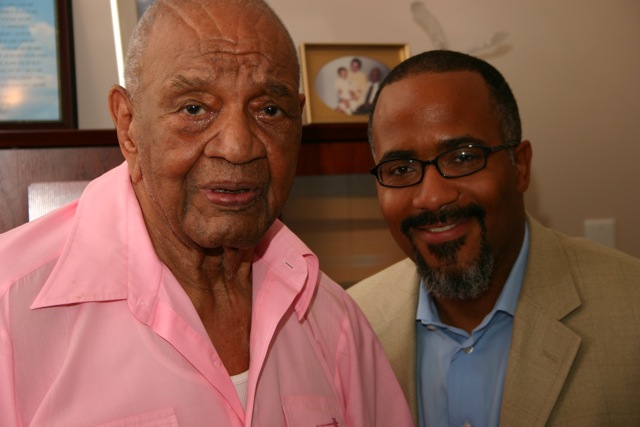
Michael and Gardner C. TaylorYesterday afternoon, the afternoon of Easter, Dr. Gardner C. Taylor died. I will reflect more on his passing, particularly as I said to Dawn on the poetic nature of him dying on Easter. It was fitting in many ways. But here is a quote from our interview with him in 2011, when his voice was as strong as a few months ago when he and Mrs. Taylor wished us a Happy New Year.

I’m literally numbering my days. I’m approaching what in my childhood we would have called my “commencement day.” My stage of life means to be aware that we all are just strangers and pilgrims. We can make this place home sometimes. Our danger is the false notion that it is home.

All in all, life’s a great experience. But by faith we believe there’s a better one. It’s hard to imagine what it can be like. At the point I have reached, one ponders more and more what it’s like. It does not yet appear. But this we know, the Bible says, that “we shall be like him, for we shall see him as he is.”

Those are tremendous things to wrestle with. Not too much for the human mind to ponder, but too much for it to have. I cannot picture this. The best I can do is try and understand the crude symbolism that we’re given. Our home will be far richer, far finer than anything we can think of. The maker of that home is God.


Jesus Went to Hell

This article refers to the early and often used Apostles Creed; it is so worth preaching:

…but before his resurrection, Jesus “descended to the dead.” The Athanasian Creed of at least a century later is more explicit, Christ “descended into hell.” Depending on context and translation Jesus either journeyed to Sheol, Hades, or Hell. But allowing for differences in language Christianity held—and technically still holds as a central tenet—the view that Jesus spent the gap between his death and resurrection “harrowing” Hell, that is journeying to the underworld to liberate the imprisoned souls of the Hebrew patriarchs who had been imprisoned there since their deaths.

Contemporary congregations will often translate “hell” into a more palatable “death” or “the grave.” There is something unseemly in the idea of Jesus among the murders, rapists, fornicators and heretics of Hell. And yet it was central to Christological accounts of salvation for two millennia that God Himself be present in the lowest rung of creation  to justify redemption for all mankind.

Holy Saturday was a day in which God was not in His heaven, but rather in his Hell.

From “Jesus Went to Hell” in the RD here.

“Valuable Spiritual Possessions”

Oddly enough the paradox is one of our most valuable spiritual possessions, while uniformity of meaning is a sign of weakness. Hence a religion becomes inwardly impoverished when it loses or waters down its paradoxes; but their multiplication enriches because only the paradox comes anywhere near to comprehending the fullness of life. Non-ambiguity and non-contradiction are one-sided and thus unsuited to express the incomprehensible.

Carl Jung (From Jung on Christianity, p. 192)