The typical ear infection, called otitis media, occurs when a cold or allergy causes swelling of the baby’s eustachian tube, causing blockage that allows bacteria to grow in the middle ear. Otitis media is particularly common in babies because their immune systems are immature and their eustachian tubes may not effectively drain fluid from the middle ear. There are two types of middle ear infections. Acute otitis media often causes pain, fever, and a bulging red eardrum. Otitis media with effusion (OME) occurs when the middle ear doesn’t drain properly and fluid is trapped behind the eardrum.
From our experience yesterday:
Whining, crying, and not cooperating at daycare; holding his ear during playtime and refusing comfort; parents being called twice, until parents confer to change schedules—so one can keep an appointment and the other can worry over making up work; an afternoon doctor’s appointment where the doctor said she’d be crying with this infection; ice cream from Brown Sugar Bakery mostly for the parents (somewhat unrelated); and the blessing of pain killers that taste like strawberry and a ten-days supply of grape-smelling medication (for the boy, of course).
GL: The family is made up of my wife Vivian and I (both 33 y.o. married almost 7 years), daughter Zoe (10 1/2 months), and our soft-coated wheaten terrier Colbie (4 years or is that 28 in dog years?).
FF: How has fatherhood changed you?
GL: I think fatherhood has enhanced my interpretation of joy. Through the challenging early goings of being new parents (with my wife Vivian BY FAR doing the most heavy lifting!) I think we grew to appreciate the small victories like when she first cooed, giggled, or slept through the night. Even just returning home from after a long work day and seeing my daughter’s face or just dancing with her in the living room bring me the most satisfaction and joy. I think it also helped me to have a higher appreciation for my own mom and dad and has given me a new viewpoint of the immense love of God. I sometimes find myself pondering how my love for Zoe is completely eclipsed by God’s mighty love for me and that truth blows me away every time.
FF: What mistakes have you made as a dad? Name at least one and talk about what it meant to you.
GL: Over protectiveness is one of my many mistakes. I guess another result of fatherhood for me is an increased sense of fear for my daughter’s well being. There have been situations where in my anxiety and panic I have spoken a bit harsh or unfairly to Vivian. For instance if I thought a piece of food was too big for Zoe to swallow, I would in a panicked-tone question Vivian why she would give that to her (clearly it probably wasn’t too big. I’m just a freak!). I’m trying to get better, thanks for being patient Viv! I think another mistake would be to take better care of my wife Vivian. I think I some arguments we’ve had stemmed from communication or just the lack of simply asking Viv on how I can help.
FF: What’s the most helpful advice you heard when you were becoming a father or advice you’ve gained since you’ve been a father?
GL: I think people gave us a healthy fear of anticipating the challenges in the first few months. I think that helped us prepare for the nightly feedings and sleepless nights. A realization for me was understanding the statement “they grow up so fast!”. Zoe’s only 10 1/2 months and everyday it seems like she has learned to do something new or something about her has changed (i.e. teeth). So advice I give now to parents is “Don’t blink or you will miss something!!”.
FF: How do you attend to your relationship with your wife outside of your being parents, and has parenting changed your marriage?
GL: People told us how important “date-nights” are for parents and we try to set aside time to connect and concentrate on our relationship. When there is time we try to do things together like workout in the house, take walks, or watch a favorite show. I definitely think our relationship has changed as a result of being parents. I think we both cherish the time we have alone and are more communicative.
FF: What are some of the things you’ve struggled with as a relatively new father? What are some of the things that have given you the most joy?
GL: I think adjusting to new routines as a result of fatherly responsibilities is a general struggle. Also another big struggle is balancing my friendships. I think it takes much more planning and intentionality to get together with friends and its hard at times to relate to friends that live generally care-free lives. The most joy I experience is in small things as I mentioned before. When Zoe learns how to wave, or clap, or just laughs and giggles it makes me proud and happy.
FF: Would you be willing to talk about how your faith has been shaped or changed in the process of you and Vivian becoming parents?
GL: There were some really dark times for us as we struggled for a number of years with our inability to conceive. As couples around us became pregnant and other families grew, we often times felt envious, isolated, and alone in our struggles. It was a load to bear and our focus and anxiety on conceiving became an unhealthy obsession that damaged our faith. It was only after we begun to share our difficulties with others that we realized our situation was not uncommon and as we reached out to others for support we felt the “body of Christ” and its loving embrace for us in our time of need.
During one Sunday (Check out the podcast on thenewcom.com from 11/21/2010 towards the end 45 min or so in) where Viv and I were probably feeling the least hopeful, Pastor Peter preached on Jonah and talked about “rival gods” and how anything that we tell ourselves we “must” have is our real God and idol. As he was preaching, I could not help to think that even our “good” and “reasonable” desires to have children was keeping our selves away from God. Our “idol” was in having a baby and I realized that my hope was in our future family and not Christ. After the sermon, Peter asked for people to come up and pray. Without talking to each other or hesitation, both Viv and I stood up, walked to the front, and were in tears. That moment confirmed to Viv and I where our hearts and minds were and that we were going to try to be, from that point on, ok with whatever God had planned for us. Child or no child. We both wanted God without condition and with an undivided heart despite our circumstances.
Little did we know, God was about to give us miraculous news. Three days later, right before thanksgiving we confirmed that we were expecting. God has a funny sense of timing and I truly believe that our journey was meant to be a testimony of how even the “good” things we naturally desire have the ability to wrestle our hearts away from the God who loves and desires our undivided hearts.
Now when I think of God while holding my daughter I am reminded of our family’s journey and know that as much as I love Zoe that my ultimate source of my joy, love, and salvation is in my God. I hope to teach my Zoe that truth one day.
FF: What surprises are there along the way for parents? What do you wish you were told to expect?
GL: I would say that the surprises are in the amount changes to your own life, personality, and character are so many that after being a parent you may never comprehend how life was before your baby. I wish I was told to expect how much baby stuff costs! Yowzas!
FF: What is one recent memory you made with your child?
GL: Swimming with Zoe for the first time. While on vacation in Florida I’ll never forget how Zoe loved being in the pool and her enormous smile as she splashed the water with her hands.
God does not die on the day when we cease to believe in a personal deity, but we die on the day when our lives cease to be illumined by the steady radiance, renewed daily, of a wonder, the source of which is beyond all reason.
Later, after I married and had a child, I learned to find equal meaning in the repeated rituals of domestic life. Setting the table. Lighting the candles. Building the fire. Cooking. All those souffles, all that creme caramel, all those daubes and albondigas and gumbos. Clean sheets, stacks of clean towels, hurricane lamps for storms, enough water and food to see us through whatever geological event came our way. These fragments I have shored against my ruins, were the words that came to mind then. These fragments mattered to me. I believed in them. That I could find meaning in the intensely personal nature of my life as a wife and mother did not seem inconsistent with finding meaning in the vast indifference of geology and the test shots; the two systems existed for me on parallel tracks that occasionally converged, notably during earthquakes.
From Joan Didion’s The Year of Magical Thinking, 190-191
Much of the time when we shop we’re probably not assuming the store owner shares our particular values and beliefs. This is true of both small businesses and larger corporations: the thought of shared values didn’t cross my mind at the local hot dog joint on Thursday or while buying ice at Walgreens on Sunday morning. There are, however, certain brands that ask for more than our dollars; they’re interested in our identities. They hope we will align ourselves with what they’re selling. This makes great sense for the company but much less so for us. Discovering something about our favorite brands that obviously clashes with who we hope to be creates – to slightly overstate it – an identity crisis.
So we are left to boycott a company we love not because of gross exploitation – again, we don’t think this way about many of the companies we frequent – but because of how closely we’ve become identified with their products and experiences.
Christians are people who don’t construct our identities but, rather, have them secured for us in Jesus. We are who we are because of who God is rather than anything so profane as a corporate marketing strategy. Does this mean Christians of all political leanings shouldn’t boycott? I don’t think so. But living differentiated from the shallow identities of savvy corporations may allow us to think differently about what what we abstain from, and why.
Our children often grow away from us. How painful it is to realize our children grow away from us, asserting independence from our wisdom and wishes. However deep the wounds and anxieties of these experiences, our children’s growth and self-determination speak to our love, care, and concern we invested in them. The end of this delicate dependence speaks to the setting of the course to which their lives must steer. The greatest example of this is marriage. In that union, our children become who they’re meant to be and step out on the foundation we have provided for them. It is our continuing prayer that the voices of their past and the voice of the Eternal attend and order the steps of their new life. There is perhaps no joy to match that of harmonious love in family where two generations are able to live not only in peace, but also in love.
From Gardner C. Taylor’s Faith in the Fire (pg. 110)
My name is Nate Noonen and I am going to be a father in about two weeks, give or take two weeks. I have always dreamed of being a dad. That sounds odd, but children were a huge part of my life growing up. I married my teddy bear, Tabitha, in a ceremony performed by my father, an ordained minister in the Nazarene church. I don’t think the ceremony was legally binding since I was three years old at the time. From that point on, every teddy bear brought into my house was a child of Tabitha and me. Having four younger sisters meant that Tabitha and I had children fairly regularly.
Tabitha now lives with my mom and the rest of my family back in Ohio and I have since married a beautiful non-ursine woman named Kimmy. We live in an apartment in Logan Square which used to be populated by a series of pet rodents until the last one died a year or so ago. After that we were going to get a dog but that was stopped by landlord intervention and a realization that what we really wanted, and felt God had prepared us for, was a child.
Kimmy had a miscarriage a year and ten days ago (July 5, 2011). We confirmed pregnancy and knew she would have a baby for less than 24 hours before the miscarriage. People don’t tell each other about those things, but they are all a part of being a parent. The joy of the positive pregnancy test followed by the agony and shared pain of having to wait that much longer for the first, second, or third child. I don’t want to get into a discussion on abortion, but I know a God who weeps for every living thing, regardless of age, and sometimes I weep with Him.
Through that sadness and the discussions we have had with other parents, we were prepared to try again, with a more in depth understanding of the fragility of life. That fragility expresses itself in every offer of genetic testing, every “this is nothing to worry about but,” every realization of just how not in control we are and how petrifying that is. A belief in a loving God does not shield us from that fear, but it does make the fear subject to the reminders of just how much He loves us, how much He loves my daughter Charlotte and knows her in her inmost being, regardless of the age at which she leaves this realm for another.
My daughter will be born at some point. That is the only fact that I know right now. Michael has asked me to write a monthly article for his blog which I will do everything in my power to fulfill.
I look forward to seeing what God has in store over the next year.
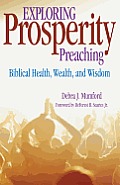
This book was graciously provided to me by Judson Press.
MW: I think one critical element within your book is faith. What is faith?
DM: Faith is the belief that God is able to do all things – even the seemingly impossible.
MW: Tell us what makes prosperity preaching so attractive. It’s a relatively recent development.
DM: At the core of prosperity preaching’s appeal that the hope that the American Dream which for many people has been elusive, can be realized by faith. If they have faith in God and are obedient to (what they are taught by prosperity preachers is) the word of God, they can be rich and enjoy perfect physical health.
This preaching is also attractive because it is cloaked inside of sound theology that sounds good. For example, four very appealing traits with which most Christians agree are:
Immovable, unshakeable faith. Nothing is impossible for God. So if Christians believe and do not doubt, nothing will be impossible for them.
Unlimited hope. Hope for a more abundant life compels believers to pray and believe for a tomorrow that is better than today. It is hard to live in this world without hope.
Personal accountability. Believers are taught to live righteous lives that are pleasing to God through prayer, reading the bible, being faithful in marriage, giving of tithes and offerings.
Importance of the Holy Spirit. Listeners are taught that the power of the anointing of the Holy Spirit is necessary for them to fulfill God’s will for them in the church and in the world.
The problem with each of these teachings is that they are taught as means of achieving financial wealth and perfect physical health. Though we all like to be beneficiaries of God’s blessings, we should strive to praise God and live Godly lives because we simply want to please the God who created us and sustains us daily.
MW: Why might other Christians have resisted this kind of hermeneutic in the past?
DM: Some people may have resisted this hermeneutic in the past because its message is problematic is many ways:
The preachers obtain their consistent message of prosperity by proof texting or interpreting verses of the bible out of context. Sighting isolated verses and ignoring the verses that come before and after them can make the bible mean almost anything.
When people do not become wealthy or have problems with their health, they (as individual followers) are blamed. Preachers tell their members that if they do not experience the wealth and health benefits prosperity preachers promise, they are obviously doing something wrong. Perhaps they do not have enough faith or are not working through all of the steps as the preachers instruct.
Adherents are encouraged to be individualistic in their thinking rather than communal. They are taught to pray and believe for their own prosperity rather than for prosperity for all people.
Social justice is overlooked. Members are taught that social ills of the world will disappear as more people are converted to Christianity. They are not taught that as Christians they have a moral and ethical responsibility to help all people and not just themselves.
MW: Talk about how your brother’s experience and your father’s ministry helped you in sustaining a critical book that was loving, analytical, and even. You could have been sharper in your exploration, but you weren’t. Yet you weren’t soft in your clear, pointed affirmations or disagreements either.
DM: It is because my father is a prosperity preacher and my brother was a member of a prosperity church that I worked to achieve balance in the book. My goal was to affirm teachings that were positive and to critique those that were not. I aimed for balance because I personally know that there are good and faithful Christians who are members of prosperity preaching churches and who preach and believe in the prosperity message. It is these people whom I had in mind when writing the book. I want them to understand from whence prosperity preaching originated and the positive and negative aspects of its teachings. I also wanted to offer them alternative ways of interpreting the bible and understanding theology.
MW: One of the important things you do, among many, is expand what poverty means. What is poverty? And can you talk about why the prosperity message, as it has been, has not necessarily been a message that for the world as much as for North America?
DM: I like the World Bank’s definition of poverty:
Poverty is pronounced deprivation in well-being, and comprises many dimensions. It includes low incomes and the inability to acquire the basic goods and services necessary for survival with dignity. Poverty also encompasses low levels of health and education, poor access to clean water and sanitation, inadequate physical security, lack of voice, and insufficient capacity and opportunity to better one’s life.
Their definition of poverty transcends money. It speaks to quality of life which I believe is what makes poverty so problematic. When people are poor, they are not only deprived of basic needs such as food, clothing and shelter, they are often also deprived of the opportunity to make their lives better. They cannot afford education and training that can help them get well- paying jobs. In our capitalistic society, money creates power. As a result, the opinions and needs of the poor are often overlooked and underrepresented. Hence, many of the poor find themselves caught in a cycle of poverty.
There are many poor in the United States of course. However, even people we consider poor in our nation, are not as poor as people in many other nations. Though it would seem that the prosperity message would not resonate well in very poor nations, it actually does. Prsoperity churches are located in nations such as Brazil, Kenya, and the Ukraine and many African countries. Many of the people who attend those churches want to be rich like people in the United States. However, the opportunities for them to become wealthy are often even more limited than they are in the US. Preaching prosperity in these poor nations is an especially egregious enterprise.
MW: I imagine you spend some time as a professor appealing to others to lean into the Bible and other sacred texts. In some ways you even put your own way of studying on the page. Why do you think it’s important to study the scriptures?
DM:The bible has been in the past and continues to be a sacred text for those of us who claim to follow Christ. The scriptures provide guidance for how we should treat our sisters, brothers, mothers, fathers, and our neighbors. It defines who our neighbors are. It offers encouragement when we want to give up, comfort when we are lonely and disheartened, strength when we are weak, and the opportunity to lament and grieve when we have suffered loss. The bible also informs the ways we see the world – that which we believe to be good and that which is bad. Unfortunately, the bible has also been used to discriminate against people for reasons such as gender, race, class, age, and sexuality. By learning to read the bible for ourselves, we will be better equipped to discern whether the messages being preached in our midst are true to the will of God. 2 Timothy 2:15 instructs us to study so that we can rightly divide the word of truth. We should all be willing to take the time to study the word of God for ourselves so we can better understand what God is calling us to do.
MW: It seems that the Word of Faith movement is, among other things, a severe attempt to apply the scriptures to a listener’s life. What are some ways you’ve suggested students/readers can approach, read, and apply the scriptures?
DM: Always pray for understanding before reading the scriptures. Then (1) read the text for basic understanding being sure to read as much of the chapter and book in which the text is found as possible; (3)use bible dictionaries, lexicons, and/or commentaries to define important and recurring words and phrases; and (4) research the geography, customs, current events, and politics of people in the text. This particular approach can enable people who read the Bible to mine its depths for deeper understanding. After following these steps, read the text again with the definitions and background information in mind. Then pray for God to help you determine how this text applies to your life.
MW: I kept thinking about theological education as I read your work. What do you see is the role of seminaries in educating leaders and non-leaders? How might congregations enhance what is happening in seminaries and divinity schools, again, for leaders and non-leaders?
DM: I believe that pastors and preachers are spiritual physicians. We would not allow medical personnel to attend to our needs without having been trained in their fields. Theological education is the training ground for pastors, preachers and religious educators. In seminaries and divinity schools women and men learn how to critically engage biblical texts, how to evangelize, how to think theologically about the world and its social conditions, how to preach and teach to different age groups and cultures, how to work effectively within the local culture of the congregations (church politics), how to engage with people who are theologically different they, and how to handle conflict. They also learn approaches to ministry to help them meet the many needs of their congregations.
People who are trained in seminaries can then teach people in their congregations how as well. Churches and denominational leaders can require their leaders earn degrees from seminaries and divinity schools. They can also encourage their members to attend seminars, lectures and conferences sponsored by theological institutions in their area. This way, all of the members will be exposed to theological education on some level.
MW: I appreciate how you gave several examples of ministers from the WOF and from the African American prophetic stream. Who are some of the preachers we who serve in churches need to hear, read, or study? Who can we not forget in your opinion, particularly from the prophetic stream?
DM:Donna Allen – Pastor, New Revelation Church, Oakland, California
Teresa Fry Brown – Professor of Homiletics and Director of Black Church Studies Candler School of Theology
MW: You talk about Christian entitlement and the danger of it. Explain that term and its accompanying dangers.
DM:Christian entitlement is the belief that only people who choose to follow particular teachings of Christ are entitled to certain benefits. It can cause people to ignore issues of social justice. If people believe they are the only people who deserve particular blessings from God, they may be less inclined to help people who believe differently than they. People who have the attitude of Christian entitle believe that, if people who believe they are being discriminated against would just be faithful, they would not have any problems. This attitude ignores the reality of systemic issues such as racism.
There may also be a sense of false pride or moral superiority. The moral superiority can cause people not to admit that though they are saved and sanctified, they are not perfect and should therefore extend to other people the grace they would like God to extend to them.
MW: What are you reading these days?
DM: I’ve been reading through the book of Job. I am always fascinated by the conversations he has with his friends throughout his ordeal. It raises questions about whether God tests us and how we respond to trials in our lives. It also raises questions about our faith in God – is it unconditional?
Books I have read recently include:
Your Spirits Walk BesideUs by Barbara Dianne Savage. Here she looks at a history of the intersections of African American religion and life through the works of icons like W.E.B. DuBois, Benjamin Mays and Carter G. Woodson, Mary McCleod Bethune, and Zora Neale Hurston.
A Quiet Revolution: The Veil’s Resurgence, from the Middle East to America by Leila Ahmed. Ahmed explores the issue of veiling for Muslim women by revealing the political, social, and religious issues at play in the lives of women who veil or do not veil.
The Anointed by Randall J. Stephens and Karl W. Giberson. The authors examine how leaders like James Dobson, Jerry Falwell, Ken Ham, Peter Marshall, Pat Robertson, Tim LaHaye, Oral Roberts came to wield their influences in the evangelical community and public square given the reality that many of them had few academic credentials (i.e. Ken Ham, founder of the Creation Museum, convinced thousands of people of the viability of his museum which rejects the concept of evolution).
MW: How can readers keep in touch with you and stay aware of your work?
DM: The seminary website and the website for my book are good places to stay aware of my work:
I am very thankful to have read Professor Mumford’s book. Share this interview with anyone you think would be interested in her work.
Professor Mumford mentioned Teresa Fry Brown above. Listen to Dr. Brown’s description of identity, preparation, and the preaching moment. There are a few pauses in the video, but you probably need them to think through her words…








 Michael Washington