Hospital stays are one of the few times in adulthood when we have an excuse to drop all the busywork that normally preoccupies us and go to be with the people we love. You simply spend time with them, without any social occasion for it–a wedding or anniversary, dinner or the theater. You just sit there in the same room, making small talk or reading, offering the dumb comfort of your presence. You are literally There for them. When you’re a kid, this is one of dullest, most dehumanizing things you’re forced to do–being dressed up in a navy blazer or a sweater vest and dragged to family reunions to be fawned over like a photo in an album, your physical presence all that’s required of you. But if you manage to make it to some semblance of adulthood, just showing up turns out to be one of the kindest, most selfless things you can do for someone. And it isn’t only selfless. At the beginning of my stay, my friend Lauren told me over the phone, “I know this seems like a drag, but someday, I promise you, you will look back and be grateful that you had this time…”
Tim Kreider, We Learn Nothing, pgs. 179-180
Category / Quotes
This category keeps the quotes of much smarter others, and the sayings are usually about parenting.
Among Many Tasks
The fall will bring a slightly different schedule for me. The whole thing holds together and will open me to new ways of deepening my vocation and the little works which make up my vocation. I’ll be doing a lot, and I’m looking forward to it.
Perhaps it seems inappropriate to hold this poem on this blog, but it seems a striking reminder for me as a parent. In the end, as I see it and believe it and imagine it, all our small works turn to one task of continued self-surrender, continued dying.
That dying sits at the bottom of my faith, though that bottom would quickly, almost too effortlessly, be named as living. That eternal life only comes after one has regularly and daily passed through the gates of death. Life comes from death, says the One we follow. May this poet’s words be a reminder of these things to me:
Among Many Tasks
Among many tasks
very urgent
I’ve forgotten that
it’s also necessary
to be dying
frivolous
I have neglected this obligation
or have been fulfilling it
superficially
beginning tomorrow
everything will change
I will start dying assiduously
wisely optimistically
without wasting time
Tadeusz Rozewicz (From The Vintage Book of Contemporary World Poetry)
Thinking About Our Labor

From George Washington Carver Garden in the St. Louis Botanic Garden
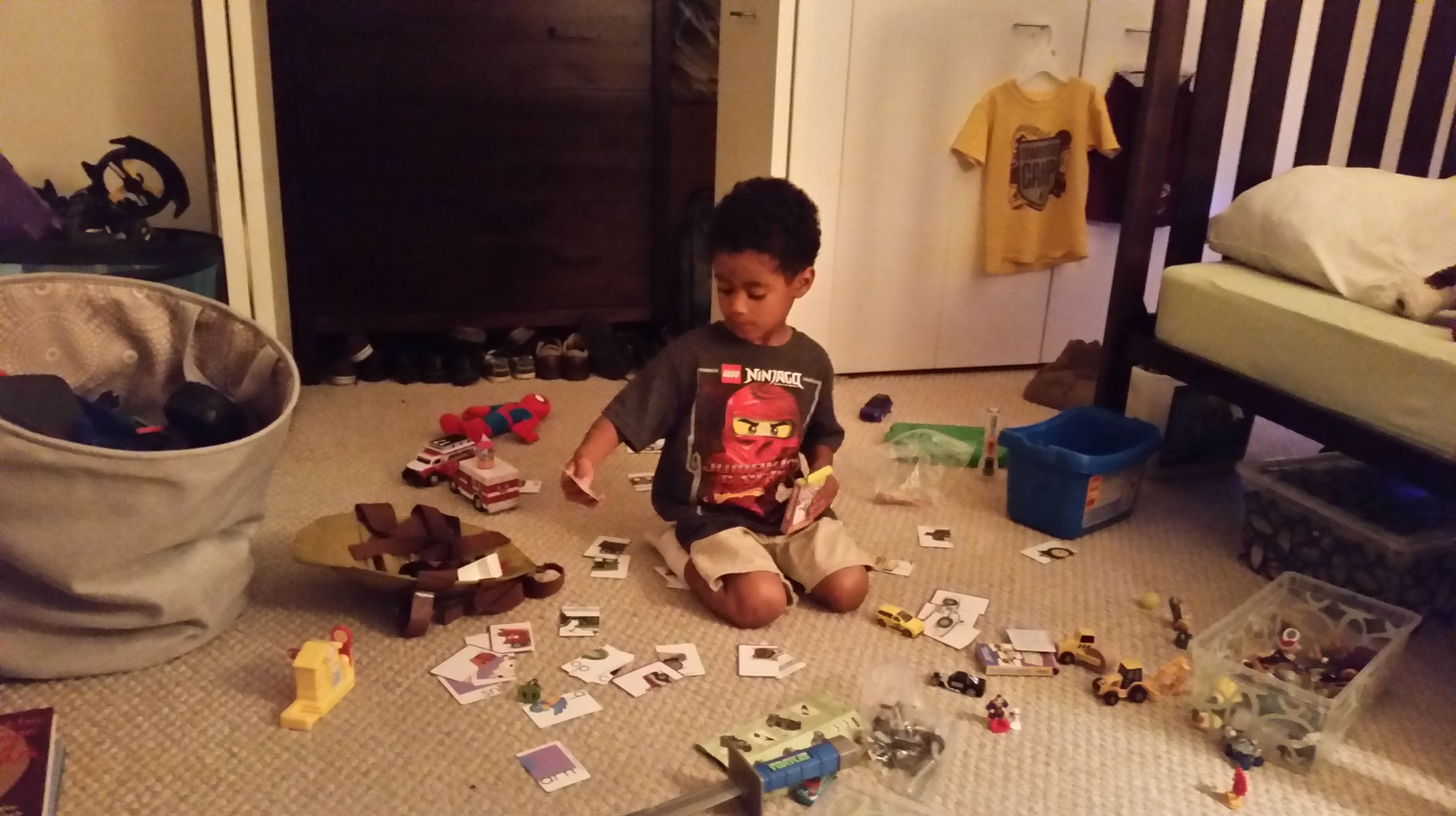
Clean Up, Clean Up, Everybody…
Averted Vision
Such a contemplative thing to say:
Perhaps the reason we so often experience happiness only in hindsight, and that any deliberate campaign to achieve it is so misguided, is that it isn’t an obtainable goal in itself but only an after-effect. It’s the consequence of having lived in the way that we’re supposed to—by which I don’t mean ethically correctly but fully, consciously engaged in the business of living. In this respect it resembles averted vision, a phenomenon familiar to backyard astronomers whereby, in order to pick out a very faint star, you have to let your gaze drift casually to the space just next to it; if you look directly at it, it vanishes. And it’s also true, come to think of it, that the only stars we ever see are not the real stars, those blinding cataclysms in the present, but always only the light of the untouchable past.
From Tim Kreider’s We Learn Nothing, pg. 218
A Response to Opposing Narratives
I originally saw this at Religious Dispatch. People of faith should be praying, considering, working, and praying:
The current military operations in Israel and the Gaza strip should disturb all people of faith. The only moral path to a solution between Israelis and Palestinians (Israeli Jewish/Muslim/Christian and Palestinian Muslim/Christian) will be dialogue and negotiation. This is a long and arduous path, but the faith that grounds our traditions can sustain the slow evolution of history. The current conflict is an outgrowth of over a century of opposing narratives and ideological differences that no military operations can resolve.
Our traditions exist to uphold the moral foundations for civilizations and as such we urge an end to the current violence. While we acknowledge the need for self defense, when the can of violence opens, as it has now, worms of vengeance and blood-feud crawl out. Then people begin to abandon the principles of justice and mercy upon which civilizations are founded. Instead they turn to more tribal urges, seeking retribution for past wrongs.
We believe the current violence crosses that line. At some point people cease looking for solutions and instead succumb to base human urges for violence. They crave the blood of the enemy to compensate for the pain of loss. This is the way of our animal instincts, the ethos of ancient tribes and clans who exist only to protect all within, while opposing all others. The teachings of our ancestors rose above that thinking long ago to build great civilizations. We believe that when we look to our texts and traditions we can rise above the narrative of suffering and victimization to find roads to healing and wholeness.
The Torah this week teaches of the “Cities of Refuge” (Numbers 35: 6-28) places where a person can flee after an accidental death or manslaughter in order so that relatives of the deceased cannot exact revenge. The one who flees must face criminal justice, and the City of Refuge serves as both a haven and prison for the man slaughterer while restricting the blood thirst of the avenger. The people living in Israel and Gaza can look at the current situation and see only murder and intentional killing, or they can see how decades of hatred breed spontaneous violence. In these heated emotions, our traditions call for cooling off, seeking refuge, and then finding a path to justice. Only through such systems can order and peace be restored.
Several verses from the Quran also give us reminders to work for the protection of life and how to respond with good and forgiveness in times of major challenge and conflict.
Read the statement here.
The Year of the Child
And you have come,
Michael Ahman, to share
your life with us.
We have given you
an archangel’s name–
and a great poet’s;
we honor too
Abyssinian Ahman,
hero of peace.
May these names
be talismans;
may they protect
you, as we cannot, in a world that is
no place for a child–
that had no shelter
for the children in Guyana
slain by hands
they trusted; no succor
for the Biafran
child with swollen belly
and empty begging-bowl;
no refuge for the child
of the Warsaw ghetto.
What we yearned
but were powerless to do
for them, oh we
will dare, Michael, for you,
knowing our need
of unearned increments
of grace.
I look into your brilliant eyes, whose gaze
renews, transforms
each common thing, and hope
that inner vision
will intensify
their seeing. I am
content meanwhile to have
you glance at me
sometimes, as though, if you
could talk, you’d let
us in on a subtle joke.
May Huck and Jim
attend you. May you walk
with beauty before you,
beauty behind you, all around you, and
The Most Great Beauty keep
you His concern.
By Robert Hayden (For his Grandson)
Pay Attention
If the only things I pay attention to are what everyone else is paying attention to, I have nothing to say.
Kevin Miller in the spring issue of Leadership.
The More You Learn

Relationships of Accountability
I believe that anyone who has a responsibility for the spiritual guidance of others should be in a relationship of accountability with another for the sake of the people he or she guides, teaches, or preaches to. Otherwise we are going to grow, if we grow at all, in a deformed shape that will be passed down to others. I see such distortions frequently. It is a biblical concept to be accountable to someone else. Timothy was mentored by Paul, Paul by the disciples in Antioch. Friedrich von Hügel, author and spiritual director, once wrote: “Behind every saint stands another saint. That is the great tradition. I never learnt anything myself by my old nose.”
From John Ackerman’s Listening to God (pg. 67).
Books That Speak For You: The Almighty Black P Stone Nation
I don’t remember who but I heard someone say how beneficial it was to read authors of one’s age, writers who grew up when you grew up. Those writers saw some of the things you saw, began framing the world during the same time you did, and knew the language, phrases, monuments, and events you did. I think of Jesmyn Ward’s work, especially Men We Reaped, and how it is the first book that says for me in her words what it meant to be born premature at six months (among too many other good reflections) and to be so mindful of those early days. I came across another book I’m ashamed I didn’t learn of until 3 years after its publication that brought that statement to mind, The Almighty Black P Stone Nation.
Natalie Y. Moore and Lance Williams co-wrote this social history of Black Chicago. Indeed it is as much as social history of Black Chicago as the city itself. One never talks about a part of our city without, at the same time, talking about the whole. In this book, Moore and Williams tell the story of Jeff Fort. They use Fort’s life as a teen who emerges into a leader of one of the country’s strongest, most prominent gangs to discuss everything from identity, neighborhood development, politics, racism, poverty, and the relationship between religion and communities.

First Presbyterian Church, Early Meeting Place for Blackstone Rangers
They trace Fort’s relationships and show how the charismatic but unlikely young man becomes a powerful, influential gang leader. I learned about Jeff Fort’s life, how he started one of the most famous gangs in my adolescence, and connected the dots between his influence and the lives of gangsters back then and today. Moore and Williams explain the various ways gangs have been talked about, employing pieces from the FBI, from pastors, and from law enforcement. The authors also point to the roles prosecutors and journalists played in building a particular perspective (almost mythology) around Fort, Eugene Hairston (his co-leader of the BPSN), and similar people in the gang.
If you don’t like reminders of violence–or being able to sit in such reminders–this isn’t the book for you. You won’t read a sugarcoated history of how good these gangsters were for the neighborhood. But you will be surprised if you think gangs were/are all bad.
You’ll see up close how mixed and complex this gang was in relationship to Chicago; in relation to the black community which it saw itself as part of; in relation to other gangs which were their original enemy; and in relation to the dubious mayor (the one spoken of very poorly in my experience on the south side), old man Richard J. Daley.
If you’re interested in exploring the world of Black Chicago, what it meant for Black people to live in the city, for instance, between the Great Migration and the Civil Rights era, and the history of gangs in the country and in Chicago particularly, this is a great, accessible, easy-to-read primer. But the book does more.
It acquaints you with some of the fundamental psychological reasons youth leaned toward gangs in the 80s and 90s, offering reminders of how youth are still youth with the same needs. The writers also give a glimpse of how different gangs are these days and how much distance they see between the earlier gangs which developed in similar social conditions even if in a different political, national, and domestic environment.
There are some things which haven’t changed since Jeff Fort and Eugene Hairston met as teens in the Woodlawn neighborhood. The federal government’s initiatives (i.e., wars) on poverty and drugs have hardly changed, though they have collected more cousins to join their ranks (Think of the current sentencing guidelines for drug possession of Blacks vs. Whites vis-a-vis the housing covenants of the 60s). There are now wars on more things and in more places. But the book opens up that earlier world when the wars started, if you will.
I am not satisfied with the book’s ending. In some ways the book ends abruptly. I think I wanted the authors to say more, to forecast more. I remember thinking the same thing about Michelle Alexander’s troubling and moving and remarkable, The New Jim Crow. For both books, in my still-naive hopefulness, I wanted the authors to paint a different picture, to suggest an alternative world (even historically), but of course, the writers were simply too good at telling their stories. They were so good and precise, so truthful, that they left me aching for change.
I wasn’t in a gang. So, in that way, The Almighty Black P Stone Nation doesn’t speak for me. But what the book does is narrate portions of a journey I did negotiate. It straddles the world of politics and religion and death and growing up, all of which were my life as a teen going from 103rd to 83rd, passing Julian on my way to Simeon to go to school, my Wednesdays and Saturdays going back and forth to rehearse and sing with the Soul Children.
It’s a book that helps me understand what it’s in my bones and what isn’t as I continue to find a home in Chicago. It gives a glimpse of why Chicago is my city, my home, the place where (many of) my family resides. I was not only born here. I shared some of the experiences Moore and Williams recall with such clear, simple truth.
I hope they turn they gaze to some of our city’s other notables. I can recommend a few subjects, but I think they already know who next can be subject to their collective intellect, care, wisdom, and words.
Something I Read to the Men in Church Today
Men:
I want to tell you
That you are beautiful and brilliant and beloved. No matter what you do, what you’ve done, what you’ve left undone or how terrible of a man you’ve been—your beauty, your brilliance, and your belovedness—these things have been true, are true, and will be true.
I want to tell you
That the world is not only against you; it is against every good that can come from you, so equip yourself with a power greater than yourself and find the grace of God that has a track record of defeating the strongest enemies.
I want to tell you
That the greatest thing you can be is a gift to somebody else. So wrap yourself up in the hope that you can be that generous, that you can turn your desires toward another, and make sure somebody else has the things you have, gets the things you get, and will have a fraction of the life you’ve had.
I want to encourage you
To stay with the best ways you’ve been taught to love. We don’t usually learn to love so when we find little ways, we need to practice them so we don’t forget them, hold them while learn to love better, and appreciate our growth in the process.
I want to encourage you
To keep to some goal in your face, to be careful who you share it with, and to be relentless in pursuing it because even if you fail, you will succeed at a behavior that is more Christian you know, more formative than you can imagine, and more enriching than success.
I want to encourage you
To enjoy yourself at least once a day, which means you’ll need to find joy in your work, in your home, in your leisure, and in your nothingness. Slowly inspect these spheres of life so that you always, every day, find joy. It’s there. Whether it seems hidden, when it seems altogether gone, joy is underneath the parts of your day, and it’s waiting for your discovery.
I want to remind you
That you will be greeted by hell every week, that you will be visited by enemies every day, that you will be undone by the hour, that you will be deconstructed at personal and systemic levels, so if you are not serious about finding your sustenance outside of society, you will find death without life. If you are not serious about finding strength in the source who is God, you will find brokenness without hope. If you are not serious about placing Mystery in front of you, you will never be covered from back to front with the power that is undefeated.
I want to challenge you
To love every woman with such skill that she will respect you, with such honor that she will speak well of you, with such care that she will trust you, and with such admiration that she will feel safe with you.
I want to challenge you
To sit alone, with yourself, for 10 minutes a day, sitting in silence, sitting and listening to the voice of God as it comes to you even if it sounds scary or strange or welcoming.
I want to challenge you
To find the people in the world who make you feel like yourself and spend time with them. They may be the truest, rarest gifts from God you have.
I want to challenge you
To be someone’s father this year, biological or not. Be a man who some child can look up to, call when she needs you, question when he wonders something, claim when no one else steps up for them. Be the man who stands in the gap for a single mother or who stands alongside another father. Be the support, the presence, the strength, the weakness, the shoulder, the legs, the backbone. Live all year and hear this greeting in some form regularly: Happy Father’s day.
And may your children love you.
 Michael Washington