Good Memories, pt 3

There are too many things to remember about our vacation.  I’ve jotted down lines in my moleskine journal to jog my mind.  Each phrase leads to a memory, to an event, to something we saw.  One line that’s not in my journal is the subject of this post.  I’ll finish up tomorrow with some pictures from our time, each one a memory in itself.

The evening I’ll write about was half way through the itinerary.  We left a show in one of the theaters on the ship.  Dawn was saying something about getting some popcorn when I went to have my nightly cup of tea.  From time to time we’d split up and agree when our next meeting would be.  We’d see a show together or make fun of people from Michigan as they guessed Motown tunes in a cafe.  Then we’d separate for a while so we could do whatever we wanted to do on our own.  We’ve found a nice complimentary system for vacations when we can do this–spending time together and apart.
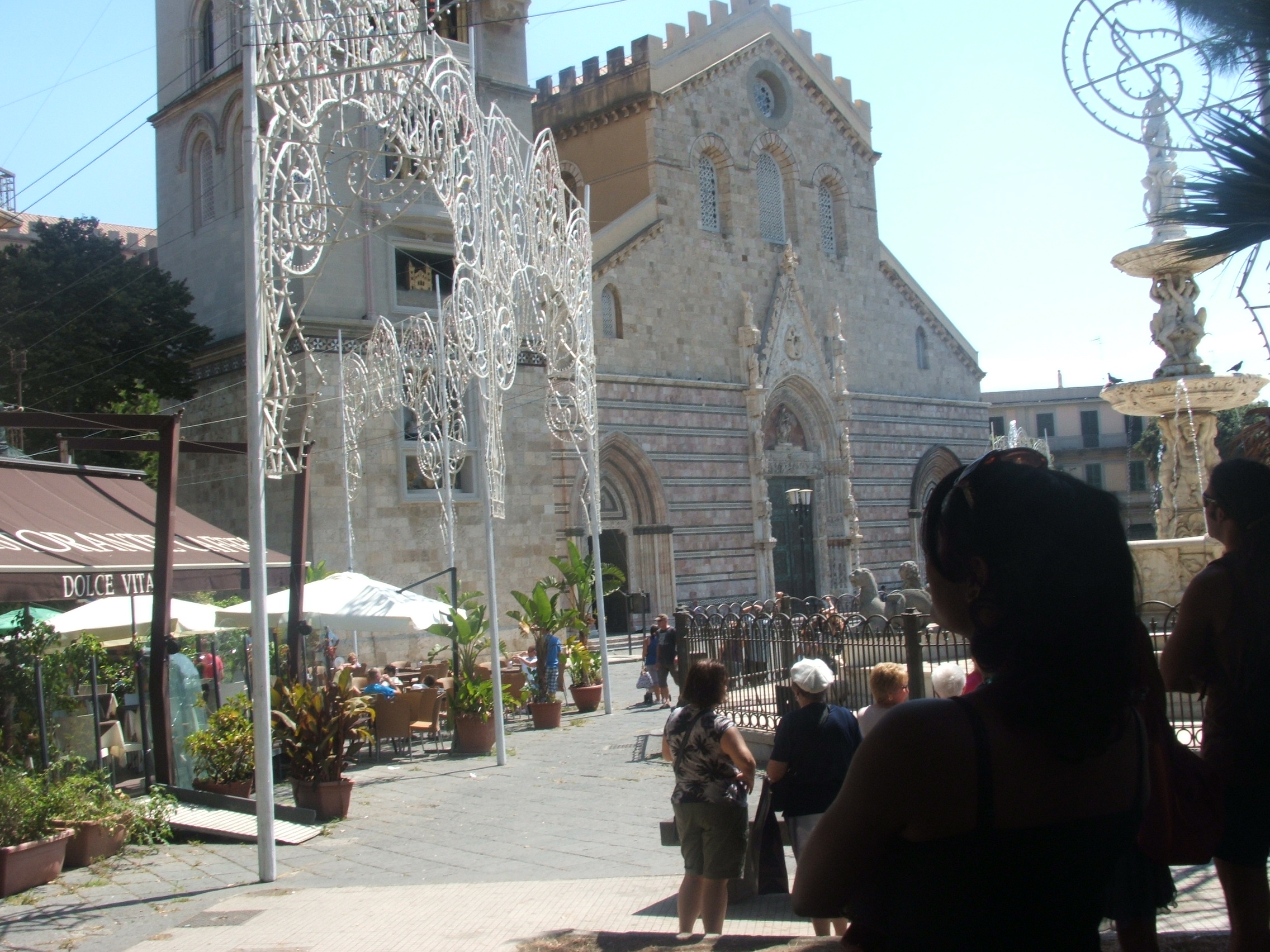
Well, as we left the show, we agreed to meet on one of the upper decks.  It was the last night in Italy.  That port was Messina, the one closest to Silicy and Taormina.  We spent that day walking around, me trying to look stern about not staying long in stores and Dawn trying, well, to do the opposite.  She looked at bags and hats and clothes.  We walked the streets, ate gelato (a practice at least one of us engaged in daily), and listened to music outside a large church near a city square with five hundred other people.  We stopped into a hidden restaurant.  I asked the woman at the door for a menu, made the decision to stay, and Dawn came in.  We asked the woman if she spoke English, and the look answered us before she could lie and mutter that she knew a little.  We thought to order by piecing together what we knew from Spanish but then chose to indulge only from the course of dishes spread on a kind of buffet table.  When Dawn asked something, the woman’s “Oh, Dear” became a joke between us, one that I’ll tell again and again.  I have no idea what we ate.

That night we passed through the last unseen Italian islands in the dark.  The decks were crammed with people.  The cruise director and the captain had promised to alter the route a bit so we could see the island of Stromboli.  It looked as if 4000 passengers lined one side of the ship to see the island, to get a glimpse at one of the world’s active volcanoes.  Me and Dawn decided to meet at a spot she’d found earlier that week, at the front of the ship.  Floors 5-7 were relatively quiet, and we were betting that most of our fellow travelers were cramping on the upper decks on the ship’s starboard? side.  We were right.  The forward portion of the vessel wasn’t empty, but we had more than enough room to ourselves in a quiet corner.  Quiet until some lovely father brought his three children, one of whom loved to say things.  She asked questions.  She made statements.  She talked about dinner.  She pointed out all the little boats around the island and wanted to know about all the 200 people on Stromboli and why they hadn’t moved since they lived under a volcano.

I looked at Dawn with that pre-parental expression, the one that’s not quite an eye roll.  I softened quickly.  One of us said something about Bryce.  He was soon to ask us a million questions about things too.  But that night, Bryce was in Chicago, having just seen his Grammie leave so that his Grandma could take her place.  It would have been about time for his afternoon visit to the park if the schedule was followed as customary.

John, the director, came on the speaker system.  Everyone quieted, even the little girl, as he told us what we knew–that we were at the island.  We stood on the front of the ship listening to the slapping of waves in ours ears.  I imagined those citizens of Stromboli, and I asked Dawn some of the same questions that little girl asked her father.  As we approached, Dawn mumbled something about going to get our camera.  I said it was too late.  We were upon the island, beyond the long wide rock it took so long to get to, and across from the volcano.

The sputtering red and orange took our collective breathes.  The kids were silent during that first bump and spray of color.  Red and yellow splattered and rolled downward.  After a while I wondered if what we saw was just for us.  It was timed too perfectly.  I told my wife that the islanders must have been pressing the big button on the side of the mountain because a ship was passing.  I also thought about those ruins of Pompeii we had seen and wondered why we were all so excited to be so close to a volcano.  Nonetheless, we saw five or six such eruptions in those too-brief moments.  They were dramatic and gorgeous and awesome.  They made me think about the greatness of God and about how many times God had seen what for us was a first.

We had been to a state park on the Hilo side of the Big Island with Karlos and Michelle four years ago.  (Incidentally, I could still move to the Island in a week if proper conditions existed.)  That day we traveled around the crater.  We ran along the edges of these huge rocks.  But we only saw steam.  We closed our noses to the smell of acid and sulfur.  We followed Karlos, running toward the red and orange, well past the STOP HERE signs.  But the lava was too far.  We were losing light.  Our wives were slowing down but still hardly complaining that they were wearing flip flops and not good shoes for volcano hopping.  That evening we went to the restaurant there in the park for dinner, somewhat disappointed.

I thought about that disappointing trek from 2007 when me and Dawn stood there whispering near Stromboli.  I love the Dodsons and would probably go anywhere with them.  But that night as we looked at those brilliant sprays and stretches of all those colors, I couldn’t think of one other person in the world I’d rather be with than my wife Dawn.  We took no pictures, though we bought one from the ship.  It’s the equivalent of a big rock with droplets and squiggles of fiery orange and yellow and red.  It’s a good picture, but I hope I can keep the images in my head for as long as I live.  I wouldn’t mind remembering those little children for all their noises either.

Good Memories, pt 2

We stood in the large hallway at the depot, both of us carrying a piece of luggage.  I wore a backpack.  Dawn had a strap hanging over her shoulder with a bag bulging at her thigh.  The bag squeaks every time she takes a step, and it reminds me of a hinge pleading for oil or grease or to be thrown to the ground.

The room looked like the check-in at an airport.  There was a line which snaked from the “enter” sign and ended with a dozen agents dressed in short sleeve white shirts.  Some of them wore ties or silk scarves, but most of them had their collars open as if they were welcoming the long lines of passengers and all the heat from outdoor Barcelona.  They wore pleasure on their faces, and I wondered whether they kept those smiles all day or if they painted them on their lips right before coming to their posts.

While we waited, we wondered to each other about the sanity of our fellow cruisers, particularly the ones who brought their children.  There was a family with a daughter.  There was a family with several daughters.  There were kids who were already making noises no one but their parents could appreciate or interpret.  Me and Dawn communicated in our party language, the way we talk to each other without words so that people can’t understand our gestures.  I’m not going to give them away, but I will tell you that there was a fair amount of glancing and nodding and shaking of the heads.  We saw a couple with a child in a stroller, and I’m sure it made Dawn think about the boy back home.  Me, well, I thought about all it took to get that kid in that line, all that money that those parents were willing to pay for a kid who couldn’t stand up in a long line with its own bags and who could only complain and who probably couldn’t say a full sentence yet.

At the counter they took my credit card, made me sign things, and told us we were welcome to board.  We turned toward the exit, still smiling; we made it.  My brother Mark being a great driver to get us to Terminal 5.  Leaving the boy with his Grannie and finding out, by the time we got to O’hare, that she had already altered his daily routine.  Stretching and walking up and down the length of a plane.  All those hours and in-flight movies.  Watching Dawn fall asleep in green chair in Amsterdam while we sagged through that first layover.  Words in Spanish that we both read with about 40% accuracy.  We made it.  Listless, limp, and faltering.  Passports and sail-n-sign cards in hand.

Outside the room with the white-shirted attendants, there was another short line of people.  The Carnival photographers were snapping pictures.  Dawn shook her head.  No pictures, she said.  I asked her, You don’t want to take a picture of this moment?  She didn’t.

This is a security photo, the nice man said.

They snapped our heads so they could prove we were who we were when we exited and re-entered the ship at the ports of call.

Then there was the embarkation photo, the one Dawn refused to take.  She took my arm, pulled her sunglasses down, and we walked by.  There was an orange background with yellow and red columns consuming a ten foot high spot.  I presumed it was evocative of Spain.  We walked by the photographer without posing, seeing the flash from the two umbrellas and muttering about those who were stopping.  They looked terrible but they didn’t care.  They were happy.  They were in Barcelona.  We were happy, too, but we had dignity.  At least the wife did.  She knew that taking pictures after flying and waiting and removing shoes and being spoken to in languages we didn’t understand and eating something in Amsterdam that hardly passed for Thai at a horribly early hour because I was starving was not wise.

But I wanted to take that first photo because I’m learning how to take pictures.  I’m learning to take them that is.

Early on in our relationship I had a thing about not taking pictures.  I didn’t care to.  I still don’t care to, but a couple years ago I made an inside promise to take more pictures.  It was something Pam Sheppard said to me, something I can’t remember.  It was probably something about the need to take them, the wisdom in keeping snapshots or something.  Pam is a brilliant and caring person.  She’s a clinician so she had to be.  As I said, whatever she said left me with the increasing impression that I should take pictures.

She probably said that one day I was going to die and when it came time for my funeral my family would have to choose that picture from seventh-grade when I wore my favorite white sweatshirt.  I was wearing Bugle Boy jeans, though you can’t see them because the shot’s a headshot.  That picture looks no different from my wedding picture because when we got married I looked like the same seventh-grader except that I was in a white jacket and not a white sweatshirt.

Even though Pam told me that I should take pictures, and even though I told her I would, and even though I do, in fact, take more pictures, I didn’t push the issue with Dawn about that first cruise shot.  After all, you have to choose which pictures to take when you’re married.  You have to choose which decisions you’ll make and resist unmaking.  You have to choose which moments you’ll capture and hold to tightly and which ones you’ll let fall into a body of water so large that you’ll never see the same wave again the way you first saw it.

Me and Dawn brought up the topic of pictures while we snapped our own shots of random strangers on the streets in Palma de Mallorca or when we took pictures of dead people in the Vatican.  I told her I was getting into collages this year, that I was going to unearth those pictures from all those envelopes in that drawer next to the glider at home.  I told her I was going to find a few ways to keep the places we’ve been and the things we’ve done before us.  I think I’m getting old or sentimental or soft or, maybe, smart.  Because it’s easy to forget where you’ve been with a person you go everywhere with, isn’t it?  No, me and the wife don’t go everywhere, but we go places together.  We share life, and we, like everybody, forget about the small, mostly ugly moments, like the ones when we’re sweaty and tired and grouchy and lagged by planes and everything else.  Remembering, taking pictures–mental or otherwise–might be the only way to prove it.

Good Memories, pt 1

As I said yesterday, these posts will focus on my scrambled thoughts as I remember good memories from our vacation.  I’m writing toward a new practice, a habit of paying attention to good things rather than my most natural tendency to hold to the bad.  Most of these memories will be good, though there are a few not-so-pleasant moments littered through the last two weeks.

The point of the post today, for you who like points to posts, is to plan a vacation.  Or a getaway.  Or a break.  Or a series of dates.  Or a significant time away from normal life.  The getaway, break, or vacation will give you an opportunity to nurture your marriage.  Of course, you could do this with a friendship or a significant relationship with some modification too.

I’m somewhat of a planner.  And traveling is important to me.  I like to do it.  You could say that I value it.  We started planning this last vacation a couple years back.

Before we had a baby, before Dawn got pregnant, we talked about how we wanted to celebrate our tenth year anniversary.  We wanted to do something big.  We wanted to stretch ourselves, save up, and have a grand time.  We couldn’t do what we really wanted which was to copy some friends who a few years ago spent a month on a different continent.  But we could stretch.  So we talked about what we wanted to do, and even though a little boy got made and delivered since those first conversations, we committed to acknowledge, in some way, that we were a we.  That we existed as a married couple.  That we were together.  To be honest, we had our challenges conceiving, and affirming who we were outside of the parenting thing nourished us in ways that we haven’t always seen.  So we determined to go on a cruise.

We’ve cruised before, done what I call the local cruises, the popular one to the Caribbean.  We cruised the year I graduated from seminary, too, because that was my gift to myself after getting another masters degree!  We also decided, in planning this last vacation, that we wanted to return to an early desire to see Italy.  I had a dream when we were engaged at 22 years-old that we’d honeymoon in Italy.  I was young.  I was, in a word, foolish, on many fronts.  I thought about a lot of things for us, but I didn’t think that going to Italy at 23 years-old when you had a mortgage and a construction project called a fixer upper was impossible.  It didn’t become possible in those early years either really.  So we took smaller trips.  We saw family.  We drove to many places.  We went on those ships that I mentioned and saw the Caribbean and parts of Mexico.  I used honorariums from speaking engagements and payments from work-for-hire contracts to make sure we were traveling together.  One reason why we got married young was so we could see the world together, so we saw what we could.

When we planned this time, it was a similar experience.  I started saving money, even though we couldn’t really afford it.  We were blessed.  I cut up portions of my second and third incomes–income that I never count until I have a contract–because my primary income is restricted to relatively fixed expenses and giving.  We agreed on an itinerary, a mix of France and mostly Italy with enough Spain to keep us interested.

Dawn started looking into logistics.  We struggled, waiting for the best time slot.  Back then, Dawn was considering school.  I had a small frame between my supervisor’s sabbatical and the start of my next calendar year in the VFCL program at GETS.  We waited as late as we could because my coworker’s decision wasn’t exactly made.  I knew when my teaching responsibilities would start.  We really could only go at a particular time because of both calendars.  Dawn looked at flight plans after I came up with a window of dates.  She reserved and purchased our tickets.

We decided easily that the boy was staying when the cruise line said he would cost the same amount of money we would.  We thought they were joking.  They weren’t.  We struggled with the matter of leaving him–for about two minutes.  I mean, we are a couple and this was our anniversary celebration.  We are not alone as a couple anymore so we were thinking that including the boy wouldn’t be all wrong.  And yet there was this voice of wisdom speaking.  Why not find a way, if it was possible, to leave the kid.  To leave him and to remember that we were separate from him.  To say our goodbyes and to have that be some shared meaning between me and the wife.  Of course, we are parents and that reality is hard to get away from.  But we are something else, a reality that’s easier to lose sight of as a couple.  Everyday we attend to him, naturally and necessarily, but there is this other thing called a relationship which needs attention too.

We met with our mothers about staying at our home one week apiece, and I texted a few people to secure supplemental childcare.  The week before we left, I went grocery shopping.  I picked up enough apple sauce and wipes and diapers to last for a month.  Just in case, you know, we couldn’t get back.  In case we decided not to come back.  I washed all the clothes in the house.  Dawn bought her textbook and read her first week’s readings.  I finished two contracts so I wouldn’t have them hanging over my head.  I looked over the syllabus for the fall semester and thought through what September would be like.  I did as much work as I could at the church to leave things well and in the hands of my colleagues.  I had a few more meetings than I thought wise.

We talked to friends about Barcelona and France and Italy.  Alan told us about the architecture in Barcelona, leaving me mad that we weren’t just going there.  His eyes widened when he spoke, and he relived days where he ate bread and salami while sitting in a park in front of some building.  I imagined him drooling while he ate in that park, though he wasn’t drooling exactly as he told his stories.  We ate with Libby and Omar who helped us figure out what to see if we only had so much time, which was true, because it was a cruise and not a land-based trip.  Libby wrote up a three-page cheat sheet and sent it to Dawn.  She gave us more direction than any guidebook.  She gave us guidebooks too!  Omar told me to wear a fanny pack to keep our euros hidden from people pick-pocketing.  I refused.  I told Dawn that I’d simply wear my I-grew-up-on-the-south-side-of-Chicago face.  It seemed to worked.

I wrote up the first draft of the cheat sheet we intended to leave our grandmothers and to our friends.  We left explicit instructions to call us only when the boy was hospitalized since calls to the ship would be $10/minute.  We had full confidence that Bryce would cooperate and not injure himself.  We packed.  We dreamed.  We talked about what we wanted to see, where we wanted to go.  We did something that a counselor I worked with during the early years in our marriage called “planning a future together.”

It’s a powerful thing to plan and map out your future.  Of course, you make vows to a spouse about a vague future, but planning it is a second strategic step.  It adds to the vow or the pledge the particular means and the specific steps.  We were doing very romantic and relationship-strengthening work: looking at those next tomorrows and saying how we, together, would face them.  Before us was a delightful series of dates.  They included easy travels, long lines which we greeted with smiles and gladness, and a lot of words we didn’t understand.  Those tomorrows included sumptuous meals and great servers and questionable taxi drivers.  It would be wonderful, a little messy, slightly nerve-wrecking, and glorious.

Good Memories, Good Marriages

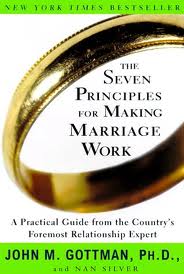
I’m rereading John Gottman’s Seven Principles For Making Marriage Work.  I started reading it again before going on holiday for a week and a half and I’ll be picking it back up now that I’m home.  To be honest, I’m biased to Dr. Gottman’s findings.  His career and research in couples work is grand and phenomenal.  He’s a trusted, clinical, scientific, and thoughtful voice in the area of marital relationships.  As he talks about in this and other books, he’s able to predict divorce with compelling accuracy, something like 93%.

In one part of the book he discusses the signs of marriage going bad.  One of them is the presence of bad memories.  He talks about how the persistent retelling of negative stories from before are an indicator of a relationship’s spiraling downward.  Having bad memories, and revisiting those memories, put a relationship at risk.

A couple quotes from the book capture what I mean.

But when a marriage is not going well, history gets rewritten–for the worse.

Another sad sign is when you find the past difficult to remember–it has become so unimportant or painful that you’ve let it fade away.

His language is helpful to me.  Helpful again, I should say.  I’m thinking a lot about how my long emotional memory impacts my life and work and relationships.  I can remember a lot of things.  Sometimes my memory is selective.  Well, of course, it’s always selective.  But that emotional portion leans toward the negative.  It’s hard work for me to relinquish bad memories and maybe just as hard to create good memories that have as much weight as the bad ones.  I think my proclivity is a posture that affects how well I do in my relationships.  It influences how much work is ahead of me in my marriage and in the other relationships I cherish.

In the next few posts, I’m going to shift from focusing on writing per se in order to look at the relationships dimension of the blog.  I’m going to reflect on a few memories, drawing from my “holiday” with Dawn.  It’s an effort to remember well, to capture memories, or, in the words from another blogger, to “catch days.”

Whether or not memory, good or bad, is something you think about, consider for a moment whether you can articulate a few positive memories from your significant relationships.  Do you “go to” the bad memories naturally?  Is your first impulse to remember something great about a relative?  With Gottman, I think that the ability to cultivate good memories is only helpful for a relationship.  Whether for a single mother who is recalling her last conversation with her child’s father; whether for a husband who’s tired of arguing about the same thing with his wife.

How do you make good memories in your relationships?  How do you balance the negative memories you actually have with the work of creating good, alternative memories?

Waking Up to Life’s Bigness

This is a quick quote from Donald Miller’s A Million Miles In A Thousand Years.  I’ve read a few of his books and always find his writing humorous, clear, insightful, and full of good stories.  He’s one of the people I read to help me see.  He writes and I’m able to see and read the stories in my life after seeing and reading the ones he tells.  If you’re looking for some nonfiction to read, consider him.  I think these words are a gentle nudge to notice or, at least, to pay attention since there may be something worth seeing in our lives that we miss.

We get robbed of the glory of life because we aren’t capable of remembering how we got here.  When you are born, you wake slowly to everything.  Your brain doesn’t stop growing until you turn twenty-six, so from birth to twenty-six, God is slowly turning the lights on, and you’re groggy and pointing at things saying circle and blue and car and then sex and job and health care.  The experience is so slow you could easily come to believe life isn’t that big of a deal, that life isn’t staggering.  What I’m saying is I think life is staggering and we’re just used to it.  We all are like spoiled children no longer impressed with the gifts we’re given–it’s just another sunset, just another rainstorm moving in over the mountain, just another child being born, just another funeral.

What We Need From Men

I read this to the men in my congregation today.  It’s not a statement to fathers only but for men in general.

What We Need From You

We need you to pay attention to God and to you and to others—though not necessarily in that order.  We need you to wake up in the morning and to spend your days doing what will contribute to your block, community, neighborhood, and world.  We need you not to be convinced by advertisements and commercials and publicity which say that you must have something or someone else other than what God has placed in front of you today.  We need you to communicate your fears and the things that keep you awake.  We need you to take your work seriously, to take your city seriously, to take your own health seriously.  We need you to cultivate an ear, not just for God and for others, but for yourself because the ability to hear others is tied and twisted with the ability to listen well to ourselves.

We need you to stop making excuses and to give yourself to God.  We need you to realize that God gives grace to the humble and that humility is simply seeing you for who you really are and the Divine for who God really is.

We need your life to matter for something other than how much you make, how many women you’ve loved, and how many babies you’ve had.  We need you to look again at numbers altogether and to turn upside-down the notions you’ve attached to them.  We need you to build wealth but in more areas than you first thought or have often been told.  We need you to give yourself to some hobby, some way of playing, some way of re-creating so that you can stay sane.  We need you to build and to create and to draw and to envision and to breathe deeply when you see something fantastic and unmistakably amazing.  We need to draw away even when you want to keep talking.  We need to pull a part so that you can be counseled by other voices.  We need to find times of silence daily and to lock yourself into the rhythm of Sabbath, keeping the command made for you.

We need you to love our children, particularly when they aren’t your own, because nobody else may love them.  We need you to, a year from reading this list, know at least one child’s name, one child’s family, one child’s story, and one child’s pain.  We need you to cultivate a relationship with a person who will live longer than you.  So that you can hear their fears and concerns and spend all the days you have left addressing them by God’s grace.  We need you to find a family whether or not they look like you and to give yourselves to them in big and small ways.  To make sure that the parents feel supported even if you know nothing about parenting.  To make the children feel encouraged even though children may scare you.  To make sure that some figure in that family unit is a reminder that there is great love and possibility and integrity present.

We need you to commit to our sisters, to our women, and to treat them as precious, powerful gifts whose purpose is to please God.  We need you to respect them and to cherish them, especially when they aren’t your wives because they don’t get enough respect.  We need you to listen to them and to befriend them for no other reason than that.  We need you to hear their pains without another motive.  We need you to take their burdens upon your shoulders and to carry their problems with them so that they can feel a community around them consisting of more than other women.  We need you to pray for our sisters more than you pray for yourselves.  We need you to question the men claiming to love them and to make sure that their relationships aren’t destructive but life-giving.  We need you to be faithful to your wives if you’re married, holding them up as significant gifts.  We need you to remind them of your love for them and tell them through word and deed what they mean to you.

We need many things from you, more than what I’ve named.

So will you, by God’s help, be greater than your station in life, than your present situation, or than your status at this point?  You are more than a box that you’ve checked, more than an unemployed or very employed person.  You are more than some unknown because we know you.  We know you to be a beautiful man.  We know you to be a strong man.  We know you to be a man of God.  We know you to be these things.  We need you to be these things.

Happy Father’s Day.

For Fathers & People Who Love Them

Tomorrow I’m launching a second blog.  I will continue to ramble about faith, writing, and relationships on this blog.  But the second blog will be for fathers and the people who love them.  I’ll share stories about parenting and focus on the skills that fathers and parents need, the interior life as a father, and the moments of grace I’m experiencing as a father.  That last part will also still get some coverage on this blog, though the posts for Intersections will be explicitly about my faith and how fatherhood is relating to, renovating, or enriching me spiritually.

Of course, I’m a man of faith whatever blog I’m writing on, so you should expect to see glimpses or full-scale shows of faith and grace on both blogs.  If you’re interested in these father-related topics, or you know someone who is, the address is forfathers.wordpress.com.  I’d love to have you or that person you know visit the blog.

The second thing about tomorrow I’d like to mention is that you should read about modern slavery in America over at the Root.  It summarizes Juneteenth, what it is, and how we should look at and respond to issues of slavery today.

Making Another Doctor’s Appointment

I made an appointment the other day with the boy’s doctor.  The kind woman told me I was “kinda late, dad.”  I knew that already.  Neither me or Dawn remembered that we were supposed to sign the kid up for a fifteen-month visit.  I heard the lady on the phone and I thought about how helpful it would be to hire some taller small person–perhaps a four or five-year old–to keep up with my son’s calendar and all the details of his needs.

The second thing I thought of was his last appointment at the doctor’s office.  The day after my son’s first birthday, he went to the doctor for his 12-month appointment.  We remembered that one.  We even got to see his actual doctor, whose schedule, I’m convinced, is tighter than Jesus’s after a long weekend.  The boy got shots for his birthday.  It was sad.  I knew it’d be too much to watch so I skipped that appointment.  Dawn went instead.  Of course, going to work was a good cover story for missing the scream fest.

I could imagine the face Bryce gave when he wiped the smile away after the doctor left with her smiling, cheery tone, only to be replaced by the nurse who returned with a tray full of little implements he’s all of a sudden remembering.  She places the tray over on that other table.  She says something, trying to sound nice like the doctor, the woman who never sticks him.  But she fails.

His face crumples into questions for his mother.  He can’t say what he thinks.  He can’t bring his advancing vocabulary to the question.  But he’s afraid of the pinching and sticking and piercing.  He looks at his mom, at the nurse.  The nurse is saying something, explaining something that he’ll never understand.  She’s going into some explication of needles.  Something about this being quick.  She’s trying to comfort him.  Bryce knows that an explanation before a needle means a really painful experience.  She moves the tray over.

He’s on his back.  There’s the crackling of plastic covers insulating the clean spikes soon to meet his skin.  His mother is standing, holding him, pinning him.  He can’t even consider why his pants are still off, but he knows.  He just won’t admit it.  The movement is so quick, the boy can’t glance from his mother to the smiling nurse quick enough.  His voice rips into a shredding yell.  Tears spring and fall down into his curly hair.  He’s thinking about the pain, the betrayal.  He’s probably thinking nothing about how I didn’t show up.  In fact, he’s probably thinking, “If my dad was here, he wouldn’t let you do this to me!”

Civil Unions, pt. 3 of 3

My first post was about the supposed association between the struggle for civil unions and the struggle for civil rights.  Yesterday I went on about marriage and how churches and church people are naturally concerned about it, particularly when we come close to the edge where law and spirituality meet.  This last post is a short reflection on why I think civil unions will be good for the people of our state.

I think that any move toward a more just society is a good move.  My hope and expectation is that civil unions will not be a step in the “wrong direction” or that marriage, as its been practiced and understood, will be damaged, but that the unions will be another chance for rights, protections, and benefits to be extended to citizens.  Here are some practical and not-so-practical implications that our state’s legislation leads me to consider and suggest:

  1. I’m trying to appreciate the complexity of civil unions.  The groundswell of antagonism and debate leading to the passage of this Act in Illinois was full and wide.  I think it was because the unions didn’t and don’t fit in a box.  They’re not just for gay couples.  I read reports of straight couples who didn’t want to marry standing in lines to get unions.  I heard a talk radio show where one person asked if it would legally be possible for a married person to have a civil union with another person precisely because it wasn’t marriage.  My head spun, and I think all these types of conversations keep me interested in politics, in how legislators negotiate the dips and cracks of our state’s laws.  And reading laws can be boring.  Complexity keeps it engaging, don’t you think?
  2. If you haven’t already, get your paperwork done.  If you don’t have a living will or an irrevocable trust, you need one; you might need both.  You need to get your papers in order so that people who care for you aren’t left with all the responsibility of caring for you when things like illness and death come.  I know that a part of the expressed desire of folks who weren’t covered by Illinois law (and still aren’t by the federal government) was being able to leave property and things to particular people at death.  Well, whether you’re getting a union, a marriage license, or neither, consider what will happen with you and your things when you can’t dictate or choose.  You will get sick.  Probably sooner than you think.  Who will make medical decisions on your behalf?  Who will administrate the affairs and messes and untied strings you leave at your big departure?
  3. Consider your own proximity to all those ‘isms.  I grew up with a memory in my bones.  It’s a memory from some slave plantation that one of my relatives–of course I don’t know which relative so don’t ask–labored at.  This relative loved a woman, married her, and was forced to leave when he was sold.  His family, his heart, was torn asunder because he couldn’t stay with his own choices.  I stand closely to that history, that shared history with African Americans, even though I’m decades from it.  And that history comes up for me when I think about the rights and protections of other marginal people.  It checks me in my gut when I hear words that sound like or hint at racism or bigotry or sexism or ageism.  I’m close to racism, to being mistreated by it and to being poisoned by it, because of my history.  And my history includes a long wall of theological nuances about sexuality in general and homosexuality in particular.  What about you?  Do you flinch and shudder with anger or bitterness when you hear about gay folks being given rights that were denied them because of their homosexuality?  Could it be because you’re afraid and fearful of homosexuality or because you hold judgments of gay people?
  4. Live justly and walk humbly.  Can this law help Illiniosians practice justice?  I think it can.  I had no difficulty at all looking at the people celebrating the passage of this law, though I was in my office preparing for a monthly prayer meeting when folks were at the municipal building or out in the park.  That’s because I saw in their faces the brows and noses of people I know, family members and friends.  When you know people who are affected by discrimination of whatever sort; when you recognize a person who is impacted by your hermeneutic, your way of understanding Scripture; when you talk to people and love people who can’t visit a hospital room, it humbles you.  It should.  This morning I officiated Christina and Joe’s wedding.  They had two passages read, one from the love chapter in Corinthians, another from Psalm 15.  I’ll end with the psalm because it fits for the day.

Who may worship in your sanctuary, Lord?  Who may enter your presence on your holy hill?  Those who lead blameless lives and do what is right, speaking the truth from sincere hearts.  Those who refuse to slander others or harm their neighbors or speak evil of their friends.  Those who despise persistent sinners, and honor the faithful followers of the Lord and keep their promises even when it hurts.  Those who do not charge interest on the money they lend, and who refuse to accept bribes to testify against the innocent.  Such people will stand firm forever (Psalm 15, NLT).

Any thoughts on these three posts?

Civil Unions, pt. 2 of 3

I love marriage as a matter of philosophy and practice.  I have one wife, have only had one, and I’m giving all that I can (and sometimes all that I can’t) to my relationship with Dawn.  To have a marriage that is honorable and full of love is a long life project.  Sometimes I really enjoy it.  Sometimes it’s grueling.  My closest friends know that I’m not the easiest to live with.  I know that my wife, the darling she is, is not always easy to live with, and the result is til death parts us.

I come to the enactment of this law with marriage in my view, with it in my experience.  I can’t quite imagine not being married.  Well, I can, because I have a creative and dancing imagination, but I’m trying to push a point.  When you’re married, you’re supposed to give yourself wholly and completely to that relationship.  And giving like that makes it difficult to envision yourself unmarried.  But as I thought about this Act–and it’s not about marriage but civil unions–I had to stretch into that imagination.

What brought me back was the pastoral viewpoint.  I think a lot of people of faith express strong sentiment against civil unions.  Of course, people of faith express support for them, too.  The same can be said about marriage.  What I want to point out, though, is that the Church (and its people, if you will) has always been concerned with marriage, and it should be.  That’s because the Church had focused on the sacraments, with what is sacramental.

To talk about the sacraments is to talk about experiencing grace.  One way of understanding sacraments is that they are expressions of invisible gifts from God through visible things.  The Church is good at dealing with what is sacramental.  Marriage is a sacrament in the Catholic tradition, but it is sacramental for other traditions too because it carries grace.  Marriage brings with it the daily reminder of our dependence upon the One who loves perfectly.  So, the church has reason to talk about marriage.  It has always had reasons.

That said, the Church has to be cautious when stepping outside of the realm of the sacraments.  I think the Church needs to be related to the civic or public arena.  But I also think that we must acknowledge that our role is unique and different from the civic arena.  Obviously I’m suggesting a split that isn’t quite borne out in real life; people from/in the Church are in the public life.  That’s good and that’s necessary because that truth makes religion relevant for daily life.  But my point is the Church holds and handles the sacraments, while the political institutions of our time handles the laws.  The thing is that marriage is a legal and spiritual institution.

When things like civil unions come up, it pushes us to an edge where we can’t help but meet at the tips of our borders, the Church’s border being the sacraments and the political world’s border being that which is judicial.  We look at each other and come to terms with what the Church’s role and concern is and what it isn’t.  I think spiritual leaders should debate and fight and pray about marriage and how it’s protected, preserved, and even revered in a culture that’s so poisonous to long commitments.  But that struggle, those prayers, and those debates are because of the grace-filled nature of marriage, not because of rights and protections and legal benefits.  Those legal benefits are properly qualified to the realm of law and politics and legislation.  Those aren’t what I deal with daily.  Those aren’t what the Church holds, handles, and invites people to participate in.

I’m celebrating a wedding tomorrow.  One of things I’ll say is that the couple before me is signing up for a long life course in commitment.  When I say that, I’ll be thinking about how everything around them will frustrate their vows and their commitments.  Their own histories will object.  Their dispositions, daily changing with the winds, will too.  But that’s the vow.  And that needs to be protected because it is a means of grace and transformation.  That’s what the Church does, engage in the prolonged discussion and celebration of grace.

Now, and I’m almost done, how that looks is different from one Church or denomination to another.  That’s because communities of faith find their answers first in the Scriptures.  Diverse readings yield diverse interpretations, which bring about a buffet of practices.  That’s how many churches can see something like marriage or gay marriage or divorce or baptism so differently.  The Church or the denomination has to do its best work, asking the question, “What do we hear from our best source?”

If Scripture is a best source–or in some communities the best source–then it’s always a part of that discernment.  If a community is under Scripture, that yields a different conclusion than if a community is next to or over Scripture.  If first place is given to culture and ethos and social acceptability, the language of Scripture (and the God of it) will be too strange to listen to when matters like gay marriage come up.  So the interpretations will be different.  But each community of faith, handling the sacrament of marriage as it naturally does, can look differently.  And the clincher is, somehow, we are still one Body, one Church, immersed and joined into one baptism if the New Testament is true.

Civil Unions, pt. 1 of 3

My wife did a smashing job in her review, didn’t she?  Well, today I’m moving away from jumping the broom, moving a bit.  But I’m staying close still.

Earlier this year, Governor Quinn signed civil unions into Illinois law, and yesterday the law went into effect.  It is called the Illinois Religious Freedom Protection and Civil Unions Act.  From what I can tell a civil union will afford a person the same legal obligations, responsibilities, protections and benefits given to a person in a spousal relationship, stopping short of the ability to legally marry.  For many Illinois people in committed same-sex relationships this legislation is a splendid and welcome gift.  It’s a gift for heterosexual couples who have put off marrying for whatever reason as well.

There has been a good amount of fear across the country in the last decades about marriage and the need to preserve and protect marriage.  Much of that fear or, to be more charitable, concern has come from religious people.  People of faith, many of them Christian, have expressed and promoted their concerns.  As a professional religious person, I am naturally connected to these expressions.

I see three issues related to the new legislation in my state.  One is the connections that have been made between civil unions and the civil rights era.  A second is the issue of marriage itself, the preservation or detraction of the institution, the right to marry, and the like.  A third issue is the civil union itself, what it is, what it allows.

I’d like to think out loud about those three issues in the next few posts.  My reflection on the connection between the struggle for civil unions and the struggle for civil rights in this country is simple, almost boring.  I don’t think there is a relationship.

There are probably lines connecting the intentions of folks working and hoping for civil unions with the intentions and needs in the movement toward civil rights for people of color, particularly Black folks.  But Black people were discriminated against in legal forms, segregated against throughout the country because of their blackness.  The thread for them was historical and long and formulated by law, again, because of their racial identity.  That link was not present for people in Illinois seeking the passage of the Act for civil unions.  They weren’t discriminated against because of their ethnicity.  They did not receive the same protections as married couples, yes.  They were going without certain benefits, true.  But the absence of those protections weren’t inside the stream of four centuries of racism, discrimination, and segregation.

There are Black folks who were denied, for all practical purposes, spousal rights because they cannot be legally married.  Black people looked forward to midnight today so that they too could be acknowledged inside the new legal structure and know some freedom and some liberty.  Those Black folks are likely drawing their own connections to the earlier movement of Black people in this country.  Perhaps I should be more measured in my criticism of those folks because they are, well, Black.  But I do think that the connection is a forced, artificial one.  I’m cautious in general because of that long, existential thread that links me to a person or a relative or a people who were told who they could love and what rights they could and couldn’t have.  My blackness makes me much more liberal in that way.  But those unions allowed under the pronouncement of the judge or the lifestyle celebrant today weren’t like the earlier unions in the brush harbors of slave plantations.  There was no “more powerful other” in the ear of those couples downtown today when Judge Evans and Mayor Emanuel snapped photos and smiled and congratulated.

I think it is an advance in our state’s political arena that the civil unions have happened.  I’ll get to that in post three.  But I am concerned that the language of the struggle has borrowed, taken from, and used the narrative of the civil rights movement.  I am concerned that the practice and habit of using Black folks for everybody else’s progress continues.  I am concerned that the hardships, fights, prayers, work, and deaths of people with skin like and darker than mine can so easily be employed and appropriated for somebody other than themselves.

I think it’s a misuse of our forebears.  It may well be consistent with movement toward a more just society.  It may be a politically expedient decision to make.  But does that mean we, once again, drop into the collective story of Black people, take what is theirs, and push it into the discourse of the next popular topic because those people’s story of struggle is effective?  It that is the case, it won’t be without people  like me thinking out loud and demanding some reconsideration.

What do you think?

Printers Row Festival


Book lovers, shoppers, people watchers, joggers, and dog-walkers line the streets.  Vendors exchange money and swipes of cards for hard and softbound worlds in between covers.  Bags and backpacks bulge with the latest novel and with goods like newspapers and t-shirts and pamphlets from street preachers around the block.  Panels sit, adjusting microphones until that clunk from some guy’s elbow sends a dong into your ear for a while.

Bunches and crowds of men and women who look like your high school librarian collect in front of a tent.  What have you missed?  Children walk around, some of them with leashes around their necks.  You laugh.  It’s funny.  Dogs roam freely while the kids are leashed.

You spot a writer you’ve read.  You get a children’s book signed by an author you respect even though you don’t read children’s books, you don’t have children to give it to, and just because it’s Nikki Giovanni.  In fact, you buy two and give one to your niece, hoping she’ll appreciate the gift.  You’re convinced she’ll trade it in a flinch for ten dollars.  You sigh and get the second book anyway.  You love supporting writers, especially writers you love.

The last time I was at the Printers Row Lit Fest it was a day full of cramped walking, scooting really.  My wife was with me.  We listened to Ms. Giovanni discuss writing and her process of developing and publishing a story about Rosa Parks.  It feels like it was a long time ago.

I saw a status update from Cathy or maybe it was Laura that the Fest is coming back.  I was and am happy.  Then I saw that one of my favorite writers will be there.  I’m reading her (Tayari Jones) novel (Silver Sparrow) now.  I was and am even happier.  Hopefully I’ll get to have a blog interview up before the Fest and one of you can win a copy she can sign in person. Whether you’re into recently published novels, cooking books, biographies, rare finds, books about spirituality or romance, you will find what you love at this fest.  You’ll need an allowance, a budget, a spending cap.  You’ll need a friend to make sure you respect that cap.  But come.

Come and bring people you like.  Bring people who enjoy reading and talking about reading.  Come if you don’t like reading but think you could be converted.  Come to the programs on the street or to the ones at the library.  Make new friends.  Have a good time.  If you’d like more information on the Fest, visit the website by clicking here.