
Category / Family
Another One Thousand Words

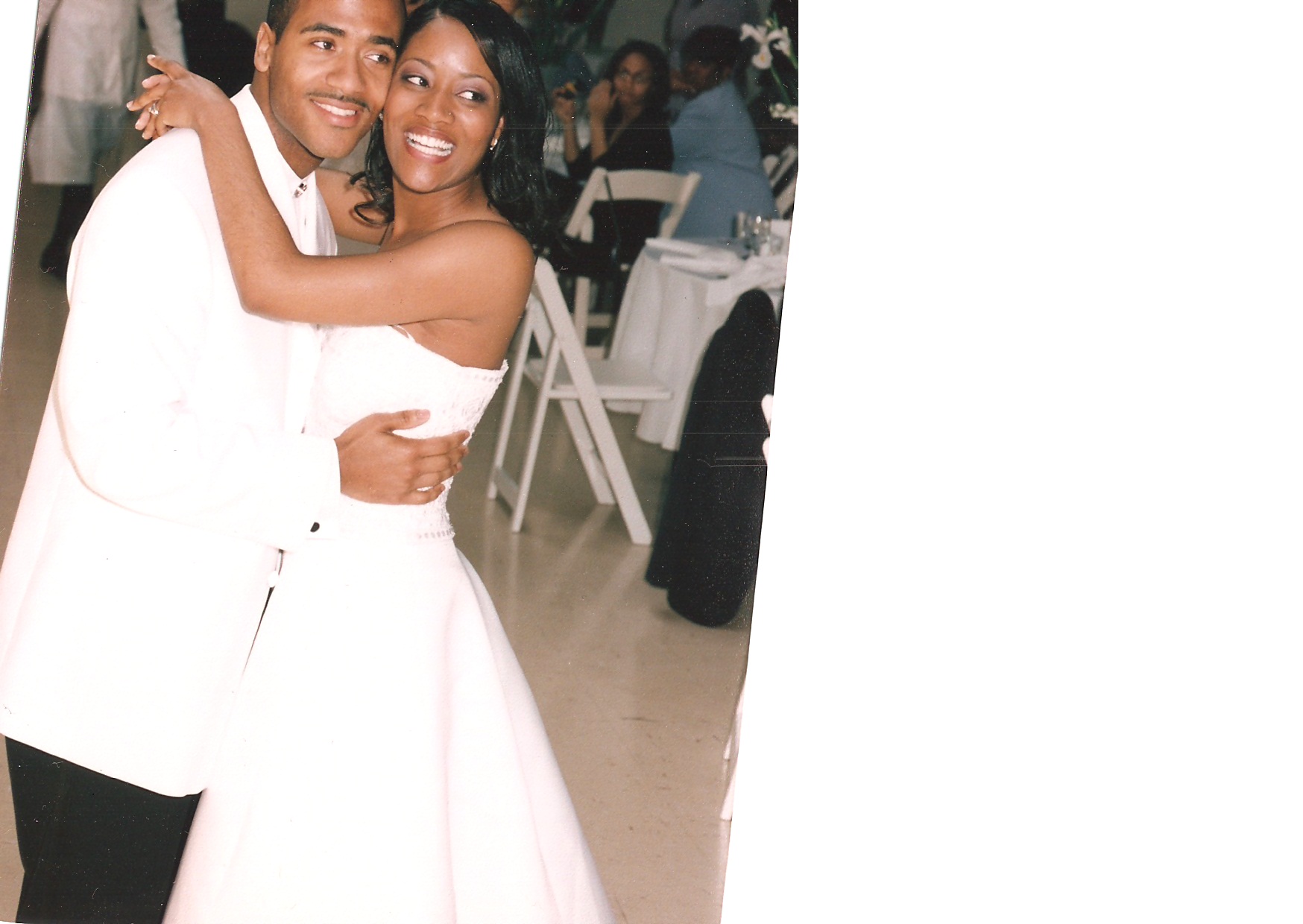
Keisha and Mark on their wedding day
To My Brother on His Wedding Day
I said this to my older brother this evening.
Mark, we never talked about our visions for marriage, for wives, for children.
I’m not sure why.
But I have a bundle of hopes and wishes and dreams for you today.
As I welcome you and your bride into this strange and stunning marital world,
As I extend my hand and pull you in along with the hands of all these loved ones today,
As I wrap my arm around yours and hold you in congratulations and compliments,
As I squeeze and tell you that I love you inside the echoes of all these other expressions of love,
I want to tell you what my dreams are for you, for Keisha, for your children, and for your future.
I want to tell you what I didn’t when we were boys, when traveled around the country singing.
I want to tell you what I didn’t on Normal, on 103rd Street, over Auntie Pat’s and Uncle Tim’s and everywhere in between.
I want to say what I didn’t when I became Dawn’s husband.
I want to say what I see, when I look at your future.
I want to welcome you to marriage, to being Keisha’s husband.
I welcome you to not knowing exactly what you’ve signed up for, to not fully knowing what you were saying moments ago when you spoke those lovely vows, to a world where being a husband means putting someone else first, all the time, and hoping that it means you will be first place again, to a world where you are becoming more like God because you are graciously and regularly putting another first.
I welcome you to finding out that being a husband means that everything changes even when your address doesn’t, to an arena when you’ll answer questions differently because you’ll always, now, have a wife who trusts you and hopes for you and gives to you and builds you and who expects that you are able to do the same for her.
I welcome you to the solidness of that simple precious circle on what was, this morning, a lonely finger, to an experience when women will want you more now than they did before (and they did before), to a world where words become symbols with the power to alter your family and your future, where compliments erase criticisms, and where the consistent practice of humility will make you a better man even when it feels defeating.
I welcome you to what will sometimes feel like unending fights with no real point behind them, to a swirl of upset with no real beginning, but I also see, in that same world, unending kisses and streams of happiness and contentment when conflicts are resolved and God meets you in the midst of joyous and sexy reconciliation.
I welcome you to the security of lifelong love and commitment and forgiveness, while running or walking or stumbling up cultural hills which tell you to leave your wife, to forget your vows, or, worse, to act as if those vows having no weight.
My dream for you is that you will always be an example in how you husband your wife and father your children.
My dream for you is that you will navigate with honor and power and grace the roads of being a father to all of these children, that you will know the boundaries but not respect them, that you will be wise in dealing with a biological father who may, at times, act sinfully, and that you will have a long and wide embrace of four children unless, of course, more come along!
My dream for you is that you will never lose strength and when you do, because you will, that you will the tap the greatest strength in the greatest and only God.
My dream is that you and Keisha will experience daily joy even while experiencing the bland parts of life, that boredom will be a minister to you and that it, like excitement, will teach you that life is about moments of boredom as much as it is about excitement.
My dream is that you will always be convinced that God loves you without condition and that you learn, daily, how to love just like that.
My dream is that you will not shudder under the heaviness of responsibility but that you will arise and arrive at that burden and that you will excel and flourish and flower.
Finally, my dream is that the Lord will bless and keep you, that the Lord’s face will shine upon you and be gracious to you, that the Lord will lift up his countenance upon you, and give you peace. Amen.
Memorable Moments
 After seeing and hearing a spectacular performance by the Alvin Ailey American Dance Theater, me and Dawn spent dinner last weekend, in part, going over memorable moments from the previous year. There were several we discussed; others went without our mentioning.
The space to do so, the room to remember, was an authentic tool for our marriage. It has been a way that we’ve made sense of things over the years, particularly when celebrating our anniversary.
Talking about things that happened and people who happened has been for us a way of putting and holding together this grace-filled experience called marriage. There are surely other times when we do what we did, remembering. We recall what’s happened during the turn from one year to another. I usually fall into a similar mental exercise around my birthday.
But anchoring memory and marriage have been helpful to me as a husband. It trains me to see and attend to Dawn, to things which impact her, and to people and events that relate to us. And it was wonderful rehearsing such times and figures from our story after having seen what must be described as musical movements by this country’s talented artists.
11 Years Today
Being interrupted by a bad photographer
My Adorable Son, An Idol
Because this fits with my themes on this blog as well as my other one, I’m posting it here too.
As a clergy person I lead people in worship. That means that I spend time with people, and while I’m with them, I point them to God. I facilitate people’s encounters with the Divine. I don’t create the encounters. I don’t create the people. I sometimes simply nudge people in a direction, or turn them around, or push them to keep listening or seeing or waiting until they notice Who was there but was, somehow, unseen. You might say that I do this for a living. In other words, when I’m with a person, a pair, or a group I’m asking the unrelenting question, how can I help this person encounter God so they can live?
What often comes with this occupation is an abiding question: what enables me to encounter God? The other day I was thinking about why I wasn’t sleeping. I was turning over in bed, trying to convince myself that I shouldn’t envy my wife or my son. I was listening to them slumber, Dawn right next to me, Bryce in the other room. Both of them were whispering little dreams to themselves, hardly moving, content. I was, as I said, turning and trying to flip away from the little anger in me that comes with occasional insomnia.
It’s not insomnia, I tell people. I can actually sleep. It’s just that I can’t sleep like abnormal people, on command. I sleep in a different time zone. I sleep later, but I do sleep. I can’t sleep like my wife or my brother, both of whom will enter into sleep 13 seconds after pulling a sheet over themselves. I look at them and I wonder why they aren’t more normal. Why don’t they fall asleep? Why must they jump into it?
When I am not asleep, my head dances. It doesn’t throb or ache, but it dances to the music of a thousand thoughts. I think about a congregant and it gives me reason, again, to pray. I think about class and whether I should just get up and read in preparation. I think about the novel I’m currently reading, Donna Freitas’s The Survival Kit, which I greatly enjoy, about the book of Maya Angelou’s poems I’m slowing reading and some snatch of words it left me. I think about one of my heroes in ministry, how he’s aging. I think about what I’ll cook tomorrow with that roasted chicken and whether I’ll cook the potatoes with onions and asparagus or just with the onions.
On the pre-dawn morning in question, I got to remembering when my son was crying a few days before. He has a tactic—I’m convinced that’s what it is—where he’ll whine, which I despise because it is a pernicious method in undoing me, and while whining he calls for his mother. He’ll do this in a tone that makes me contemplate how quickly I can climb down from our balcony and onto a neighbor’s despite our sixth floor setting. His voice, which isn’t a voice as much as a dismal sound in the distance just like the fire truck that kept sounding all night long that night prior and that I counted screaming four times from 6:55 to 7:23AM, his voice drones as he calls.
That day, last week, he called her as was normal and then he started into my title. Daddy. Daddy. And like a dripping drain it came until I turned looking for a clue because I had already started failing at my dogged resistance of the boy. I am really good at keeping the rules of our parenting pact. We don’t go into him after he’s in bed. But that week was a strange week for a lot of reasons. And we caved. Dawn mostly did, but I did too. I had come home late two evenings, rather than one, and he hadn’t seen me. He missed me. Dawn said this to me. I said this to me. Bryce’s whine said this to me.
After it all was done, days later, there I was listening to those damn birds that sang all night long because they, too, were confused about the weather outside and about whether birds should be awake and singing from 2:30 to 5:30AM. I didn’t know they were keeping me company. It took the congested sound of the delivery truck, gurgling below at 7:35AM, for me to remember that earlier, melodious birdsong. I lay there thinking about the way my heart jumped when the boy called for me. I didn’t move as quickly as I wanted to, but I did want to.
It got me thinking that my son was in a dangerous position, a position anyone loved by another can be placed in. Bryce was a potential idol. He was a potential reason for getting up and doing. He could become, I thought while fighting for sleep, the reason why I did what I did. That little toddler, full of nonsensical noise and play and fun, could turn me away from the One for whom I’m spending my life. I know it’s a slip of movement. It’s a crazed thought, one that I’d probably only come to when I hadn’t been taken my some real night dream instead. But it stayed with me, that thought. It was like all those birds and that heaving meat truck and those red blaring engines from the night and the morning. It didn’t leave me.
10 Moments In Marriage’s History
I saw this BBC article, written primarily from an English perspective (maybe for the same audience) about ten critical moments in the history of marriage. There are moments that aren’t addressed, but it’s an interesting summary for the most part. I wonder what you might add.
1. Strategic alliances
For the Anglo-Saxons and Britain’s early tribal groups, marriage was all about relationships – just not in the modern sense. The Anglo-Saxons saw marriage as a strategic tool to establish diplomatic and trade ties, says Stephanie Coontz, author of Marriage, A History: How Love Conquered Marriage. “You established peaceful relationships, trading relationships, mutual obligations with others by marrying them,” Coontz says.
This all changed with the differentiation of wealth. Parents were no longer content to marry their children off to just “anyone in a neighbouring group”. They wanted to marry them to somebody as least as wealthy and powerful as themselves, Coontz says. “That’s the period when marriage shifts and becomes a centre for intrigue and betrayal.”
2. Consent
During the 11th Century, marriage was about securing an economic or political advantage. The wishes of the married couple – much less their consent – were of little importance. The bride, particularly, was assumed to bow to her father’s wishes and the marriage arrangements made on her behalf.
However, for the Benedictine monk Gratian the consent of the couple mattered more than their family’s approval. Gratian brought consent into the fold of formalised marriage in 1140 with his canon law textbook, Decretum Gratiani.
The Decretum required couples to give their verbal consent and consummate the marriage to forge a marital bond. No longer was a bride or groom’s presence at a ceremony enough to signify their assent.
The book formed the foundation for the Church’s marriage policies in the 12th Century and “set out the rules for marriage and sexuality in a changing social environment”, says historian Joanne Bailey of Oxford Brookes University.
3. The sacrament of marriage
As early as the 12th Century, Roman Catholic theologians and writers referred to marriage as a sacrament, a sacred ceremony tied to experiencing God’s presence. However, it wasn’t until the Council of Trent in 1563 that marriage was officially deemed one of the seven sacraments, says Elizabeth Davies, of the Catholic Bishops’ Conference of England and Wales.
Following the development of Protestant theology, which did not recognise marriage as a sacrament, the Council felt a need to “clarify” marriage’s place. “There was an underlying assumption that marriage was a sacrament, but it was clearly defined in 1563 because of the need to challenge teaching that suggested it wasn’t,” Davies says.
4. Wedding vows
Marriage vows, as couples recite them today, date back to Thomas Cranmer, the architect of English Protestantism. Cranmer laid out the purpose for marriage and scripted modern wedding vows nearly 500 years ago in his Book of Common Prayer, says the Reverend Duncan Dormor of St John’s College at the University of Cambridge.
Although the book was revised in 1552 and 1662, “the guts of the marriage service are there in 1549,” he says. “All the things that you think of, ‘to have and to hold, from this day forward, for better, for worse, for richer, for poorer’, all of that stuff comes from that point.” The marriage service has had “remarkable continuity” compared with most other services, he says.
But much of it was “pilfered from Catholic medieval rites”, such as the Sarum marriage liturgy, which was all in Latin except the actual vows. “What makes the 1549 service significant is that it is the introduction of a Protestant service in English, and it’s basically the words that we all know with a couple of small tweaks,” Dormor says.
5. Divorce
Before 1858, divorce was rare. In 1670, Parliament passed an act allowing John Manners, Lord Roos, to divorce his wife, Lady Anne Pierpon. This created a precedent for parliamentary divorces on the grounds of the wife’s adultery, according to the National Archives.
This marked “the start of modern ‘divorce’,” says Rebecca Probert of the University of Warwick School of Law.
It also set the precedent for more than 300 cases between the late 17th and mid-19th Centuries – each requiring an act of Parliament. It was only in 1858 that divorce could be carried out via legal process. Even then divorce was too expensive for most people, and there was the added challenge for wives of proving “aggravated” adultery – that their husbands had been guilty of cruelty, desertion, bigamy, incest, sodomy or bestiality, Probert says.
The gates for divorce opened with the Divorce Reform Act of 1969. Instead of pointing the finger, couples could cite marital breakdown as the reason for the split.
“Prior to 1969, the script was that marriage was for life” says Bren Neale, a University of Leeds sociologist. “The divorce law meant that people trapped in bad marriages need not stay in them forever.” The emphasis on marriage shifted from a long-term commitment at all costs to a personal relationship where individual fulfilment is important, she says.
Click here to finish reading the article.
Fighting Fair
I’ve written a few posts about marriage. I believe in marriage, in supporting people who are married and who want to be married. One abiding question is: How do you not ruin a marriage? Here is some helpful material from Victoria Costello over at Psychology Today. She offers ten rules for fair fighting:
If you wish to avoid conflicts in your life, you should stay single, or find a very submissive partner. To deal with disagreements in a constructive way, you need to establish rules for fair fighting. Any rules you decide on should be tailored to your unique relationship. Someone who can’t tolerate a voice raised in anger (many people) is going need a rule that both partners use a normal tone of voice when fighting. Once you’ve agreed upon your rules, it’s a good idea to write them down. Then both sign and date this document as you would any binding agreement.
However, before you begin to review these rules, there’s one principle you should understand and think about how it applies to you and your marriage. That is, the difference between emotions and reason in marital disagreements. In most human beings, emotions affect decision-makingmore than logic does. When a woman says “You don’t love me anymore,” she is offering an extreme emotional reaction, also called a “You message,” when someone attempts to put total responsibility for a problem on her partner. Most likely, the woman’s response is provoked by something to which she incorrectly attaches an extreme reaction. For example, she may be bitterly disappointed on February 14th when her husband fails to come home with a Valentine gift. What else might she say that would be more appropriate to the situation? How about, “I’m hurt that you didn’t acknowledge Valentine’s Day by giving me a token of your love.” This “I message” would be both reasonable and appropriate. Especially if, by expressing this feeling, it opens up the subject of gift giving for this couple to discuss, including what holidays they jointly choose to celebrate, and what compromises they settle on if they don’t see eye to eye. Finding harmony within a relationship requires that each partner deal first with his emotions and then for both to explore reasonable accommodations or compromises in the marriage – without making either right or wrong, or making the relationship subject to the emotional swings of either partner.
The following ten rules for fair fighting are designed to help you create the boundaries needed to help you make room for openly acknowledging important emotions that may be lurking behind your behaviors (sometimes feelings you are unconscious of), but then invite in reason and compromise. Boundaries – another word for ground rules – are a safety net. If you cannot provide this safety net on your own, you will need an outside mediator to facilitate those disagreements that tend to generate deep emotional responses and destabilize your marriage.
Rule 1: Keep it private
Fighting by a married couple in front of other people is embarrassing to those around you and undermines your relationship. A sharp criticism or negative outburst made in front of other people is often a power play by the more verbally skilled spouse, or whichever one does not mind theembarrassment. By fighting in front of in-laws or friends, you risk giving them the impression that your relationship is in perpetual strife. This can then become a self-fulfilling prophecy. You also may get uninvited opinions on the issue under discussion. This will only roil the situation and make agreement more difficult. Resist the impulse to ask others’ opinions on your marital disagreements; certainly never call for a vote from whoever happens to be nearby. It may sound silly, but this is unfortunately not unusual in a dysfunctional relationship.
If a fight erupts in front of other adults and especially children make an immediate agreement to handle it privately at another time.
To finish reading click here. I wonder if you’d add anything.
Making Marriage Work
I’ve quoted and recommended John Gottman for married couples and for folks interested in marriage. Over my years as a newlywed, I’ve enjoyed learning about marriage from the scholar and marriage researcher. He and his wife have built a more than thirty-year career answering the question, how do you make marriages work?
Margarita Tartakovsky wrote a piece summing up one of my favorite Gottman books, The Seven Principles For Making Marriage Work. I imagine there is much that you’ll agree with in Gottman, even if you aren’t married. If you’re interested in seeing Margarita’s article, click here. From her summary:
1. “Enhance your love maps.” Love is in the details.
2. “Nurture your fondness and admiration.” Happy couples respect each other and have a general positive view of each other.
3. “Turn toward each other instead of away.” According to Gottman, “[Real-life romance] is kept alive each time you let your spouse know he or she is valued during the grind of everyday life.”
4. “Let your partner influence you.” Happy couples are a team that considers each other’s perspective and feelings.
5. “Solve your solvable problems.” Gottman says that there are two types of marital problems: conflicts that can be resolved and perpetual problems that can’t. It’s important for couples to determine which ones are which.
6. “Overcome gridlock.” Gottman says that the goal with perpetual problems is for couples to “move from gridlock to dialogue.” What usually underlies gridlock is unfulfilled dreams.
7. “Create shared meaning.” “Marriage isn’t just about raising kids, splitting chores, and making love. It can also have a spiritual dimension that has to do with creating an inner life together…
Secret To Marital Success
I get google alerts, and I’ve noticed several articles lately on the decline of marriage, the irrelevancy of marriage, and the increasing amounts of trouble for married folk. Most of the observations are old ones. Financial hardship challenges marriages. Correlations between educational background and marital satisfaction remain solid. Marriage is hard. The usual stuff.
And marriage has always been hard. And people have always had a host of reasons to marry. Regardless of their reasoning, marriage takes work. In one of my mentor’s words, “Marriage is not for children.” It takes work for those with and without jobs. It requires commitment and a host of other skills and gifts from husbands and wives.
Despite the many sobering words this week about marriage, I came across this story, celebrating a Florida couple’s 70th wedding anniversary. The wife, Mildred, says that the secret to a successful marriage is to forgive and be forgiven. I think words are worth meditating on.
Living With a Writer
I was browsing freshly pressed WordPress blogs about writing and saw Amy Nichols’ recent post. It’s an interview with her husband and it gives his perspective on what it’s like to live with a writer. I thought about a few similar experiences that me and the wife have had as I read it.
Because I wouldn’t ask Dawn these questions at this point–who has the time?–I’m forwarding a few of Amy’s questions and her husband’s responses. You can see the entire Q&A by clicking here.
Me: Am I a writer?
Him: Yes, but I think you spend more time being a writer than writing.
Me: Interesting. What is the difference between being a writer and writing?
Him: Doing all of the things that are trappings of the profession than the actual profession.
Me: Like what? What are those trappings?
Him: I would say mostly being online, doing things like blogs and facebooking and networking with people. That seems to happen far more of the time than actual writing.
Me: (gulp) Right. So how do you think that impacts a writer?
Him: What impacts a writer?
Me: Not writing.
Me: And what is your advice to a writer who isn’t writing?
Him: Write.
Me: Have you ever tried writing?
Him: Sure.
Me: And what did you think of it?
Him: It’s not a whole lot of fun. It’s fun to be done with it.
Me: What is it like living with a writer who is writing?
Him: Well, when you see them (laughs), it’s good because they’re excited, they’re energized by it. Mostly it’s they’re somewhere else, writing. Mostly it’s not seeing them. But when you do see them, they’re fired up and energetic and energized by it, so it’s good.
Me: Do you think it takes a special kind of person to be married to a writer?
Him: You know, I think it takes a special kind of person to be married to any other person. Everyone’s got their quirks, and a writer is just one way to be quirky.
Me: Would you prefer that I not be a writer?
Him: No, that would be worse. (laughs) I love the artistic part of you, and I would love to have the artistic part of you doing art all of the time and being happy about doing the art all of the time. The part I don’t like is the everything else that goes with it.
Me: The business side of it?
Him: Yeah.
Me: Do you think most writers would agree with that statement as well?
Him: I don’t know.
Me: What advice do you have for people who live with writers?
Him: I think the trick is to find balance. Say, this is your writing space, and when you’re not in that space, then you have to come out of that space. You can’t keep one foot in both worlds and try to be happy at all times. You need a sequestered time to work on it, and then you need a time when you’re going to interact with the planet.
Good Memories, pt 4
Here are a few more pictures from our trip, pictures which passed my wife’s I-can-show-these test.

On St. Peter's Square

People Shopping in Palma de Mallorca

Estate at Pisa

Rome From A Window

Dawn Outside Vatican City

People Shopping in Marseilles

Dawn Headed To Sagrada Familia

Me On The Street in Marseilles

Dawn & Stracciatella

At A Hat Store

 Michael Washington