Good Memories, pt 3

There are too many things to remember about our vacation.  I’ve jotted down lines in my moleskine journal to jog my mind.  Each phrase leads to a memory, to an event, to something we saw.  One line that’s not in my journal is the subject of this post.  I’ll finish up tomorrow with some pictures from our time, each one a memory in itself.

The evening I’ll write about was half way through the itinerary.  We left a show in one of the theaters on the ship.  Dawn was saying something about getting some popcorn when I went to have my nightly cup of tea.  From time to time we’d split up and agree when our next meeting would be.  We’d see a show together or make fun of people from Michigan as they guessed Motown tunes in a cafe.  Then we’d separate for a while so we could do whatever we wanted to do on our own.  We’ve found a nice complimentary system for vacations when we can do this–spending time together and apart.
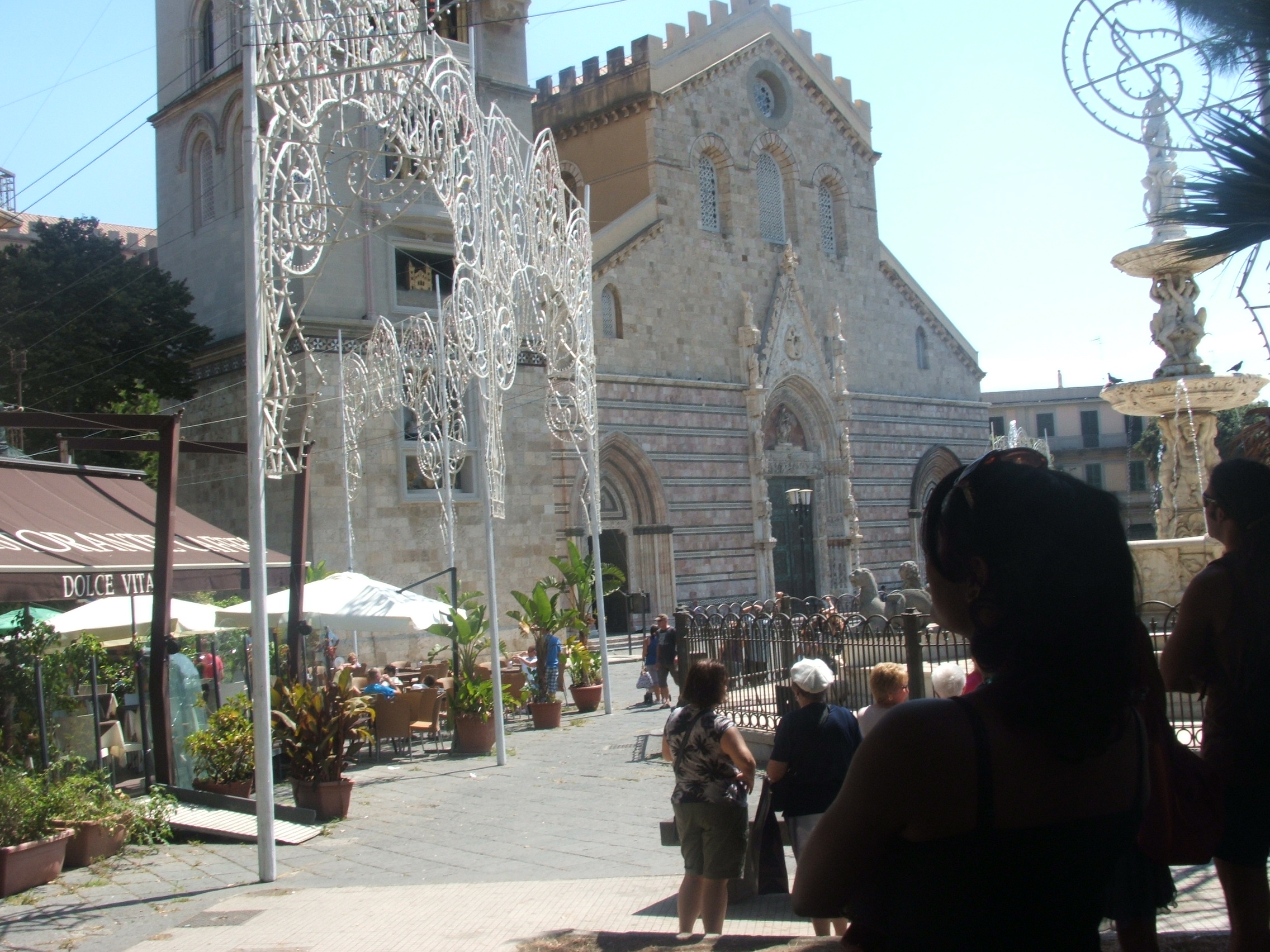
Well, as we left the show, we agreed to meet on one of the upper decks.  It was the last night in Italy.  That port was Messina, the one closest to Silicy and Taormina.  We spent that day walking around, me trying to look stern about not staying long in stores and Dawn trying, well, to do the opposite.  She looked at bags and hats and clothes.  We walked the streets, ate gelato (a practice at least one of us engaged in daily), and listened to music outside a large church near a city square with five hundred other people.  We stopped into a hidden restaurant.  I asked the woman at the door for a menu, made the decision to stay, and Dawn came in.  We asked the woman if she spoke English, and the look answered us before she could lie and mutter that she knew a little.  We thought to order by piecing together what we knew from Spanish but then chose to indulge only from the course of dishes spread on a kind of buffet table.  When Dawn asked something, the woman’s “Oh, Dear” became a joke between us, one that I’ll tell again and again.  I have no idea what we ate.

That night we passed through the last unseen Italian islands in the dark.  The decks were crammed with people.  The cruise director and the captain had promised to alter the route a bit so we could see the island of Stromboli.  It looked as if 4000 passengers lined one side of the ship to see the island, to get a glimpse at one of the world’s active volcanoes.  Me and Dawn decided to meet at a spot she’d found earlier that week, at the front of the ship.  Floors 5-7 were relatively quiet, and we were betting that most of our fellow travelers were cramping on the upper decks on the ship’s starboard? side.  We were right.  The forward portion of the vessel wasn’t empty, but we had more than enough room to ourselves in a quiet corner.  Quiet until some lovely father brought his three children, one of whom loved to say things.  She asked questions.  She made statements.  She talked about dinner.  She pointed out all the little boats around the island and wanted to know about all the 200 people on Stromboli and why they hadn’t moved since they lived under a volcano.

I looked at Dawn with that pre-parental expression, the one that’s not quite an eye roll.  I softened quickly.  One of us said something about Bryce.  He was soon to ask us a million questions about things too.  But that night, Bryce was in Chicago, having just seen his Grammie leave so that his Grandma could take her place.  It would have been about time for his afternoon visit to the park if the schedule was followed as customary.

John, the director, came on the speaker system.  Everyone quieted, even the little girl, as he told us what we knew–that we were at the island.  We stood on the front of the ship listening to the slapping of waves in ours ears.  I imagined those citizens of Stromboli, and I asked Dawn some of the same questions that little girl asked her father.  As we approached, Dawn mumbled something about going to get our camera.  I said it was too late.  We were upon the island, beyond the long wide rock it took so long to get to, and across from the volcano.

The sputtering red and orange took our collective breathes.  The kids were silent during that first bump and spray of color.  Red and yellow splattered and rolled downward.  After a while I wondered if what we saw was just for us.  It was timed too perfectly.  I told my wife that the islanders must have been pressing the big button on the side of the mountain because a ship was passing.  I also thought about those ruins of Pompeii we had seen and wondered why we were all so excited to be so close to a volcano.  Nonetheless, we saw five or six such eruptions in those too-brief moments.  They were dramatic and gorgeous and awesome.  They made me think about the greatness of God and about how many times God had seen what for us was a first.

We had been to a state park on the Hilo side of the Big Island with Karlos and Michelle four years ago.  (Incidentally, I could still move to the Island in a week if proper conditions existed.)  That day we traveled around the crater.  We ran along the edges of these huge rocks.  But we only saw steam.  We closed our noses to the smell of acid and sulfur.  We followed Karlos, running toward the red and orange, well past the STOP HERE signs.  But the lava was too far.  We were losing light.  Our wives were slowing down but still hardly complaining that they were wearing flip flops and not good shoes for volcano hopping.  That evening we went to the restaurant there in the park for dinner, somewhat disappointed.

I thought about that disappointing trek from 2007 when me and Dawn stood there whispering near Stromboli.  I love the Dodsons and would probably go anywhere with them.  But that night as we looked at those brilliant sprays and stretches of all those colors, I couldn’t think of one other person in the world I’d rather be with than my wife Dawn.  We took no pictures, though we bought one from the ship.  It’s the equivalent of a big rock with droplets and squiggles of fiery orange and yellow and red.  It’s a good picture, but I hope I can keep the images in my head for as long as I live.  I wouldn’t mind remembering those little children for all their noises either.

Good Memories, pt 2

We stood in the large hallway at the depot, both of us carrying a piece of luggage.  I wore a backpack.  Dawn had a strap hanging over her shoulder with a bag bulging at her thigh.  The bag squeaks every time she takes a step, and it reminds me of a hinge pleading for oil or grease or to be thrown to the ground.

The room looked like the check-in at an airport.  There was a line which snaked from the “enter” sign and ended with a dozen agents dressed in short sleeve white shirts.  Some of them wore ties or silk scarves, but most of them had their collars open as if they were welcoming the long lines of passengers and all the heat from outdoor Barcelona.  They wore pleasure on their faces, and I wondered whether they kept those smiles all day or if they painted them on their lips right before coming to their posts.

While we waited, we wondered to each other about the sanity of our fellow cruisers, particularly the ones who brought their children.  There was a family with a daughter.  There was a family with several daughters.  There were kids who were already making noises no one but their parents could appreciate or interpret.  Me and Dawn communicated in our party language, the way we talk to each other without words so that people can’t understand our gestures.  I’m not going to give them away, but I will tell you that there was a fair amount of glancing and nodding and shaking of the heads.  We saw a couple with a child in a stroller, and I’m sure it made Dawn think about the boy back home.  Me, well, I thought about all it took to get that kid in that line, all that money that those parents were willing to pay for a kid who couldn’t stand up in a long line with its own bags and who could only complain and who probably couldn’t say a full sentence yet.

At the counter they took my credit card, made me sign things, and told us we were welcome to board.  We turned toward the exit, still smiling; we made it.  My brother Mark being a great driver to get us to Terminal 5.  Leaving the boy with his Grannie and finding out, by the time we got to O’hare, that she had already altered his daily routine.  Stretching and walking up and down the length of a plane.  All those hours and in-flight movies.  Watching Dawn fall asleep in green chair in Amsterdam while we sagged through that first layover.  Words in Spanish that we both read with about 40% accuracy.  We made it.  Listless, limp, and faltering.  Passports and sail-n-sign cards in hand.

Outside the room with the white-shirted attendants, there was another short line of people.  The Carnival photographers were snapping pictures.  Dawn shook her head.  No pictures, she said.  I asked her, You don’t want to take a picture of this moment?  She didn’t.

This is a security photo, the nice man said.

They snapped our heads so they could prove we were who we were when we exited and re-entered the ship at the ports of call.

Then there was the embarkation photo, the one Dawn refused to take.  She took my arm, pulled her sunglasses down, and we walked by.  There was an orange background with yellow and red columns consuming a ten foot high spot.  I presumed it was evocative of Spain.  We walked by the photographer without posing, seeing the flash from the two umbrellas and muttering about those who were stopping.  They looked terrible but they didn’t care.  They were happy.  They were in Barcelona.  We were happy, too, but we had dignity.  At least the wife did.  She knew that taking pictures after flying and waiting and removing shoes and being spoken to in languages we didn’t understand and eating something in Amsterdam that hardly passed for Thai at a horribly early hour because I was starving was not wise.

But I wanted to take that first photo because I’m learning how to take pictures.  I’m learning to take them that is.

Early on in our relationship I had a thing about not taking pictures.  I didn’t care to.  I still don’t care to, but a couple years ago I made an inside promise to take more pictures.  It was something Pam Sheppard said to me, something I can’t remember.  It was probably something about the need to take them, the wisdom in keeping snapshots or something.  Pam is a brilliant and caring person.  She’s a clinician so she had to be.  As I said, whatever she said left me with the increasing impression that I should take pictures.

She probably said that one day I was going to die and when it came time for my funeral my family would have to choose that picture from seventh-grade when I wore my favorite white sweatshirt.  I was wearing Bugle Boy jeans, though you can’t see them because the shot’s a headshot.  That picture looks no different from my wedding picture because when we got married I looked like the same seventh-grader except that I was in a white jacket and not a white sweatshirt.

Even though Pam told me that I should take pictures, and even though I told her I would, and even though I do, in fact, take more pictures, I didn’t push the issue with Dawn about that first cruise shot.  After all, you have to choose which pictures to take when you’re married.  You have to choose which decisions you’ll make and resist unmaking.  You have to choose which moments you’ll capture and hold to tightly and which ones you’ll let fall into a body of water so large that you’ll never see the same wave again the way you first saw it.

Me and Dawn brought up the topic of pictures while we snapped our own shots of random strangers on the streets in Palma de Mallorca or when we took pictures of dead people in the Vatican.  I told her I was getting into collages this year, that I was going to unearth those pictures from all those envelopes in that drawer next to the glider at home.  I told her I was going to find a few ways to keep the places we’ve been and the things we’ve done before us.  I think I’m getting old or sentimental or soft or, maybe, smart.  Because it’s easy to forget where you’ve been with a person you go everywhere with, isn’t it?  No, me and the wife don’t go everywhere, but we go places together.  We share life, and we, like everybody, forget about the small, mostly ugly moments, like the ones when we’re sweaty and tired and grouchy and lagged by planes and everything else.  Remembering, taking pictures–mental or otherwise–might be the only way to prove it.

Good Memories, pt 1

As I said yesterday, these posts will focus on my scrambled thoughts as I remember good memories from our vacation.  I’m writing toward a new practice, a habit of paying attention to good things rather than my most natural tendency to hold to the bad.  Most of these memories will be good, though there are a few not-so-pleasant moments littered through the last two weeks.

The point of the post today, for you who like points to posts, is to plan a vacation.  Or a getaway.  Or a break.  Or a series of dates.  Or a significant time away from normal life.  The getaway, break, or vacation will give you an opportunity to nurture your marriage.  Of course, you could do this with a friendship or a significant relationship with some modification too.

I’m somewhat of a planner.  And traveling is important to me.  I like to do it.  You could say that I value it.  We started planning this last vacation a couple years back.

Before we had a baby, before Dawn got pregnant, we talked about how we wanted to celebrate our tenth year anniversary.  We wanted to do something big.  We wanted to stretch ourselves, save up, and have a grand time.  We couldn’t do what we really wanted which was to copy some friends who a few years ago spent a month on a different continent.  But we could stretch.  So we talked about what we wanted to do, and even though a little boy got made and delivered since those first conversations, we committed to acknowledge, in some way, that we were a we.  That we existed as a married couple.  That we were together.  To be honest, we had our challenges conceiving, and affirming who we were outside of the parenting thing nourished us in ways that we haven’t always seen.  So we determined to go on a cruise.

We’ve cruised before, done what I call the local cruises, the popular one to the Caribbean.  We cruised the year I graduated from seminary, too, because that was my gift to myself after getting another masters degree!  We also decided, in planning this last vacation, that we wanted to return to an early desire to see Italy.  I had a dream when we were engaged at 22 years-old that we’d honeymoon in Italy.  I was young.  I was, in a word, foolish, on many fronts.  I thought about a lot of things for us, but I didn’t think that going to Italy at 23 years-old when you had a mortgage and a construction project called a fixer upper was impossible.  It didn’t become possible in those early years either really.  So we took smaller trips.  We saw family.  We drove to many places.  We went on those ships that I mentioned and saw the Caribbean and parts of Mexico.  I used honorariums from speaking engagements and payments from work-for-hire contracts to make sure we were traveling together.  One reason why we got married young was so we could see the world together, so we saw what we could.

When we planned this time, it was a similar experience.  I started saving money, even though we couldn’t really afford it.  We were blessed.  I cut up portions of my second and third incomes–income that I never count until I have a contract–because my primary income is restricted to relatively fixed expenses and giving.  We agreed on an itinerary, a mix of France and mostly Italy with enough Spain to keep us interested.

Dawn started looking into logistics.  We struggled, waiting for the best time slot.  Back then, Dawn was considering school.  I had a small frame between my supervisor’s sabbatical and the start of my next calendar year in the VFCL program at GETS.  We waited as late as we could because my coworker’s decision wasn’t exactly made.  I knew when my teaching responsibilities would start.  We really could only go at a particular time because of both calendars.  Dawn looked at flight plans after I came up with a window of dates.  She reserved and purchased our tickets.

We decided easily that the boy was staying when the cruise line said he would cost the same amount of money we would.  We thought they were joking.  They weren’t.  We struggled with the matter of leaving him–for about two minutes.  I mean, we are a couple and this was our anniversary celebration.  We are not alone as a couple anymore so we were thinking that including the boy wouldn’t be all wrong.  And yet there was this voice of wisdom speaking.  Why not find a way, if it was possible, to leave the kid.  To leave him and to remember that we were separate from him.  To say our goodbyes and to have that be some shared meaning between me and the wife.  Of course, we are parents and that reality is hard to get away from.  But we are something else, a reality that’s easier to lose sight of as a couple.  Everyday we attend to him, naturally and necessarily, but there is this other thing called a relationship which needs attention too.

We met with our mothers about staying at our home one week apiece, and I texted a few people to secure supplemental childcare.  The week before we left, I went grocery shopping.  I picked up enough apple sauce and wipes and diapers to last for a month.  Just in case, you know, we couldn’t get back.  In case we decided not to come back.  I washed all the clothes in the house.  Dawn bought her textbook and read her first week’s readings.  I finished two contracts so I wouldn’t have them hanging over my head.  I looked over the syllabus for the fall semester and thought through what September would be like.  I did as much work as I could at the church to leave things well and in the hands of my colleagues.  I had a few more meetings than I thought wise.

We talked to friends about Barcelona and France and Italy.  Alan told us about the architecture in Barcelona, leaving me mad that we weren’t just going there.  His eyes widened when he spoke, and he relived days where he ate bread and salami while sitting in a park in front of some building.  I imagined him drooling while he ate in that park, though he wasn’t drooling exactly as he told his stories.  We ate with Libby and Omar who helped us figure out what to see if we only had so much time, which was true, because it was a cruise and not a land-based trip.  Libby wrote up a three-page cheat sheet and sent it to Dawn.  She gave us more direction than any guidebook.  She gave us guidebooks too!  Omar told me to wear a fanny pack to keep our euros hidden from people pick-pocketing.  I refused.  I told Dawn that I’d simply wear my I-grew-up-on-the-south-side-of-Chicago face.  It seemed to worked.

I wrote up the first draft of the cheat sheet we intended to leave our grandmothers and to our friends.  We left explicit instructions to call us only when the boy was hospitalized since calls to the ship would be $10/minute.  We had full confidence that Bryce would cooperate and not injure himself.  We packed.  We dreamed.  We talked about what we wanted to see, where we wanted to go.  We did something that a counselor I worked with during the early years in our marriage called “planning a future together.”

It’s a powerful thing to plan and map out your future.  Of course, you make vows to a spouse about a vague future, but planning it is a second strategic step.  It adds to the vow or the pledge the particular means and the specific steps.  We were doing very romantic and relationship-strengthening work: looking at those next tomorrows and saying how we, together, would face them.  Before us was a delightful series of dates.  They included easy travels, long lines which we greeted with smiles and gladness, and a lot of words we didn’t understand.  Those tomorrows included sumptuous meals and great servers and questionable taxi drivers.  It would be wonderful, a little messy, slightly nerve-wrecking, and glorious.

Good Memories, Good Marriages

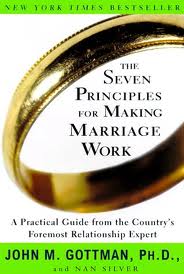
I’m rereading John Gottman’s Seven Principles For Making Marriage Work.  I started reading it again before going on holiday for a week and a half and I’ll be picking it back up now that I’m home.  To be honest, I’m biased to Dr. Gottman’s findings.  His career and research in couples work is grand and phenomenal.  He’s a trusted, clinical, scientific, and thoughtful voice in the area of marital relationships.  As he talks about in this and other books, he’s able to predict divorce with compelling accuracy, something like 93%.

In one part of the book he discusses the signs of marriage going bad.  One of them is the presence of bad memories.  He talks about how the persistent retelling of negative stories from before are an indicator of a relationship’s spiraling downward.  Having bad memories, and revisiting those memories, put a relationship at risk.

A couple quotes from the book capture what I mean.

But when a marriage is not going well, history gets rewritten–for the worse.

Another sad sign is when you find the past difficult to remember–it has become so unimportant or painful that you’ve let it fade away.

His language is helpful to me.  Helpful again, I should say.  I’m thinking a lot about how my long emotional memory impacts my life and work and relationships.  I can remember a lot of things.  Sometimes my memory is selective.  Well, of course, it’s always selective.  But that emotional portion leans toward the negative.  It’s hard work for me to relinquish bad memories and maybe just as hard to create good memories that have as much weight as the bad ones.  I think my proclivity is a posture that affects how well I do in my relationships.  It influences how much work is ahead of me in my marriage and in the other relationships I cherish.

In the next few posts, I’m going to shift from focusing on writing per se in order to look at the relationships dimension of the blog.  I’m going to reflect on a few memories, drawing from my “holiday” with Dawn.  It’s an effort to remember well, to capture memories, or, in the words from another blogger, to “catch days.”

Whether or not memory, good or bad, is something you think about, consider for a moment whether you can articulate a few positive memories from your significant relationships.  Do you “go to” the bad memories naturally?  Is your first impulse to remember something great about a relative?  With Gottman, I think that the ability to cultivate good memories is only helpful for a relationship.  Whether for a single mother who is recalling her last conversation with her child’s father; whether for a husband who’s tired of arguing about the same thing with his wife.

How do you make good memories in your relationships?  How do you balance the negative memories you actually have with the work of creating good, alternative memories?

Comments Please

I went to a wedding last weekend, one I didn’t officiate this time.  It left me interested to know how blog readers would respond to some things.  Answer any of these in the comments if you will:

  1. What does marriage mean?
  2. What does it mean for a man to lead in a home?
  3. What does mutual submission look like in real life?
  4. Will you tell a story of the most fun you’ve had a wedding?

Why Don’t Pastors Tell People Who To Marry

If you’ve read a few posts on this blog, you may know that I’m in the midst of wedding season.  I’m officiating weddings this summer.  A lot of them.  So many, in fact, that in my spare time, I’m giving my energies to the rest of what it means to be a staff pastor at a church, an adjunct faculty member at a seminary in an intensive class, and a cab driver and chief entertainer for my son.

When you look at my schedule, it almost looks like most of what I do is weddings.  Thus far I’ve had one in the chapel at NU, one on a boat, and one in a rose garden.  Later, this year I know I’m going back to Alice Milar, maybe twice.  I have three more in front of me.  I’m toying with the idea of learning to play the guitar and making a full-fledged business out of it.  I could sing, open the ceremony, charge the couple, and lead the vows in 30 minutes or less!  I could offer a package.  I know a great photographer.  I could ask some capable videographers to go in on the work, too.

Uh, I’m kidding.  I don’t officiate everybody’s wedding, despite my schedule.  I’ve pointed to my thoughts behind my pastoral practice in this post here.

The other day I met with one of the couples for whom I’ll officiate in August.  The groom-to-be asked me an interesting question.  We were talking about discernment, my word for decision-making.  I had asked my two questions for the first premarital session.  He was answering the first question.  And in his answer he asked, in other words, why pastors weren’t forthcoming with helpful feedback or wisdom when it came to a guy deciding to marry.  When a guy wanted to know if this girl was the right one to marry, would a pastor be helpful?  I loved the question.

My response to him was only slightly satisfying to me.  It was even less satisfying to him, I think.  And I’d be interested to know if you had any feedback.  I told him that the decision to marry was a narrow decision inside a larger–what word did I say? I can’t remember, so I’ll make another up–world of decisions.   Pastors are concerned with helping people develop the overall ability to pay attention to scripture (since that is our primary text), more appropriately to attend to the God of the scripture, and to connect the story of scripture with the stories of our lives (since the lives of people are our secondary texts, if you will).

I told him that our roles in people’s ears was to say over and over, “Are you submitted to God?  If you are, your decisions will reflect that, including the decisions about who to marry.”  I told him that when we’re submitted to God, it doesn’t matter, the particular question.  I told him that pastors do our best work when we stay a little distant from the questions about this job or that job, about this relationship or that relationship.

Of course there are flags to respect.  Wisdom and experience leave pastors and ministers with some tools and abilities that we must honor and offer when obvious.  But offering my experience is a slippery slope if someone could mistake what Pastor Michael said with what God said.  That happens.  And it’s a slight move, in some people’s lives, to go from “I had my doubts about this person and when the pastor said to stay or leave them, that’s what I did” and “Since the pastor thinks this, it must be what God wants.”  So here are a few reasons why pastors don’t tell people who to marry.

  1. People are grown.  A friend of mine asked me if I took the weight of marriages on my shoulders.  I told him no.  I told him that I didn’t for the same reasons that I didn’t take the decision for a couple to marry on my shoulders: those people are grown.  Sure, I told him, I have a responsibility to care, to offer biblical and theological tools, to connect dots, to point out potential concerns.  But the couple is grown.  And, in the words of a seasoned pastor, grown people do what grown people do.
  2. We respect the decisions couples make.  We should.  Yes, we should “check” those decisions when needed, but we should still respect the agency of the men and women in our churches.  We are pastors, not police officers.  Well, there is an example or two where a pastor (one of my mentors) will look at a guy’s credit report and say to his intended, “Don’t you dare marry this guy.”  Indeed, we are shepherds and spiritual leaders, and our role, in part, is to ensure that our couples have a sense of what marriage will bring, an understanding of the covenant of marriage, language for what scripture and tradition says of the relationship, and community to challenge, support and love them through their transition as a couple.  That means that it is a couple’s solemn responsibility to choose, to decide, and to do so every day after a marriage ceremony.  We don’t just choose when we pop the question.  We choose when we wake up every morning next to the same person, when we come home daily, when we’re present and committed.
  3. Pastors aren’t that smart.  One of my favorite researchers in marital literature is John Gottman.  I first made his acquaintance through the text in James Cordova’s psychology of couples and intimacy course at Illinois.  Dr. Gottman can predict divorce.  He’s a 30-year veteran of marriage, relationships, and psychology, and he can predict divorce after watching an interaction with a couple.  But pastors are pastors.  We aren’t John Gottman.  We aren’t psychics, not that Gottman is.  We aren’t future tellers.  Most aren’t at least.  So why would we set ourselves up to be someone we aren’t?  To misrepresent ourselves and our work?  Our work is not to identify the couples that will last or to only marry the good ones.  Our assumption and approach is that every couple will honor their vows, living together in faithfulness to those sacred words, for life.  And there are no good ones if the Gospel is true.  All of us are incompatible, and that’s how grace becomes essential to life.  But we can’t predict tomorrow.  That’s why we are professional people of faith.
  4. Pastors aren’t supposed to make matches.  We get in trouble when we do.  People break up, before the altar and after the altar.  It’s a sad truth, but it is real.  And if a pastor steps in the business of suggesting who is a good fit for you, that pastor is inviting a problem.  He or she is doing something that is best done by the people who watch your life closely.  In most churches, that’s a small group of people, a circle of friends, a ministry group, not the pastoral leader.  As a rule, introduce your pastor to the person after you’ve come to some sense of determination.  That’ll relieve us.  We don’t want to decide for you.  Now, we might not mind taking the credit for your relationship 20 years down the road.  And even then, we’re telling ourselves that your relationship was not in our hands.  Our lives as leaders should be daily reminders to ourselves and to our congregations that our lives and our relationships are in Someone else’s hands.  That doesn’t mean, though, that pastors can’t be in the business of weddings after the couples have matched.  We can sing at weddings.  So if you hear that I’ve started guitar…

Civil Unions, pt. 2 of 3

I love marriage as a matter of philosophy and practice.  I have one wife, have only had one, and I’m giving all that I can (and sometimes all that I can’t) to my relationship with Dawn.  To have a marriage that is honorable and full of love is a long life project.  Sometimes I really enjoy it.  Sometimes it’s grueling.  My closest friends know that I’m not the easiest to live with.  I know that my wife, the darling she is, is not always easy to live with, and the result is til death parts us.

I come to the enactment of this law with marriage in my view, with it in my experience.  I can’t quite imagine not being married.  Well, I can, because I have a creative and dancing imagination, but I’m trying to push a point.  When you’re married, you’re supposed to give yourself wholly and completely to that relationship.  And giving like that makes it difficult to envision yourself unmarried.  But as I thought about this Act–and it’s not about marriage but civil unions–I had to stretch into that imagination.

What brought me back was the pastoral viewpoint.  I think a lot of people of faith express strong sentiment against civil unions.  Of course, people of faith express support for them, too.  The same can be said about marriage.  What I want to point out, though, is that the Church (and its people, if you will) has always been concerned with marriage, and it should be.  That’s because the Church had focused on the sacraments, with what is sacramental.

To talk about the sacraments is to talk about experiencing grace.  One way of understanding sacraments is that they are expressions of invisible gifts from God through visible things.  The Church is good at dealing with what is sacramental.  Marriage is a sacrament in the Catholic tradition, but it is sacramental for other traditions too because it carries grace.  Marriage brings with it the daily reminder of our dependence upon the One who loves perfectly.  So, the church has reason to talk about marriage.  It has always had reasons.

That said, the Church has to be cautious when stepping outside of the realm of the sacraments.  I think the Church needs to be related to the civic or public arena.  But I also think that we must acknowledge that our role is unique and different from the civic arena.  Obviously I’m suggesting a split that isn’t quite borne out in real life; people from/in the Church are in the public life.  That’s good and that’s necessary because that truth makes religion relevant for daily life.  But my point is the Church holds and handles the sacraments, while the political institutions of our time handles the laws.  The thing is that marriage is a legal and spiritual institution.

When things like civil unions come up, it pushes us to an edge where we can’t help but meet at the tips of our borders, the Church’s border being the sacraments and the political world’s border being that which is judicial.  We look at each other and come to terms with what the Church’s role and concern is and what it isn’t.  I think spiritual leaders should debate and fight and pray about marriage and how it’s protected, preserved, and even revered in a culture that’s so poisonous to long commitments.  But that struggle, those prayers, and those debates are because of the grace-filled nature of marriage, not because of rights and protections and legal benefits.  Those legal benefits are properly qualified to the realm of law and politics and legislation.  Those aren’t what I deal with daily.  Those aren’t what the Church holds, handles, and invites people to participate in.

I’m celebrating a wedding tomorrow.  One of things I’ll say is that the couple before me is signing up for a long life course in commitment.  When I say that, I’ll be thinking about how everything around them will frustrate their vows and their commitments.  Their own histories will object.  Their dispositions, daily changing with the winds, will too.  But that’s the vow.  And that needs to be protected because it is a means of grace and transformation.  That’s what the Church does, engage in the prolonged discussion and celebration of grace.

Now, and I’m almost done, how that looks is different from one Church or denomination to another.  That’s because communities of faith find their answers first in the Scriptures.  Diverse readings yield diverse interpretations, which bring about a buffet of practices.  That’s how many churches can see something like marriage or gay marriage or divorce or baptism so differently.  The Church or the denomination has to do its best work, asking the question, “What do we hear from our best source?”

If Scripture is a best source–or in some communities the best source–then it’s always a part of that discernment.  If a community is under Scripture, that yields a different conclusion than if a community is next to or over Scripture.  If first place is given to culture and ethos and social acceptability, the language of Scripture (and the God of it) will be too strange to listen to when matters like gay marriage come up.  So the interpretations will be different.  But each community of faith, handling the sacrament of marriage as it naturally does, can look differently.  And the clincher is, somehow, we are still one Body, one Church, immersed and joined into one baptism if the New Testament is true.

The Big Deal About Weddings, pt. 3 of 2

I didn’t intend a third post in last week’s two-part rambling about marriage.  But I was over at Cathleen Falsani’s blog and read the transcript from Bishop Chartres’s homily at the royal wedding.  I’ve linked to the Bishop of London’s sermon here.  But it is below for your thoughtful reflection and meditation.  It’s a great message, isn’t it?

“Be who God meant you to be and you will set the world on fire.” So said St Catherine of Siena whose festival day it is today. Marriage is intended to be a way in which man and woman help each other to become what God meant each one to be, their deepest and truest selves.

Many are full of fear for the future of the prospects of our world but the message of the celebrations in this country and far beyond its shores is the right one – this is a joyful day! It is good that people in every continent are able to share in these celebrations because this is, as every wedding day should be, a day of hope.

In a sense every wedding is a royal wedding with the bride and the groom as king and queen of creation, making a new life together so that life can flow through them into the future.

William and Catherine, you have chosen to be married in the sight of a generous God who so loved the world that he gave himself to us in the person of Jesus Christ.

And in the Spirit of this generous God, husband and wife are to give themselves to each another.

A spiritual life grows as love finds its centre beyond ourselves. Faithful and committed relationships offer a door into the mystery of spiritual life in which we discover this; the more we give of self, the richer we become in soul; the more we go beyond ourselves in love, the more we become our true selves and our spiritual beauty is more fully revealed. In marriage we are seeking to bring one another into fuller life.

It is of course very hard to wean ourselves away from self-centredness. And people can dream of doing such a thing but the hope should be fulfilled it is necessary a solemn decision that, whatever the difficulties, we are committed to the way of generous love.

You have both made your decision today – “I will” – and by making this new relationship, you have aligned yourselves with what we believe is the way in which life is spiritually evolving, and which will lead to a creative future for the human race.

We stand looking forward to a century which is full of promise and full of peril. Human beings are confronting the question of how to use wisely a power that has been given to us through the discoveries of the last century. We shall not be converted to the promise of the future by more knowledge, but rather by an increase of loving wisdom and reverence, for life, for the earth and for one another.

Marriage should transform, as husband and wife make one another their work of art. It is possible to transform as long as we do not harbour ambitions to reform our partner. There must be no coercion if the Spirit is to flow; each must give the other space and freedom. Chaucer, the London poet, sums it up in a pithy phrase:

“Whan maistrie [mastery] comth, the God of Love anon,

Beteth his wynges, and farewell, he is gon.”

As the reality of God has faded from so many lives in the West, there has been a corresponding inflation of expectations that personal relations alone will supply meaning and happiness in life. This is to load our partner with too great a burden. We are all incomplete: we all need the love which is secure, rather than oppressive, we need mutual forgiveness, to thrive.

As we move towards our partner in love, following the example of Jesus Christ, the Holy Spirit is quickened within us and can increasingly fill our lives with light. This leads to a family life which offers the best conditions in which the next generation can practise and exchange those gifts which can overcome fear and division and incubate the coming world of the Spirit, whose fruits are love and joy and peace.

I pray that all of us present and the many millions watching this ceremony and sharing in your joy today, will do everything in our power to support and uphold you in your new life. And I pray that God will bless you in the way of life that you have chosen, that way which is expressed in the prayer that you have composed together in preparation for this day:

God our Father, we thank you for our families; for the love that we share and for the joy of our marriage.

In the busyness of each day keep our eyes fixed on what is real and important in life and help us to be generous with our time and love and energy.

Strengthened by our union help us to serve and comfort those who suffer. We ask this in the Spirit of Jesus Christ. Amen. 

The Big Deal About Weddings, pt. 2

As I said yesterday, I’ve been working with engaged couples from my church.  It’s a part of my job.  It’s a good part really.  I think it’s one of the best ways I can talk to people about themselves and during a time when they are in meaningful life time but while they aren’t exactly in a crisis.

I mentioned Kate Shrout’s article at the Religious Dispatches.  If you haven’t read it, take a look.  In the last section she deals with the myth of feminine upward mobility.  One of the reasons I love scholars is that they are often good writers.  They find ways to express stuff about life and people and the things people do.  Dr. Shrout wrote about the myth, and that’s what I want to park on in this post.

The myth of feminine upward mobility has to do with achieving princesshood by being given the right things.  As she explains, while invoking the example of Cinderella, it is

It is a myth of feminine upward mobility, facilitated through consumption, enacted by women especially on the wedding day. It is about rite of passage—how girls become women—and I, for one, would argue the transition is brought about less by Prince Charming than it is by the Fairy Godmother, the kindly feminine personification of the marketplace. You become a woman by becoming visibly beautiful, and you become beautiful by getting the right stuff.

A couple key points about this myth.

  1. Women move upward by being given something by someone else.  Shrout’s preference is to point to the Godmother rather than the Prince.  Whichever you choose, the myth of mobility seems tied to someone outside of our sisters.  As true as this is, especially around the subject of weddings, I’m frustrated that the one special day is the one time many women will feel esteemed and valued.  It’s sad that females cannot look forward to a life of recognition, appreciation, and esteem, and that those three get crammed into one day.  That one day carries so much significance.  If it doesn’t happen, if it doesn’t happen in a timely manner, the meaning tied to it is lost.
  2. Myth has its problems.  Some myths are real, and as I think of this one, I’m frustrated by a dozen instances in recent memory where I’ve heard of women being told in one way or another, “You aren’t beautiful unless you do this.”  Or, “You haven’t achieved until you’ve accomplished that.”  Shrout says that this myth is about women “getting the right stuff.”  I hope you think that this myth, as realistic as it may be, is equally unacceptable for the women in your life.
  3. Women need men to recognize all kinds of beauty.  My wife will tell you–I will tell you–that I am “eye conscious.”  Dawn says that all men are eye conscious.  But she’ll say I’m really eye conscious.  I’d never heard that until she told me.  In other words, men (including me) like beautiful things.  I appreciate beauty.  As a man, a part of my life task is to recognize beauty in women, in all forms, and not just physical beauty.  I think a lot of men doing that will create a world where women begin to see themselves as beautiful and not necessarily beautiful because of some thing they’ve done, some thing they’ve gotten.
  4. Faith communities can be gift givers.  I’d love to see communities of faith, or positive communities in general, being the voices which give to the women around us, so that their inherent beauty is pointed out, while they are receiving gifts from others in a safe way.  I’d love to imagine a church or a temple or a youth group as the place where little sisters growing up will hear that they are beloved because they are and not simply because of something they can do for someone else.  I think words like celibacy and singleness come up when a faith community is giving.  I think we draw out a person’s creativity and honor a person’s sexuality when a community is giving.

The Big Deal About Weddings, pt. 1 of 2

I have not followed the events leading up to the only wedding happening in London this week.  But I am struck by how exalted Prince William and Princess Kate’s relationship and ceremony have become.  Over the last month, I’ve changed the radio station in my car, turned the channel on the television, and scrolled down my computer screen as the news has reported, promoted, and surveyed the events leading up Friday’s wedding.

I must say that I hadn’t considered blogging about the big deal around this wedding before reading Katy Shrout’s article over at Religious Dispatches.  Dr. Shrout poses several good why questions in her essay.  She surveys a quick history of the last century and a half of white weddings and discusses how we’ve come to stuff our faces with multi-layered cakes and how brides came to love things like tiaras and creampuff dresses.  More pointedly though, she deals with the myth of feminine upward mobility, which I’ll come back to tomorrow.

To be clear, I am happy for the couple.  I think the decision to marry is a serious and joyful one.  I’m happy they’ve chosen to wed.  I’m happy.  And I’m not sure that my happiness extends to the press coverage of their engagement and all the snapshots and videos and commentary promised to trail from their marriage service.  The press has dealt with the superficial and chosen to stay above the water of what marriage really is, what marriage really takes.  They haven’t hinted at the harder choices ahead, the significant losses to come–and aren’t all of them significant, even the little ones like leaving an apartment you liked for a bigger one or buying a different brand of toothpaste because that’s what she likes or because that’s what was on sale?  The press hasn’t mentioned the highs and lows of the couple’s life together.  I’m not surprised.  I’m not that naive.

I haven’t seen two straight weeks this year without talking personally to at least one couple looking toward “the altar,” readying themselves for marriage.  I’ve spent the same months walking with a husband and wife through the dark nights of marital trouble.  It’s been a weird and somehow normal existence.  Looking ahead with some and looking backward with others.

After our Easter service I met one of the engaged couples for the fourth and final session before their day, and we talked about their ceremony.  We’ll meet once, at least once, months after the wedding, but that was the last time we would meet to discuss their decision to marry and what comes because of it.  We’ve spent hours talking about communication, grace and personality, family history seen through the lens of genograms.  We’ve talked about the massive role that Jesus has in their relationship and how their relationship is “sacramental,” though I didn’t put it exactly in that word.

As a pastor, I hope that the royal couple, the one in the UK–has gotten counsel, that they’ve explored to their best efforts the mystical and material union that is marriage.  I presume they have.  They are, after all, royal.  They have advisors, including all those priests at the amazing cathedral that is the Abbey.  They are making a decision with international implications, just like the couple in my church frankly, though our couples in Chicago aren’t getting press coverage.  I hope they are making a big deal about their marriage and not just their ceremony.

Marriage & Things I Couldn’t See

Yesterday I celebrated a milestone with Dawn, our tenth wedding anniversary.  We ended the evening by mumbling and sighing how good God has been to have kept us.  Kept us sane.  Kept us together.  Kept us loving.

Marriage, to me, is hard.  I mean that two ways.  To me, marriage is hard.  And marriage to me is hard.  Though my wife has no other referent, she’ll gladly confess that I am right when I say being married to me is challenging.  I have been described as difficult, mostly by people who are themselves difficult.  They are difficult and they are, sometimes, right. And still, I thought throughout the day of my traits and issues and about how when we got married, there were many things about married life I couldn’t see.

The effort it took to renovate a fixer upper the first year.  Having to walk a dog early in the morning even in the cold.  Feeling unknown in a relationship when I was trying still to know myself.  The error in selling a house six months too soon.  The joy in learning about my wife’s interest in something.

Being thrown up on after tacos because my wife hated my cooking.  Just kidding.  She was really really sick, and I know how to cook.

I didn’t see how much I liked road trips and how little Dawn did.  I didn’t see the encouraging conversations of friends saying that they believed I was built to be good at marriage, even when I thought nothing could be less truer.  I couldn’t know that models would stand up and walk before me and help me be something I never saw everyday as a child.

I couldn’t see death coming to people we loved.  Breakups that shook us and made us pray when we really don’t pray much as a couple.  The strange tension that came with being a pastor and a husband.  The life of working all the time while going to seminary, the feeling that I could do more still, and, years later, the questioning of that same crazy mindset.  I didn’t imagine the pleasure of traveling to a few beautiful places and not wanting to go with any other person than my wife.  I couldn’t know how long it would take us to conceive.  I couldn’t see the arguments in the closet, the disagreements over big and little things, the silence between us after I answered one too many of her questions with–what I still believe is a scholarly answer–“I don’t know.”

Nobody sees everything when they stand underneath a preacher’s pronouncement or a judge’s declaration.  I like to remind couples looking to marry–and couples not looking to do so–that it takes work to see, to notice.  And it takes courage.  Even with work and courage, though, you still don’t see it all.  Even when you’re trying hard, you miss things.  You prepare and after preparing, you still need the experience to come and show you what a thing is all about.  You need the experience to acquaint you with what you don’t know, with your broken places, with your potential, and with grace.  Marriage has been like that for me.

A friend of mine sent a quote to me once, a quote I asked her to locate and resend because I heard it in my head, but couldn’t say it the way I remembered.  Unfortunately she misplaced it, couldn’t herself remember who said it.  I attributed it to Mark Twain because that’s who I thought she said it was from originally.  But, alas, it’s lost for now.  Maybe it wasn’t Mark Twain.  Maybe it was Ms. Anonymous.  Nonetheless, the sentence had something to do with seeing in a relationship.  I wish I could capture it in the concise way I read it.  I do.  It makes me less of a writer that I can’t remember.  Anyway.  It was something on the order of…people who see too much too soon don’t stay–or–sometimes seeing everything is really seeing too much.

I think that God is gracious when we don’t see all the things ahead of us.  Seeing, as bold a behavior it is, opens us to things that require maturity.  I’m glad I couldn’t see all of what would come in that last ten years.  And somehow I am looking forward to the next ten.  I mean that literally.

My wife wrote to a few people in her end of the year letter last December that she said to me–and I’ll close with this as an utterance of agreement, slightly revised to fit the post about our ten years–if we could make it through last year, we could make it through any year.  I agree.  I believe.  And may it be so.

Popping The Question

I got married in April.  A long time ago.  Ten years.  I got married when I was around sixteen, so that means I’m coming up on my last years in my twenties.  Perhaps I’m revising a bit of personal history.  I think I have one more year in my twenties.  I can tell you, though, that when I asked my wife–who wasn’t my wife then–to marry me, well, I asked.

I heard a back and forth the other day about sisters asking brothers to marry them, women asking men.  And the questions in the conversation were along the lines of how men would respond, should women propose, what difference does it make, etc?

My older brother popped the question in February.  I haven’t asked him if he’s set a date yet.  It’s amazing that I’ve meant to ask him, but I haven’t.  What can I say?  I’m distracted.  I ask him about my two nieces.  I ask him about his work.  We talk about exercise and maintaining health.  We ask each if we’re calling our parents.  I say something funny that our dad said.  He tells me something somebody told him to tell me.  We have a lot to talk about.  I cannot keep up with the details that send my mind back to wedding planning.

Anyway, Mark asked Keisha to marry him.  She said yes.  Yes is the key to getting the ring.  I always say that you shouldn’t show the ring until you hear the yes.  Ask Dawn if I had the box out before she said some synonym of “absolutely”.  Well, my brother and his fiancée are looking forward to life together.  But I wonder how Mark would have reacted to his intended asking him to marry her.

Does you have a thought about this?  Do men have to ask women to marry them?  Does it makes a difference for the relationship as you see it?